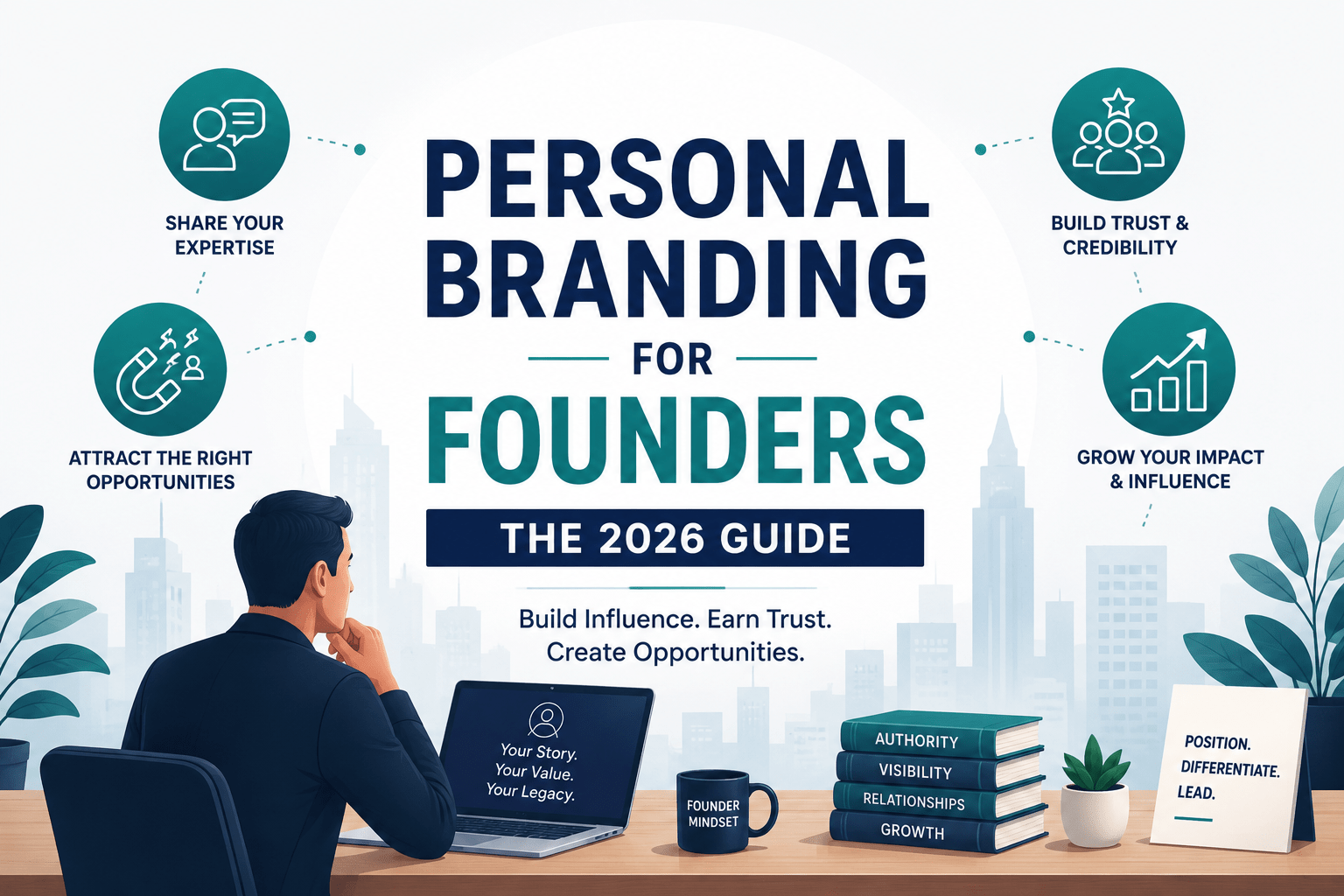
Build a personal brand that generates leads, earns trust, and grows your business. A practical 2026 guide for founders covering LinkedIn, content, positioning, and AI search visibility.
That’s the commercial case for founder personal branding, told in the most direct terms available. Not the abstract benefit of “visibility” or “thought leadership” — the concrete, revenue-connected reality of what changes when a founder’s reputation becomes an asset that works on their behalf.
Most founders know this intuitively. They’ve seen it happen to someone in their network. The challenge isn’t convincing them that personal branding matters — it’s getting them to do it consistently, strategically, and without feeling like they’re performing or compromising the authenticity that made them worth following in the first place.
That tension — between building a brand and staying real — is where most founder personal branding advice falls flat. It pushes founders toward polished, performative content that doesn’t sound like them and doesn’t convert. This guide takes a different approach.
The Commercial Case: Why This Isn’t Optional Anymore
Let’s establish the business case clearly before we get into strategy, because “personal branding” still gets dismissed by some founders as vanity — something for influencers, not for serious operators. The data says otherwise.
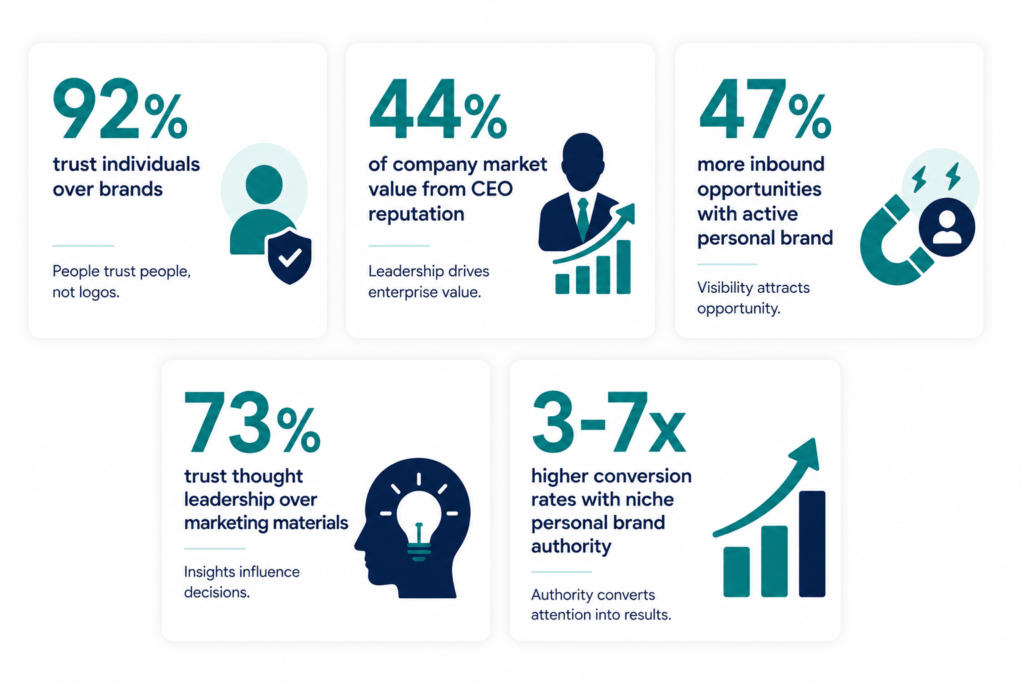
Executives say 44% of a company’s market value comes from the CEO’s personal brand strength and reputation. Founders and creators with strong niche authority personal brands see 3-7x higher conversion rates compared to traditional corporate marketing.
92% of people trust individuals over brands. 77% of consumers are more likely to buy from individuals with a strong personal brand. 89% of readers find thought leadership content useful in decision-making.
Professionals with active personal brands receive 47% more inbound opportunities than those with dormant profiles.
73% of decision-makers say that an organisation’s thought leadership content is a more trustworthy source for assessing a company’s capabilities and competencies than its marketing materials and product sheets.
58% of decision-makers choose a business based on its thought leadership. 61% find themselves more willing to pay premium prices when they can engage with a company’s decision-makers.
Read those numbers together and the commercial implication becomes clear. The founder’s reputation is not separate from the business’s commercial performance. It is a direct driver of deal conversion, pricing power, investor confidence, hiring quality, and partnership opportunities.
In B2B especially — where only 5% of your target market is ready to buy at any given moment — the founder’s personal brand is the mechanism that keeps you visible and credible to the other 95% while they move toward readiness. When those buyers are finally ready to make a decision, the founder they’ve been reading, watching, and forming an opinion about for six months has an enormous advantage over the competitor they’ve never heard of.
That’s not brand awareness in the abstract sense. That’s pipeline development that works while you’re sleeping.
What Personal Branding Actually Is — And What It Isn’t
Before the strategy, a definition that matters — because most of the confusion about personal branding comes from a misunderstanding of what it actually involves.
Personal branding is not:
- Performing a version of yourself that feels inauthentic
- Posting motivational quotes or generic business wisdom
- Building a large following at the expense of a relevant one
- Polishing yourself into a corporate spokesperson
- Posting constantly about your company’s products and wins
Personal branding is:
- Making your genuine expertise visible to the people it’s relevant to
- Building a consistent, recognisable point of view on the things that matter in your space
- Demonstrating through published content and public presence that you think clearly about the problems your clients face
- Creating the kind of reputation that makes introductions unnecessary — because the right people already know who you are and what you stand for
The distinction is significant. The founders who build personal brands that generate real commercial results are the ones who lead with genuine insight, specific perspective, and honest stories from the work. They’re not performing expertise — they’re demonstrating it.
The ones who fail — or who try briefly and give up — are usually the ones who treated personal branding as marketing and started producing content designed to impress rather than content designed to be genuinely useful.
LinkedIn marketing in 2026 rewards consistency, authenticity, and genuine expertise. The algorithm reflects something true about how humans respond to content: they trust people who show up consistently, say something specific, and write with the confidence of someone who’s actually done the work.
Step 1: Define Your Positioning Before You Post Anything
This is where most founders jump straight past and regret it. They start posting before they’ve answered the question that determines whether the content builds anything or just makes noise.
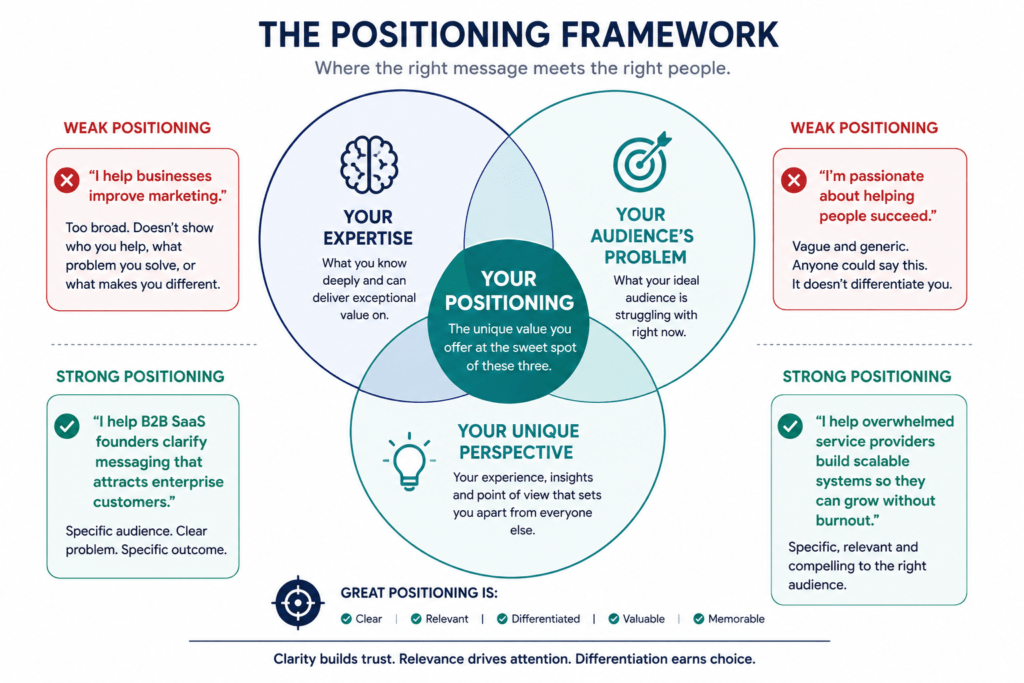
The positioning question is: What specific expertise do I bring, for whom, that creates a perspective nobody else in my space is articulating in quite the same way?
It’s not “I’m a founder who’s passionate about growth.” Every founder on LinkedIn is passionate about growth. It’s not “I share insights on leadership and entrepreneurship.” So do 800,000 other people.
Strong founder positioning sounds more like:
- “I help B2B SaaS founders close more enterprise deals — and I write about what actually moves in complex sales cycles, which is almost never what the textbooks say.”
- “I build and operate food businesses. I write about the margin reality behind hospitality — the stuff that looks glamorous from the outside and terrifying from the inside.”
- “I’m a two-time founder in HR tech. I write about what corporate recruiting gets systematically wrong, and I have the data to back it up.”
Notice what these have in common: they’re specific, they imply a point of view, they signal who will find the content relevant, and they hint at expertise that isn’t generic. They make a implicit promise that the content that follows will be substantive — not motivational, not vague, not a collection of things the reader already knows.
Your positioning statement needs to pass three tests:
One — is it specific enough that someone who reads it knows immediately whether it’s relevant to them? If a financial services founder and a DTC e-commerce founder could both relate to it equally, it isn’t specific enough.
Two — does it imply a point of view? Positioning built purely around a topic (“I write about marketing”) has no authority signal. Positioning built around a perspective (“I write about why most marketing attribution models are misleading — and what to measure instead”) signals someone who has thought past the surface.
Three — could you say this at a networking event and have someone find it interesting rather than generic? Real expertise has texture. It sounds like it comes from experience. If it sounds like a job title, it’s not positioning yet.
Step 2: Optimise Your LinkedIn Profile as a Conversion Asset
Once positioning is clear, your LinkedIn profile is the first thing to fix — because it’s the landing page that everyone who encounters your content will eventually visit. A profile that doesn’t convert a curious visitor into a follower or connection wastes every piece of content that drives them there.
Professionals with active personal brands receive 47% more inbound opportunities than those with dormant profiles. But that opportunity requires a profile equipped to receive it.
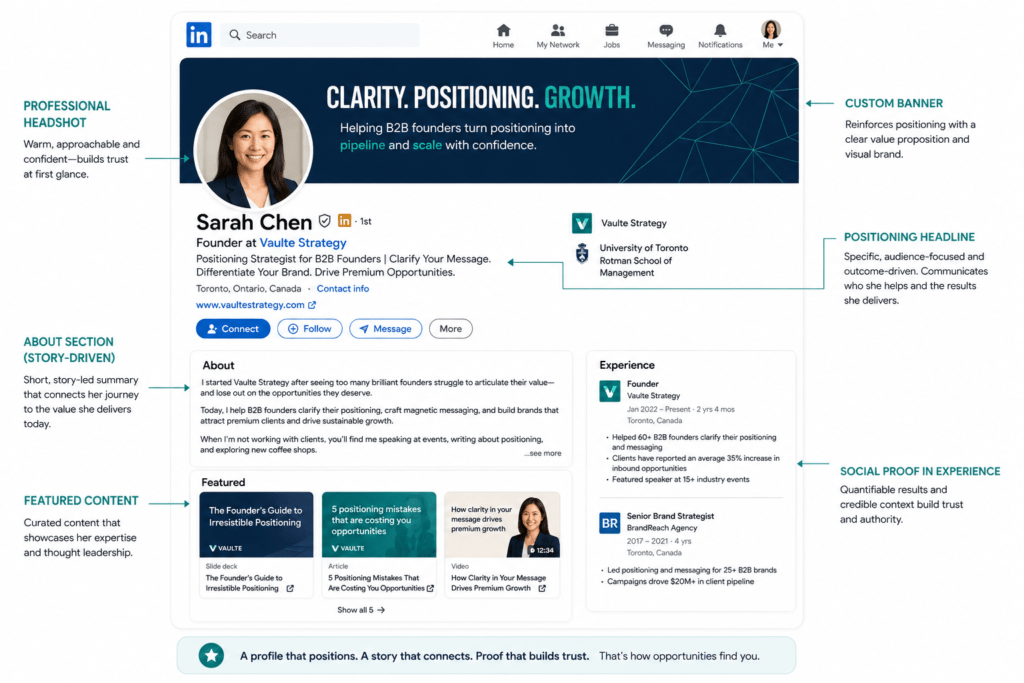
The headline is the most underused real estate on LinkedIn.
Most founders default to “Founder & CEO at [Company Name].” That’s a job title, not a positioning statement. Your headline is what appears under your name in every search result, every comment, every connection request. It’s the one-line pitch that decides whether someone clicks to your profile.
A headline that converts looks like: “Helping B2B SaaS founders close enterprise deals | 2x founder | Writing about what actually moves in complex sales.” It communicates your expertise, your audience, your channel, and your credibility in 12 words.
The About section is your narrative, not your CV.
Most About sections are a chronological history of employment. They read like a polished version of a job application. The About sections that convert — that turn profile visitors into followers, connection requests, and inbound enquiries — read like the first chapter of a book. They open with the problem or the moment, tell the story of how you got here, make clear what you believe and why, and end with a specific invitation.
Structure it like this: the hook (what’s the most interesting or counterintuitive thing about your journey or expertise?), the story (how did you arrive here, what did you learn that mattered?), the belief (what do you think about your industry that most people in it don’t say out loud?), and the invitation (what should someone do if this resonates with them?).
Your featured section is your portfolio.
Use the Featured section to pin your three strongest pieces of content — a LinkedIn post that performed exceptionally well, a press mention, a newsletter issue, a case study, a talk. New profile visitors who scroll past your About section will land here. Make what they find impressive and specific.
Social proof belongs in your experience entries.
Don’t just list your role and company. Add specific outcomes: “Grew ARR from £400K to £2.8M in 18 months,” “Built and sold a 12-person agency,” “Led 40+ enterprise implementations across financial services.” Specificity signals real experience. Vagueness signals none.
Step 3: Build a Content System That Doesn’t Burn You Out
The single biggest reason founder personal brands fail is inconsistency. Not bad content — inconsistency. A founder posts five times in the first two weeks of their personal branding effort, sees modest results, and gradually reduces to once a week, then once a fortnight, then nothing.
The algorithm notices. The audience notices. And the compounding effect of consistent presence — which is what generates the 17x more profile views, the 47% more inbound opportunities — never materialises because the consistency never did.
The solution isn’t discipline. It’s a system.
The art of posting content consistently without burning out is to say one thing in 100 different ways.
That insight reframes the entire content creation challenge. You don’t need new ideas constantly. You need a clear positioning and the willingness to explore it from different angles, different formats, different stories, different evidence — consistently. Every founder has more content than they think. They just haven’t built a system to extract it.
The Content Pillar Framework
Define three to four content pillars — the specific themes within your positioning that you’ll return to repeatedly. For a founder in B2B sales technology, the pillars might be: enterprise deal dynamics, product-led growth versus sales-led growth, the psychology of B2B buying decisions, and lessons from building a remote sales team. Every piece of content fits within one of those pillars. Every pillar reinforces the same positioning.
This structure prevents the most common founder content failure: posting randomly about whatever feels topical, producing a scatter of topics that builds no coherent reputation. A profile that posts about leadership one day, team culture the next, a product launch the next, and a quote from a book the day after that is a profile nobody can characterise. And a profile nobody can characterise generates no authority.
The Content Extraction Process
The raw material for most founder content is already in your working week. The client conversation that surfaced an insight you hadn’t articulated before. The decision you made and the reasoning behind it. The thing you believed three years ago that experience proved wrong. The question you get asked at every conference that your industry still gets wrong.
Spend 30 minutes at the end of each week writing down the most interesting thing you observed, debated, or decided. That’s your content backlog. Structure one of those observations as a LinkedIn post, expand another into a carousel, turn a third into the basis for a newsletter issue. The ideas aren’t the scarce resource. The extraction and structure are.
Posting Frequency and Timing
The algorithm treats personal content as more authentic and relevant. Personal profiles generate 8x more engagement than company pages.
Post 3 to 5 times per week for optimal LinkedIn engagement. Quality always trumps quantity: one well-crafted carousel post outperforms five generic text updates. Maintain at least 12 to 18 hours between posts to avoid cannibalising your own reach. Tuesday, Wednesday, and Thursday consistently see the highest engagement rates.
Three posts per week is the minimum for meaningful compounding. Five is optimal. More than five starts to compete with itself in the algorithm.
Step 4: Master the Formats That Actually Work in 2026
Not all content formats perform equally, and the format hierarchy has shifted meaningfully since 2024. Here’s what’s actually working for founders building personal brands on LinkedIn in 2026:
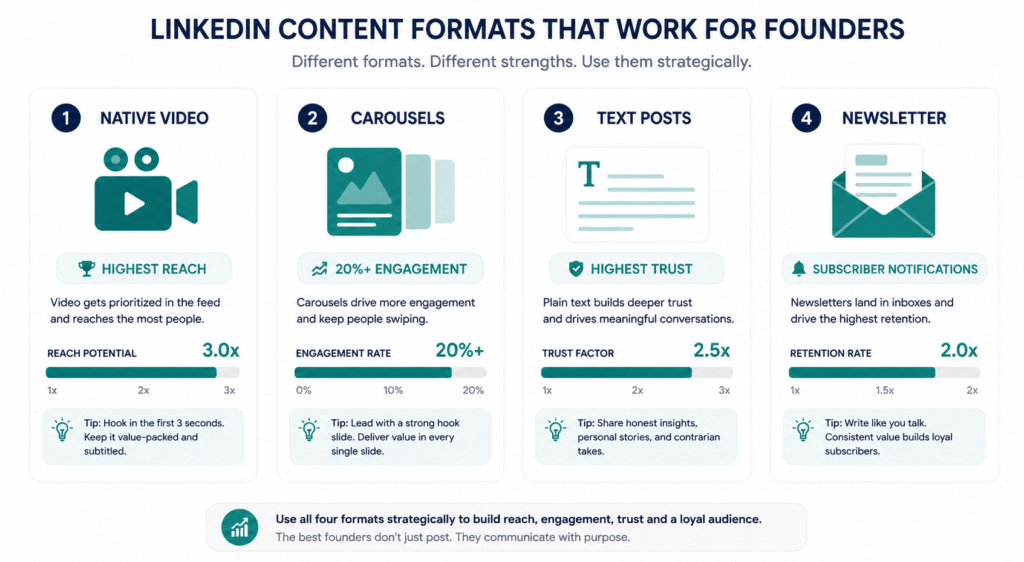
Native Video — The Highest Reach Format
LinkedIn’s algorithm now heavily favours native video — not YouTube links, native video uploaded directly to the platform. A 60-second video of you talking beats a carousel of stock photos.
This doesn’t mean produced, edited, branded video with b-roll and a music track. The video content performing best for founders in 2026 is close to the opposite: a founder talking directly to camera for 45–90 seconds about one specific thing they’ve observed, decided, or learned this week. No script read-through. No teleprompter stiffness. Direct, confident, specific.
The founders resisting video because they feel uncomfortable on camera are ceding the highest-reach format on the platform to those willing to feel awkward for the first few weeks until it becomes natural. That discomfort is temporary. The reach advantage is ongoing.
Carousels — The Highest Engagement Format
Carousels deliver the highest engagement rates in 2026 — over 20% engagement — making them ideal for educational content and frameworks.
A carousel works for founders when it does one of three things: teaches a specific framework (a model the founder uses that clients could apply independently), shares a counterintuitive finding (data or experience that challenges a common assumption), or tells a process story (how the founder approached a specific decision, step by step).
The structure that performs: slide 1 is the hook — a bold claim, a question, or a surprising statistic. Slides 2–9 are the substance — specific, dense, useful. The final slide is the CTA — follow for more, comment to receive a resource, or a specific question that invites response.
Text-Only Posts — The Thought Leadership Format
Long-form text posts — personal stories, strong opinions, counterintuitive takes — remain the format that generates the deepest engagement for founders with a clear point of view. Long-form content drives 20% more trust than short posts.
The best founder text posts read like the opening of a good essay: a specific scene or moment, a counterintuitive claim, or a question that the post then explores. They avoid bullet-pointing everything into digestible fragments and instead make an argument — one that readers can agree or disagree with, which is exactly the engagement behaviour the algorithm rewards.
LinkedIn Newsletter — The Owned Audience Asset
LinkedIn Newsletters have matured. LinkedIn’s newsletter feature now functions as a reliable email substitute for professional audiences, with subscriber notifications that give newsletter editions significantly more reach than standard posts.
A LinkedIn Newsletter is the highest-leverage owned asset a founder can build on the platform. Unlike standard posts, newsletters generate a subscriber notification — meaning a new issue reaches subscribers’ LinkedIn notification centres rather than relying purely on feed algorithm placement. For founders who’ve built a following through consistent posting, converting that following into newsletter subscribers creates a communication channel that outlasts any individual post’s reach.
The newsletter that works for a founder is not a company newsletter — it’s a founder’s perspective newsletter. Monthly cadence, 500–1000 words, one strong idea explored thoroughly. The format signals seriousness without demanding weekly production.
Step 5: The Engagement Strategy That Builds Faster Than Posting Alone
Here’s the LinkedIn growth insight that gets underestimated consistently: commenting is as important as posting, and for many founders, it’s actually more efficient in the early stages of building a presence.
Consistent strategic commenting — 10-15 quality comments per day — typically generates 200-500 profile views per week, 30-50 new connection requests, and 3-5 inbound DMs from potential clients. This is the single highest-ROI LinkedIn activity for B2B professionals, especially for founders and consultants building personal brands.
The mechanism is straightforward: when you leave a substantive comment on a post by someone in your target audience’s network, your name and headline appear in that post’s comment thread. The post’s engagers — who are already interested in the topic — see your comment, find it interesting, and click your profile. If your profile is optimised and your own content reflects the same expertise, they follow.
A comment that works isn’t “Great post! I totally agree.” It’s a paragraph that adds a specific perspective, challenges an assumption respectfully, or extends the argument with an example from your own experience. Substantive comments are remembered. Generic ones are invisible.
Ideally, comment for 15-60 minutes per day, 3-5 days per week. Comment on 5-6 other posts before you publish your LinkedIn post, and 5-6 after. LinkedIn rewards active users, and you’ll see more impressions on your posts as a result.
This combined approach — consistent posting and strategic engagement — compounds in ways that neither activity does alone. Your posts reach your existing network. Your comments reach adjacent networks. Together, they expand your audience far faster than posting in isolation.
Step 6: Build External Authority — Beyond LinkedIn
LinkedIn is the primary platform, but a personal brand that exists only on LinkedIn is fragile. Algorithm changes, platform shifts, and the natural ceiling of any single channel all argue for building authority across multiple touchpoints.
The external authority signals that matter most in 2026:
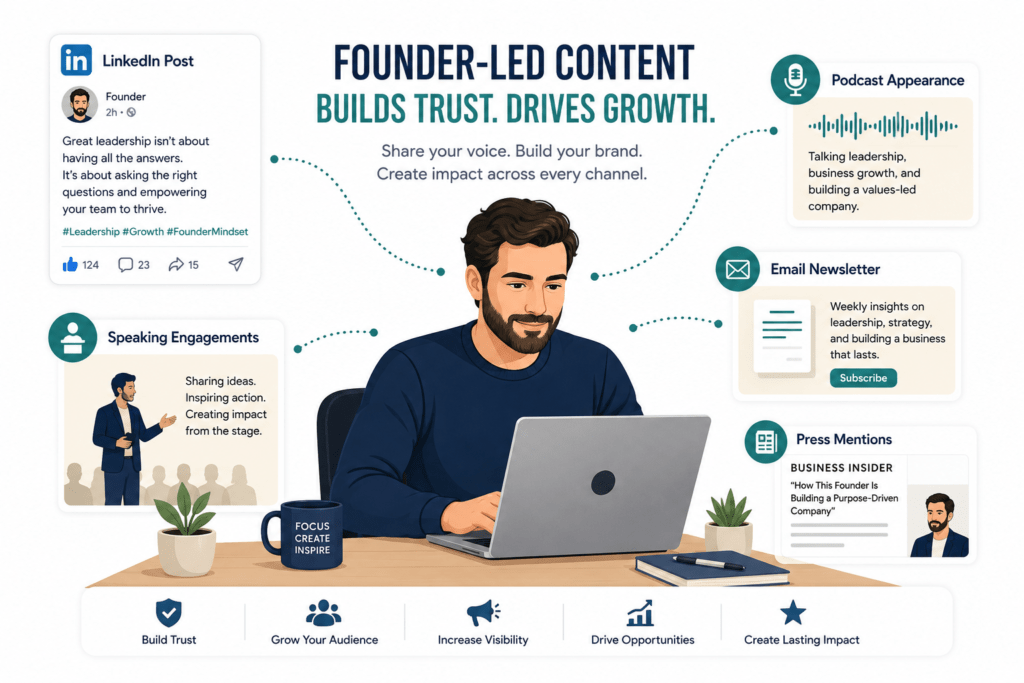
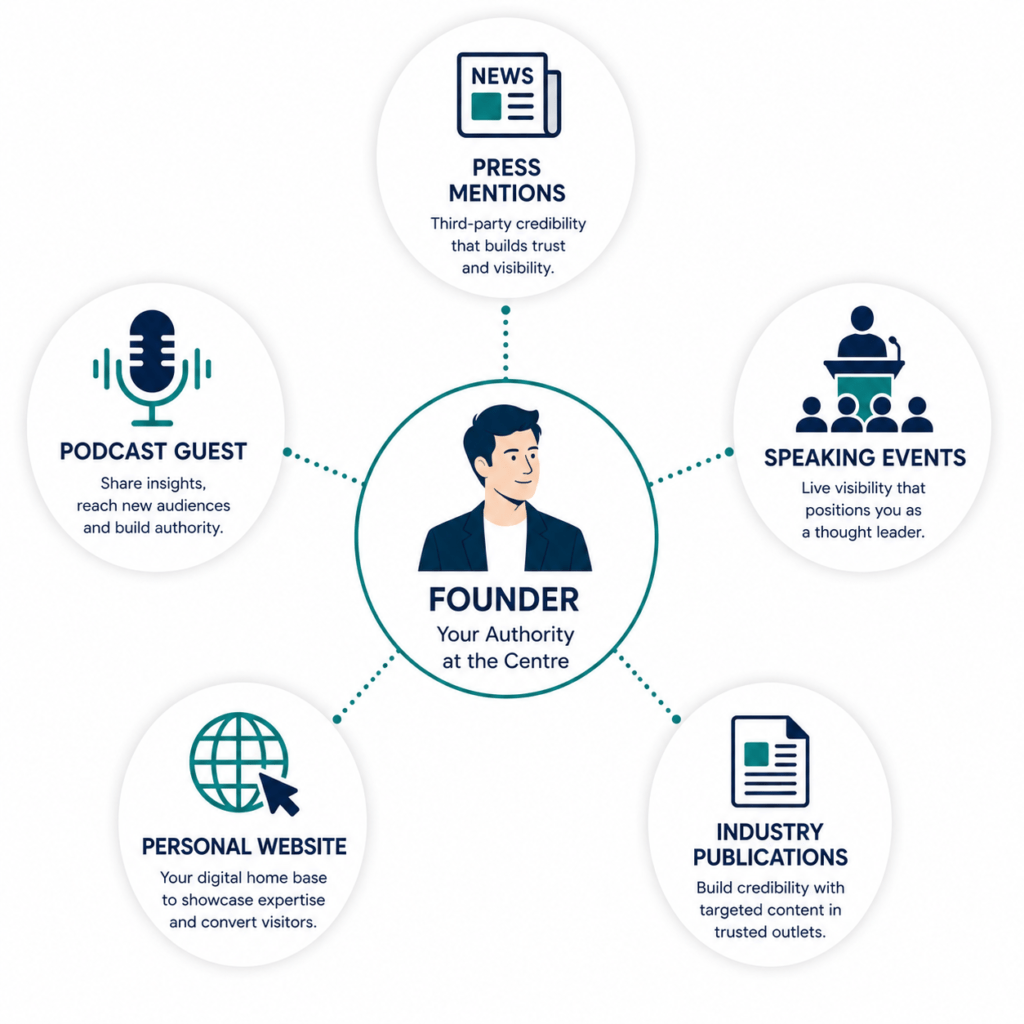
Press and media mentions. Being quoted in an industry publication, trade journal, or mainstream business press as an expert in your field is one of the most credible authority signals available. It’s also one that feeds directly into AI search visibility — AI tools synthesise information from multiple credible sources, and a founder mentioned in TechCrunch, Business Insider, or their sector’s leading publication is more likely to appear in AI-generated responses to relevant queries than one whose expertise exists only on their own channels.
B2B marketers increased thought leadership budgets by 53% in 2024. 79.5% of employee advocacy programs now include senior leaders. The race to establish thought leadership through external channels is accelerating — which means the founders who start building press relationships and media presence now are building a harder-to-replicate asset than any content strategy alone.
Podcast appearances. The founder who appears as a guest on five industry-relevant podcasts in a year reaches each podcast’s existing audience — people who are already engaged, already interested in the topic, and predisposed to trust a guest who’s been vetted by a host they trust. Podcast appearances also generate a distributed network of audio and transcript content that indexes in search and feeds AI citation systems.
Speaking opportunities. Conference and event speaking is the highest-trust form of expert authority — a selection committee has evaluated you, a real audience has paid to attend, and the content is documented and often promoted by the event. Start with smaller industry events and build toward the conference stages that reach your ideal clients and partners.
A personal website. This is the owned asset that underpins everything else. A personal website with a clear positioning statement, published writing, a speaker bio, press mentions, and Person schema markup (as documented in the schema section above) creates a single, authoritative reference point that AI tools can consistently cite. Without it, your expertise is distributed across platforms you don’t control.
Step 7: Personal Branding and AI Search Visibility — The GEO Dimension
This is the dimension of founder personal branding that most guides haven’t caught up to — and it’s one of the most commercially significant developments of the past 18 months.
AI tools like ChatGPT, Perplexity, and Google AI Overviews are increasingly being used to answer questions like “who is the leading expert in [your field]?” or “which founders should I follow for insights on [your topic]?” or “recommend a consultant who specialises in [your area]?” These queries are being answered by AI systems that synthesise information from multiple sources — and the founders who appear in those answers are the ones with established, consistent, credible entity profiles across the web.
The signals that improve a founder’s AI visibility are:
Consistent information across platforms. Your name, your expertise area, your company, and your positioning should be stated consistently across your LinkedIn profile, your personal website, your bio on any publication you contribute to, your podcast guest bios, and your social profiles. This consistency builds entity confidence — the degree to which an AI system is certain enough about who you are to cite you without hedging.
Original, citable content on a specific topic. A founder who has published 50 LinkedIn posts on enterprise sales strategy, written three guest articles in SaaS publications on the same topic, appeared on four podcasts discussing it, and has a personal website with a clear positioning statement on that topic is a credible entity for AI tools to cite when answering “who are the best enterprise sales experts?”
Person schema on your personal website. As documented in the schema section above, Person schema markup makes your expertise, credentials, and external profiles machine-readable — giving AI tools structured data to parse rather than requiring them to infer your expertise from unstructured content.
Third-party citations. The founders who appear in AI-generated expert recommendations are almost always those who are cited by multiple credible sources — mentioned in publications, referenced by other experts, quoted in press coverage. Building the external footprint described in Step 6 is, simultaneously, building AI search visibility.
The GEO dimension of personal branding isn’t separate from everything else — it’s the accumulated result of the authority-building that genuine expertise and consistent publishing produce over time. The founders who start now are building an advantage that becomes harder to replicate as the field matures.
Common Mistakes That Stall Founder Personal Brands
These are the failure modes that appear most consistently — in founders who try and stop, and in founders who are active but not progressing.
Posting about the company instead of the founder. Product launches, company milestones, team announcements, and award wins are company content. They belong on the company page. Founder personal brand content is about the founder’s perspective, experience, and expertise — not their company’s news. A feed full of company announcements tells the audience nothing about who the founder is or what they think.
Chasing virality over authority. A post that gets 10,000 impressions from people outside your target market is worth less than a post that gets 500 impressions and five DMs from qualified prospects. The metric that matters for commercial personal branding isn’t reach — it’s the quality and relevance of the attention you’re attracting. Optimise for resonance with your specific audience, not algorithmic reach from anyone.
Disappearing after a slow start. The compounding nature of consistent LinkedIn presence means the first 90 days are almost always disappointing relative to the effort invested. Founders who quit after three months never find out what month six looks like. Consistency beats virality on LinkedIn. One great post means nothing. But a steady stream of valuable content builds unstoppable momentum.
Posting without engaging. A founder who publishes content but never comments on others’ posts, never responds to comments on their own posts, and never initiates conversations is treating LinkedIn as a broadcast channel. It isn’t. The algorithm rewards reciprocal engagement, and the audience builds connection through conversation, not consumption alone.
Being strategic at the expense of being human. The most successful founder personal brands combine strategic consistency with genuine personality. The founders people follow, trust, and hire are the ones who occasionally share something that didn’t work, express a view that’s uncomfortable, or tell a story that reveals something honest about the difficulty of building. Perfection is not a trust signal. Honesty is.
Outsourcing the voice. This is the failure mode that’s becoming more common as AI content tools improve. A founder who delegates their personal brand content to a ghostwriter or AI tool — without substantive editorial involvement — produces content that sounds like nobody. The audience can feel the absence of a real person behind the words. Personal brand content that doesn’t sound like the person it represents does more damage than silence.
Real Founder Examples: What Building a Personal Brand Actually Produces
The B2B Founder Who Closed Deals She’d Never Have Had Otherwise
A founder running a 15-person operations consultancy had relied entirely on referrals for three years. Reliable, but slow-growing and entirely dependent on existing client relationships staying active.
She committed to LinkedIn for six months: three posts per week covering her specific niche (supply chain operations for mid-market manufacturers), weekly engagement with 10–15 relevant posts by people in her target market, and monthly long-form articles on specific operational challenges her clients faced.
By month four, she was receiving two to three inbound enquiries per month from people who had never been referred — prospects who had found her content while researching supply chain challenges, followed her for weeks, and reached out when their internal need became acute. By month six, her pipeline had doubled and her close rate on inbound leads was significantly higher than on cold outreach — because the prospect arrived already familiar with her thinking and already partially convinced of her expertise.
She hadn’t changed her service, her pricing, or her team. She’d made her expertise visible.
The Technical Founder Who Used Personal Brand to Attract an Investment Round
A technical co-founder of a developer tools startup had a track record of building impressive product but had been invisible publicly — no LinkedIn presence, no writing, no community engagement.
After a strategic advisor suggested that investor recognition often comes before formal outreach, he spent four months publishing weekly on LinkedIn: technical deep-dives on the problems his product solved, perspective pieces on where developer tooling was heading, and honest retrospectives on decisions made during the build. He also started appearing on developer-focused podcasts discussing the technical problems his company was solving.
When his company began its Series A process, three of the investors who eventually participated had been following his LinkedIn content for months and reached out proactively. The investor conversations started from a position of established credibility rather than a cold pitch deck.
The Service Business Founder Who Raised Prices by Building Authority
A freelance brand strategist had struggled with price resistance for years — clients would negotiate, compare her rates to cheaper alternatives, and occasionally lose the engagement to a lower-cost provider.
After 18 months of consistent LinkedIn publishing — focused on brand positioning philosophy, case study observations, and the strategic mistakes she saw businesses making — her positioning as an expert rather than a service provider shifted the sales dynamic entirely. Prospects began arriving having already decided she was the person they wanted, which transformed the fee conversation from negotiation to agreement. Her average project value increased 40% without any change to her service offering.
The commercial case isn’t theoretical. It’s the practical result of what visibility in the right context does to perceived value.
Expert Observations: What We’ve Seen Work Consistently
After working with founders across different industries, stages, and starting points on personal brand strategy, a few consistent patterns:
Specificity is more powerful than scale. A founder with 2,000 highly relevant followers — CFOs of mid-market manufacturing businesses, say — is more commercially valuable than a founder with 20,000 followers distributed across every sector. The goal is an audience that matches your ideal client profile, not an audience that matches a vanity metric.
The best founder content comes from things that didn’t go to plan. The deals that were lost, the hires that didn’t work out, the pivots that were forced rather than chosen — these make far more compelling and trust-building content than success stories. Vulnerability, paired with clear analysis of what was learned, is one of the highest-trust content signals available. It also has almost no competition, because most founders are too cautious to publish it.
The newsletter is underused and overdue. Most founders who publish consistently on LinkedIn never start a newsletter, despite the fact that newsletter subscribers are a more committed, more convertible audience than passive feed followers. The newsletter builds an asset that exists outside the LinkedIn algorithm — people who have chosen to receive your thinking, consistently, in their inbox.
Engagement compounds faster than posting alone. The founders who grow most efficiently are the ones who treat LinkedIn as a conversation platform rather than a broadcast channel. Strategic commenting, responding to every comment on your own posts, and initiating DM conversations with people who engage with your content — these behaviours build a reputation that feeds back into content performance in ways that posting alone doesn’t.
Future Trends: Where Founder Personal Branding Is Heading
AI will make generic content invisible. As AI tools produce more content, faster, the content that stands out will be the content that only a specific human could have written — specific experience, specific opinion, specific data from specific situations. The founder who publishes genuinely original thinking will have an increasing advantage over the one who publishes AI-accelerated generic insights.
Video will become mandatory, not optional. Posts with video attached beat generic text, and LinkedIn’s algorithm now heavily favours native video. Founders who delay building comfort with video are compounding their disadvantage in the highest-reach format on the primary personal branding platform.
AI search will become a meaningful traffic source for founders. As more buyers use ChatGPT and Perplexity to discover and evaluate experts, the founders with established entity authority — consistent information across multiple credible sources, published content on specific topics, press and podcast presence — will appear in AI-generated recommendations at higher rates. This is a slow-building advantage that starts accruing from the first pieces of published, schema-marked content and compounds over time.
The founder as media company model will accelerate. The most commercially powerful founder brands in 2026 are operated more like media companies than marketing functions — with editorial calendars, content series, newsletter strategies, and audience development as first-class business activities rather than after-thoughts around the “real work.” This model produces audiences that become leads, partnerships, and investment opportunities with a regularity that traditional marketing cannot match.
Conclusion: Your Reputation Is Your Most Valuable Business Asset
The case for personal branding as a founder isn’t complicated, even if the execution requires patience. People trust people. They buy from people they trust. They pay more to the people they’ve decided are the best at what they do. And they decide who those people are based on what those people have demonstrated publicly, over time, in the places where the relevant audience is paying attention.
92% of people trust individuals over brands. 77% of consumers are more likely to buy from individuals with a strong personal brand. Those numbers describe something that has always been true about human behaviour — we trust people, not logos. Personal branding is simply the intentional, strategic version of what has always driven trust-based commerce.
The founders building the most commercially effective personal brands in 2026 are not the loudest, the most polished, or the most followed. They’re the most consistent, the most specific, and the most willing to demonstrate genuine expertise in public — week after week, in the formats that reach their specific audience, with the patience to let compounding do what compounding does.
Your expertise already exists. Your stories are already there. Your perspective is already formed by years of hard-won experience that most of your ideal clients haven’t had. Personal branding is just the decision to make it visible.
Start with your positioning. Build the profile. Post three times this week. Comment on five posts that matter in your space. Do it again next week. And the week after that.
The reputation you build this year is the pipeline you harvest for the next five.
Ready to build a founder personal brand that generates inbound opportunities? Start with your positioning statement — the specific, one-sentence answer to “what do I bring, for whom, that nobody else articulates quite like I do?” Get that right, and everything else becomes a delivery mechanism for an idea that’s already worth finding.
Frequently Asked Questions
Q: Why is personal branding important for founders? Personal branding is commercially important because 92% of people trust individuals over brands and 77% are more likely to buy from someone with a strong personal brand. Executives with strong personal brands contribute up to 44% of their company’s market value. Founders with active personal brands receive 47% more inbound opportunities. In B2B, 73% of decision-makers trust thought leadership content more than marketing materials — making your reputation directly linked to deal conversion rates.
Q: How do founders build a personal brand from scratch? Five steps: define your positioning (specific expertise, for whom, with a perspective that’s distinctly yours); optimise your LinkedIn profile to reflect that positioning; begin publishing 3–5 times per week on LinkedIn focused on your niche; build external authority through press, podcasts, and speaking; and create an owned asset — a newsletter or blog — that you control regardless of platform changes.
Q: What is the best platform for founder personal branding in 2026? LinkedIn. Personal profiles generate 8x more engagement than company pages. Personal posts receive 5–7x more organic reach than company page posts. 93% of B2B marketers use LinkedIn, and personal brands receive 47% more inbound opportunities than dormant profiles. Native video now receives the highest reach of any format on the platform.
Q: How often should a founder post on LinkedIn? 3–5 posts per week is the optimal frequency for founders building personal brands. 91% of active LinkedIn creators posted at least once every three days. Consistency over time matters more than frequency in any individual week — a founder posting three times per week for a year dramatically outperforms one who posts ten times in a burst and then disappears.
Q: What content should founders post on LinkedIn? Approximately: 40% industry insights and perspective, 30% behind-the-scenes and personal stories, 20% client results and case studies, and 10% direct promotional content. The formats that perform best: native video (highest reach), carousels with frameworks or findings (20%+ engagement), and text-only posts for thought leadership and personal stories.
Q: Can a strong founder personal brand affect company valuation? Yes. Executives say 44% of company market value comes from the CEO’s personal brand strength. 73% of business decision-makers consider thought leadership when evaluating partners. 61% of buyers find themselves more willing to pay premium prices when they engage with a company’s decision-makers. The founder’s reputation is a direct contributor to pricing power, investor confidence, and deal conversion rates.
Q: How does founder personal branding help with AI search visibility? AI tools like ChatGPT and Perplexity synthesise information from multiple credible sources when answering “who is the leading expert in [field]?” questions. Founders with consistent information across LinkedIn, a personal website, press mentions, podcast appearances, and industry publications — with Person schema markup — are significantly more likely to appear in AI-generated expert recommendations than founders whose expertise exists only on their company’s website.
Q: How long does it take to build a founder personal brand? Meaningful compounding typically begins around month three to four of consistent publishing. A recognisable, inbound-generating personal brand usually takes six to twelve months of consistent effort. The founders who quit after 30 days because results are modest never see what month six produces. The investment is in time and consistency, not budget — and the returns compound as long as the consistency continues.