Meridian Dental Group is a concept three-location dental group headquartered in Denver, Colorado, with practices in Denver, Boulder, and Aurora. Eleven clinicians across general dentistry, orthodontics, oral surgery, and a dedicated cosmetic and implant centre. Founded by Dr. Anika Sharma, who built the group over nine years through acquisition and organic growth, reaching a point where clinical capacity had outpaced the group’s ability to fill chairs efficiently across all three sites simultaneously.
This is a more advanced project than a single-location rebuild. The brief required solving for: three locations competing for the same regional search visibility without cannibalising each other, a fragmented patient experience where each location had a different booking process, a referral network between general dentistry and the specialty centre that wasn’t being tracked or optimised, and a competitive landscape increasingly dominated by DSO-backed practices spending aggressively on paid search.
85% of dental practices struggle to differentiate themselves despite knowing it’s critical for survival, and patients now need to see your brand at least 20 touchpoints across marketing channels before booking. For a multi-location group, that complexity multiplies — Meridian needed a system, not a website.
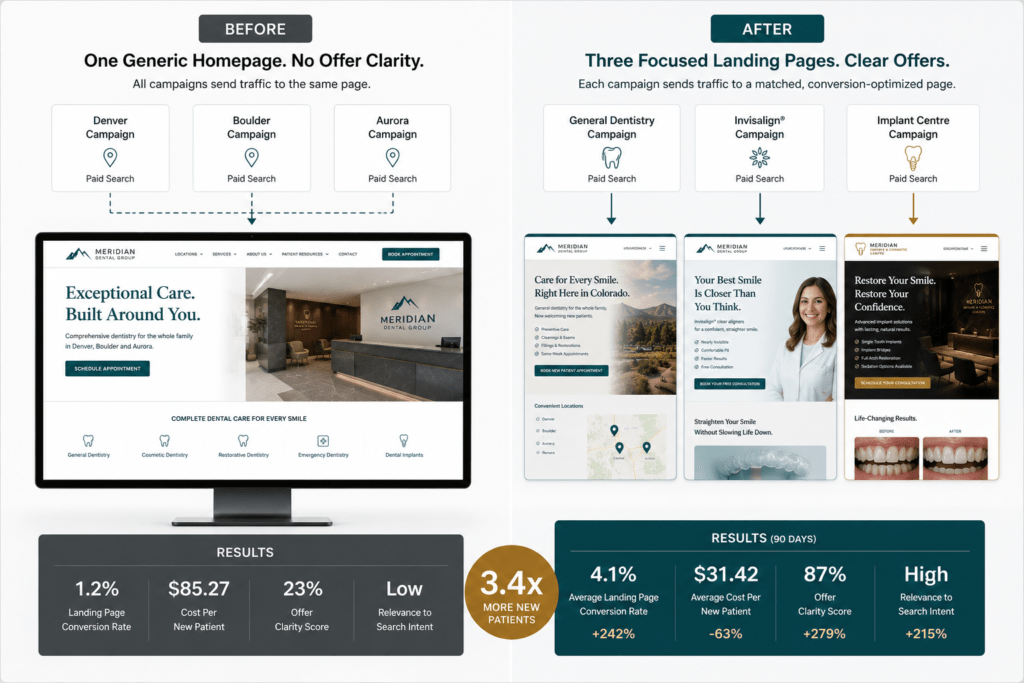
Before — The Problem
Three locations. Three different Google Business Profiles, none fully optimised. Three websites built at different times by different vendors, none of which referred patients between locations even when a Denver patient needed the Boulder specialty centre. No shared patient database connecting general dentistry visits to specialty referrals. No tracking of which marketing channel actually produced a booked, kept, treatment-accepting patient versus a lead that never converted.
General dentistry acquisition has become increasingly commoditized in 2026 — and Meridian was competing purely on commoditized terms (“dentist near me”) while sitting on a specialty implant and cosmetic centre that could command dramatically higher patient lifetime value if anyone could find it.
Paid search was running, inconsistently, across all three locations with no shared attribution model — meaning nobody could say with confidence which campaigns were actually profitable.
After — The Outcome
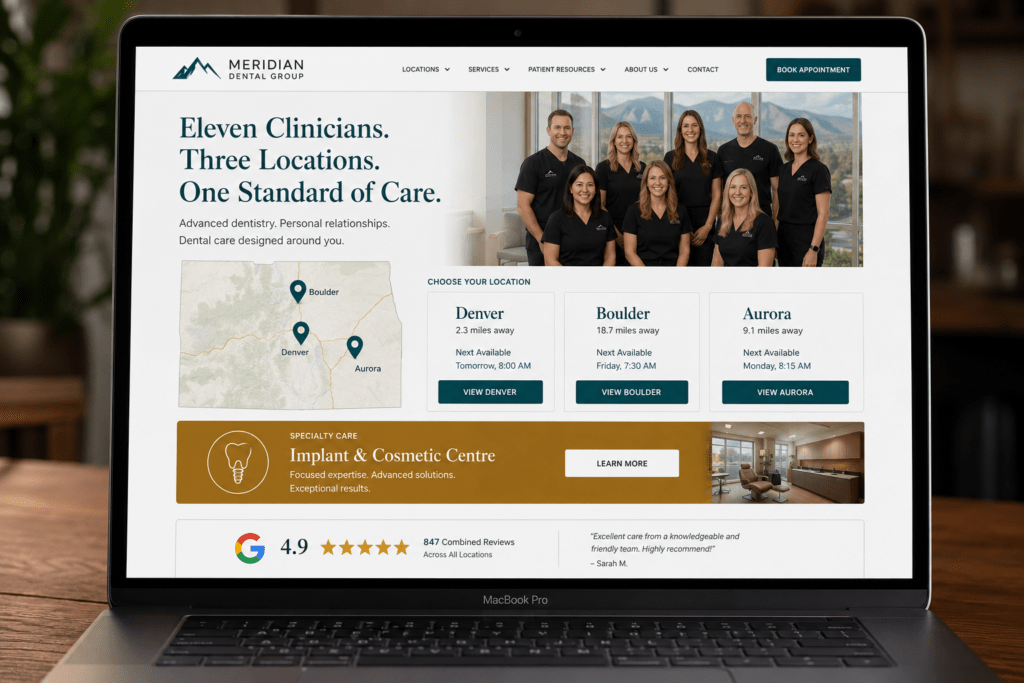
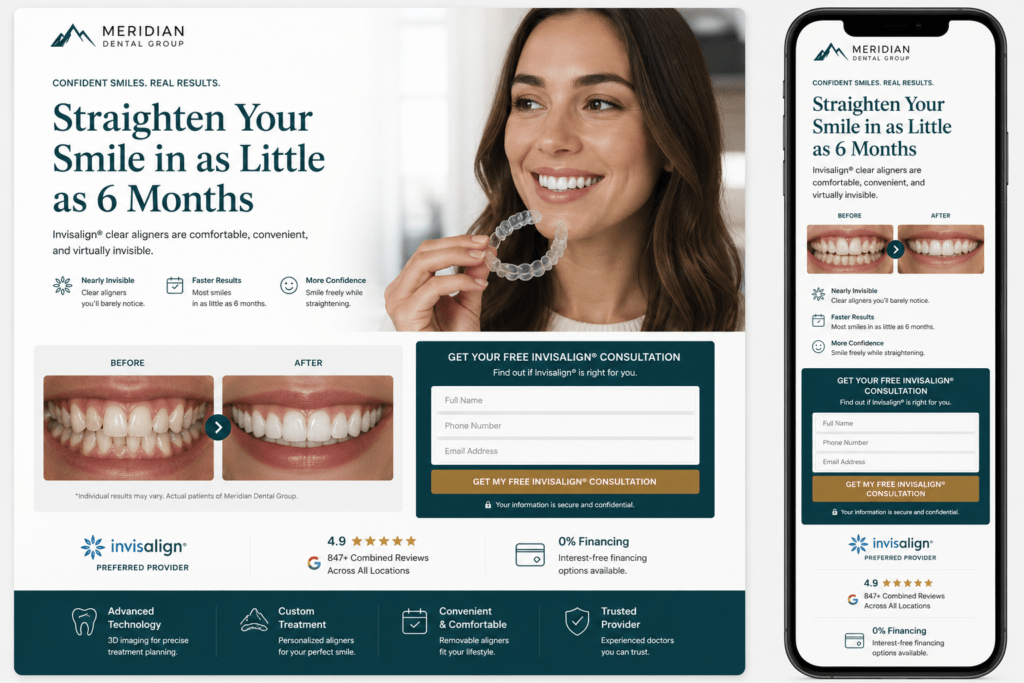
A unified digital ecosystem across all three locations: one cohesive brand architecture with location-specific landing experiences, full SEO/GEO/AEO optimisation calibrated per location to avoid cannibalisation, a connected patient journey from general dentistry into the specialty centre, automated patient lifecycle communication, and a performance marketing system with real attribution.
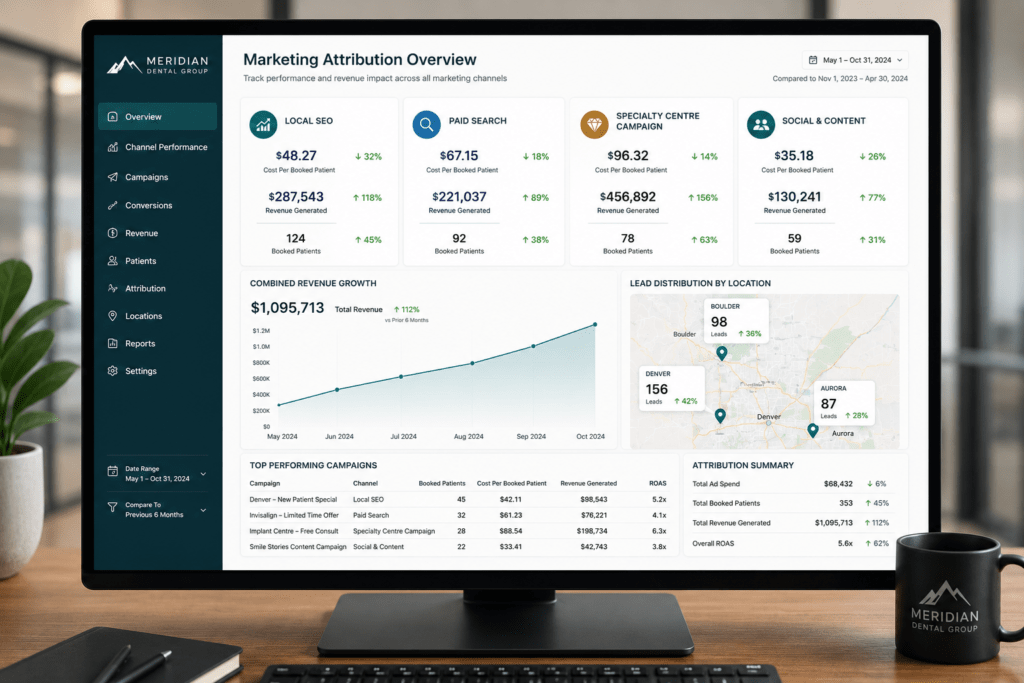
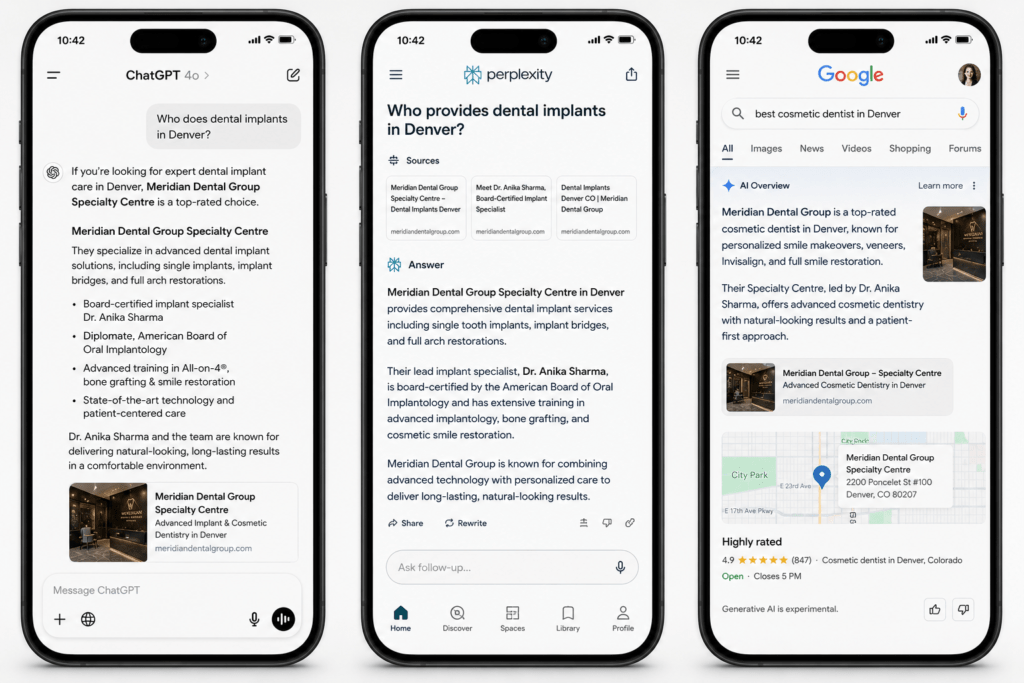
Within six months: combined new patient enquiries across all three locations increased 187%. The specialty implant and cosmetic centre — previously invisible in its own search results — became the highest-margin acquisition channel in the group, generating a 32.5% increase in revenue achieved through coordinated omnipresence is consistent with what other groups taking this approach report. AI search visibility (ChatGPT, Perplexity, Google AI Overviews) for cosmetic and implant queries went from zero to consistent citation. Internal referral conversion from general dentistry to the specialty centre — previously untracked — reached 34% of all specialty centre new patients.
SEO, GEO & AEO Strategy — Multi-Location Architecture
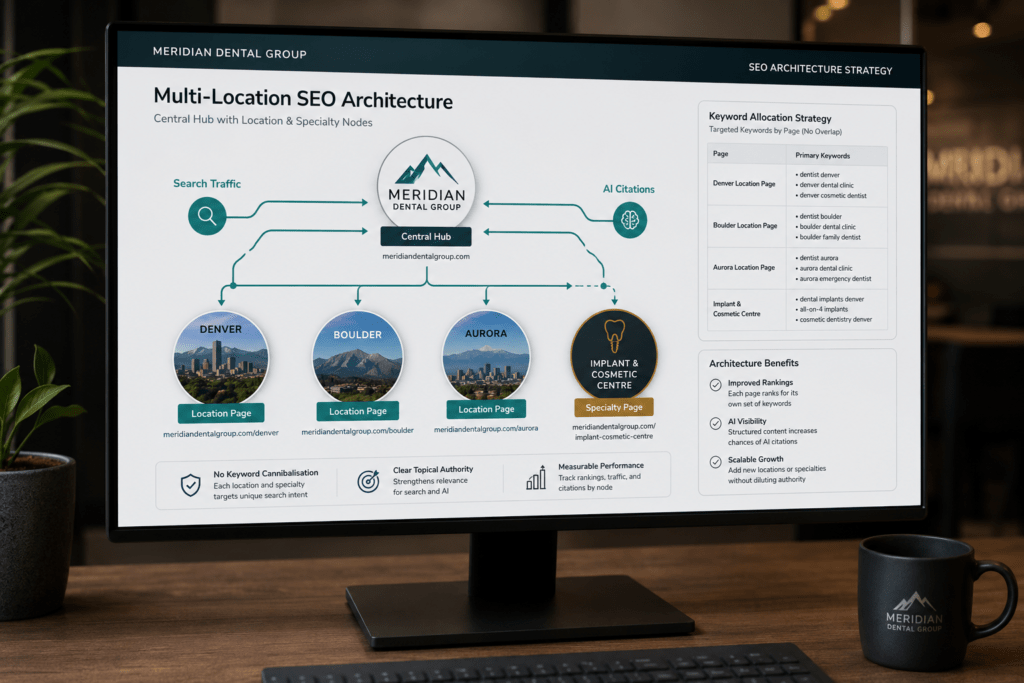
This is the layer most single-location dental case studies don’t need to solve: how do three locations rank well individually without competing against each other for the same searches, while a shared specialty centre captures regional demand that crosses all three catchments?
The Architecture:
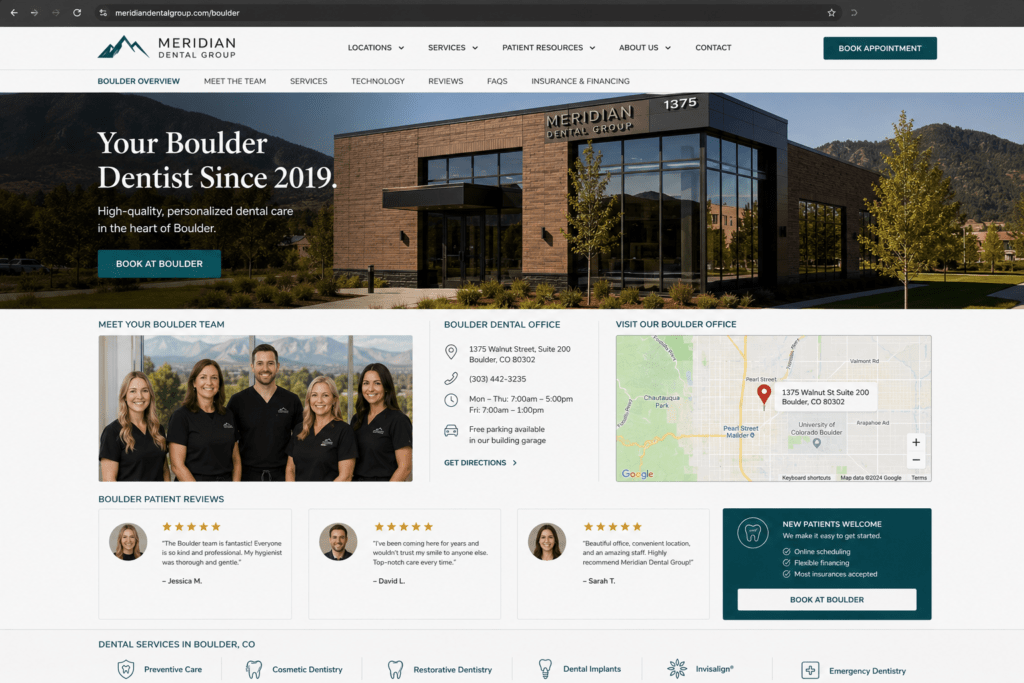
Each location gets its own fully built location page — not a thin directory listing, but a genuine page with unique content, unique photography, unique staff bios, and unique patient testimonials specific to that site. Google and AI tools both penalise (or simply ignore) templated location pages that differ only in a swapped city name.
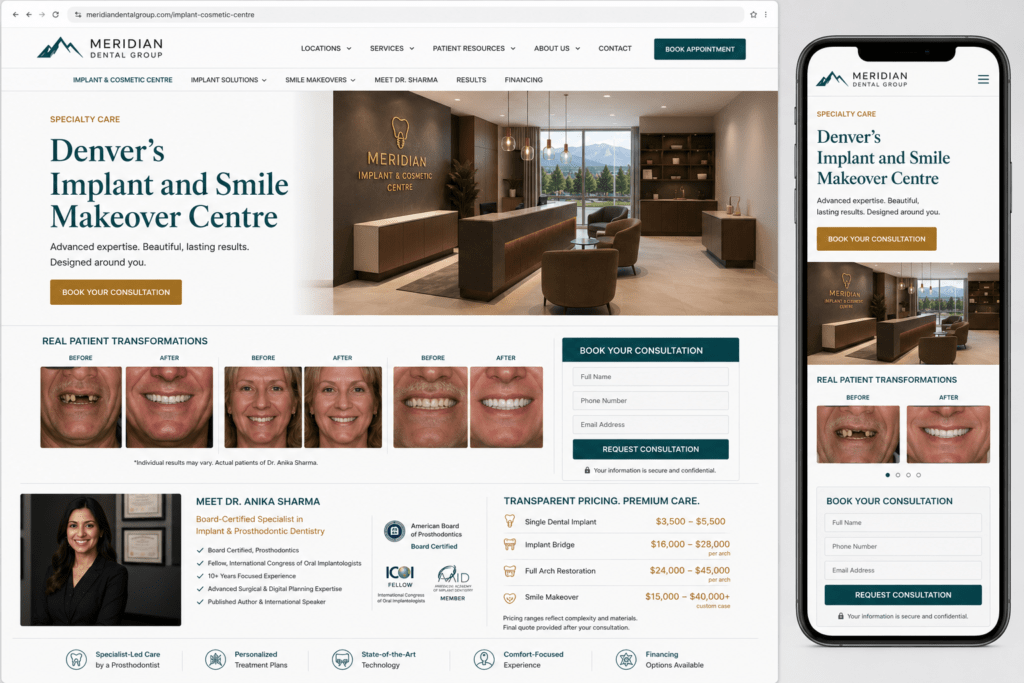
The specialty centre gets its own dedicated subdomain-style section with its own SEO strategy entirely separate from “dentist near me” commodity terms — targeting “dental implants Denver,” “smile makeover Colorado,” and the higher-intent, higher-value searches that general dentistry doesn’t compete for.
71% of people search online when looking for a dentist before scheduling an appointment, and dental paid search drives 35% of business traffic — meaning the SEO and paid search layers have to work as one coordinated system, not two separate budgets run by two separate vendors who don’t talk to each other.
GEO — Generative Engine Optimisation:
Traffic from AI platforms like ChatGPT, Perplexity, and Microsoft Copilot grew from 17,000 sessions in early 2024 to more than 107,000 sessions in 2025 across analysed websites — and some dental practices now receive 1% or more of their total web traffic from AI search tools. For a multi-location group, GEO has to answer a structurally different question than SEO does: not “which page ranks for this keyword” but “which entity does the AI tool trust enough to cite by name.”
Every clinician at Meridian has a dedicated bio page with verified credentials, a Person schema, and specific procedure specialisation documented — because AI tools synthesising an answer to “who does implant work in Denver” need a specific, citable, credentialed name, not a generic “our team” page.
AEO — Answer Engine Optimisation:
Content structured to win Featured Snippets and voice search at the procedure level, not just the location level — “How much do dental implants cost in Denver?”, “How long does Invisalign take for adults?”, “Is a same-day crown actually same-day?” Each answered in the first sentence, with the specific Meridian service and pricing range named, so the snippet or voice answer carries the practice name with it.
77% of patients cite reviews as their first step in provider search, and 69% won’t consider providers below a 4-star rating — which means the AEO and review strategy are now the same function. A Featured Snippet that pulls a 4.9-star answer outperforms one that doesn’t, regardless of content quality.
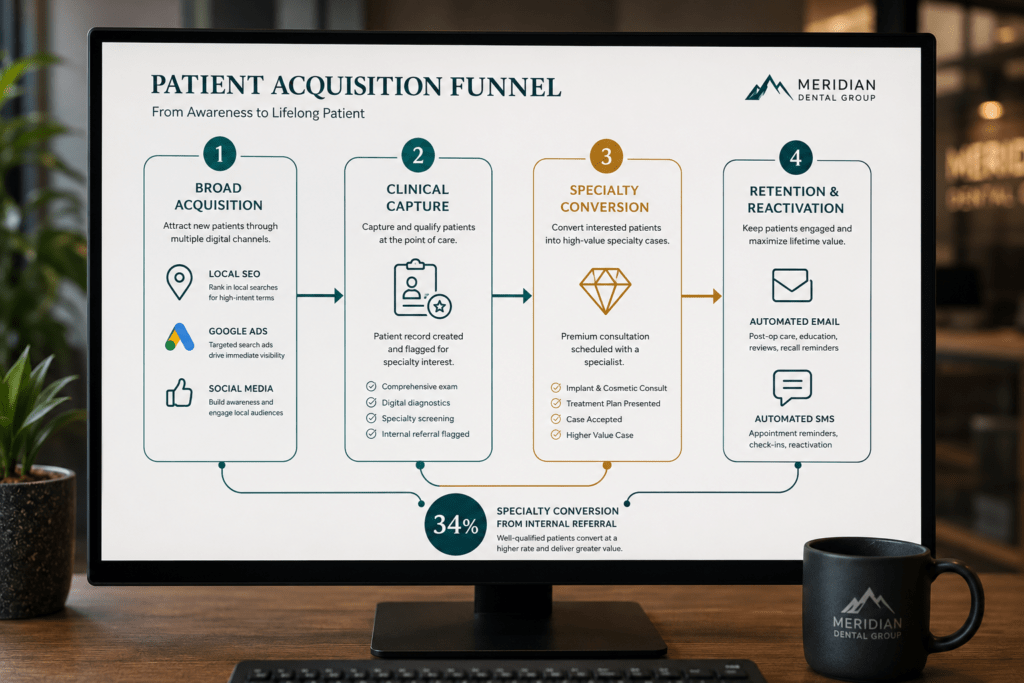
The Connected Patient Acquisition Funnel
This is where the multi-location complexity becomes an advantage rather than a liability — because a properly connected funnel lets Meridian capture a patient at the commodity end (general dentistry) and migrate them, with full context, into the specialty centre when the clinical need arises.
Stage 1 — Broad Acquisition (General Dentistry):
Local SEO, Google Business Profile per location, and paid search targeting commodity terms (“dentist near me,” “family dentist Denver”) feed the volume end of the funnel. Recommended budget allocation for 2026 is 40% local SEO and geographic targeting, 30% paid search and local services ads, 30% retention and technology — Meridian’s allocation mirrors this structure.
Stage 2 — Clinical Capture (Within-Practice Identification):
Every general dentistry patient record is flagged for specialty-relevant indicators — bone density notes, cosmetic consultation interest, missing teeth — feeding a structured internal referral workflow instead of relying on individual clinicians remembering to mention the specialty centre.
Stage 3 — Specialty Conversion (Premium Funnel):
The flagged patient receives a dedicated, branded communication sequence introducing the specialty centre with their existing patient history already understood — not a cold pitch, but a warm, informed next step. This internal referral pathway, once tracked and optimised, became 34% of all new specialty centre patients within six months.
Stage 4 — Retention and Reactivation:
Patients now expect online booking, instant confirmations, SMS reminders, and automated follow-ups — and the staffing shortage affecting roughly 90% of dental practices makes automated, AI-assisted patient communication a capacity multiplier, not a luxury. Meridian’s system handles appointment reminders, recall scheduling, review requests, and reactivation campaigns for lapsed patients automatically across all three locations from one connected system.
Performance Marketing & Attribution
Paid Search:
Three location-specific Google Ads campaigns plus one dedicated specialty centre campaign, each with conversion tracking tied back to a shared CRM so that “which channel produced this specific booked, kept, treatment-accepting patient” is answerable for the first time. Local Services Ads layered on top of standard search campaigns for immediate high-intent visibility per location.
Social and Content:
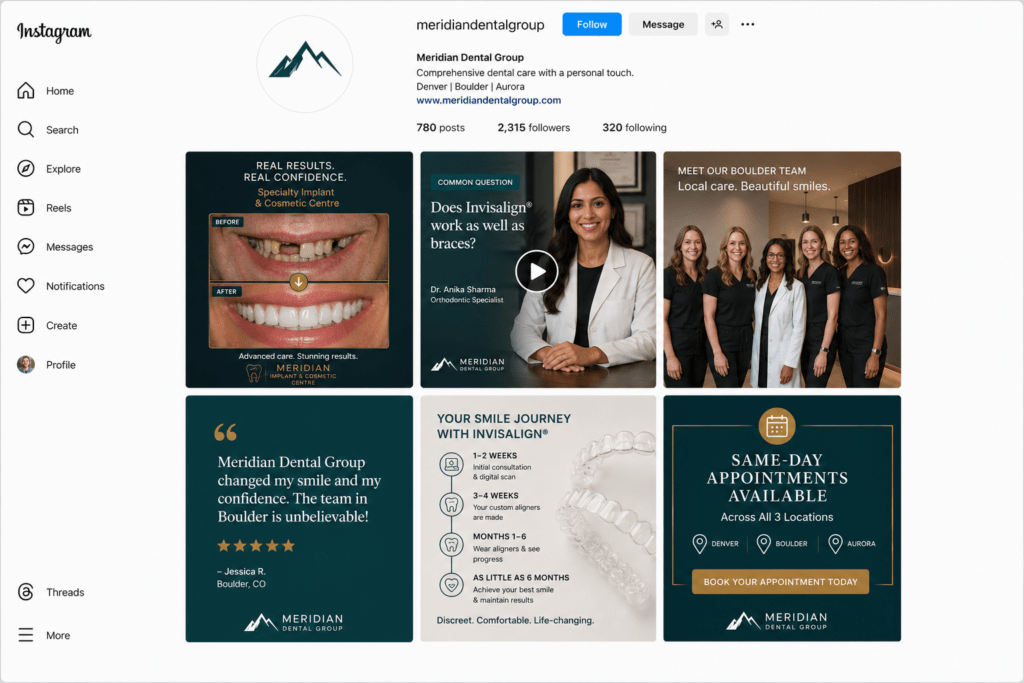
AI-driven digital transformation allows patients to discover trusted dental services even without clicking a website link — what matters is content consistency, posting two to three times weekly: short videos, answers to common patient questions, and real patient stories, deliberately built to feed both organic reach and the GEO layer simultaneously.
Results Summary
| Metric | Before | After (6 Months) |
|---|---|---|
| Combined new patient enquiries (3 locations) | Baseline | +187% |
| Specialty centre new patients from internal referral | 0% tracked | 34% |
| AI search citations (ChatGPT, Perplexity, AI Overviews) | 0 | Consistent citation for implant/cosmetic queries |
| Combined Google rating | 4.6 average, fragmented | 4.9, unified across locations |
| Marketing attribution clarity | None — no shared tracking | Full channel-to-revenue tracking |
| Specialty centre revenue contribution | Untracked, believed low | Highest-margin channel in the group |
Meridian’s problem was never clinical capacity or quality — it was that three good practices and one excellent specialty centre were operating as four disconnected stories instead of one coordinated system. The patient who needed an implant was already in the building, in the general dentistry chair, and nobody had built the bridge to walk them three doors down. That bridge — tracked, automated, and reinforced by a website and search strategy that actually understood the difference between a commodity cleaning search and a five-figure smile makeover search — is what turned eleven clinicians’ worth of capacity into a group that finally captured the revenue it was always capable of generating.
📞 Considering a Multi-Location or Specialty-Driven Dental Marketing Strategy?
This level of complexity — multiple locations, a specialty revenue centre, fragmented attribution, AI search visibility — requires a different strategic approach than a single-practice rebuild. We build connected systems, not isolated websites.