

Board-certified psychiatrist in Portland, OR specialising in anxiety, depression, trauma, and burnout. Private pay and insurance accepted. Book a free 15-minute consultation today.
MindBridge Therapy is a concept private psychiatry and therapy practice run by Dr. Sarah Chen, an independently practicing psychiatrist based in Portland, Oregon. Single practitioner. Private pay and insurance-accepted. Specialising in anxiety, depression, trauma, and burnout in adults aged 25–50.
Built a complete digital presence that attracts the right patients, communicates safety and expertise before the first contact, and converts website visitors into consultation bookings — without feeling clinical, cold, or overwhelming to someone already in a vulnerable state.
Before — The Problem
Dr. Chen had been practicing for six years, built entirely on referrals from two GP networks. When those referral streams thinned post-pandemic, her pipeline dried within four months. She had no website, no Google Business Profile, no social presence, and no way for a patient to find her independently.
Her expertise was exceptional. Her digital presence was nonexistent.
The challenge unique to this sector: a patient researching a psychiatrist is often doing so during one of the most difficult periods of their life. Every design, copy, and UX decision had to balance professional credibility with emotional warmth — too clinical and patients disengage, too casual and trust is lost.
After — The Outcome
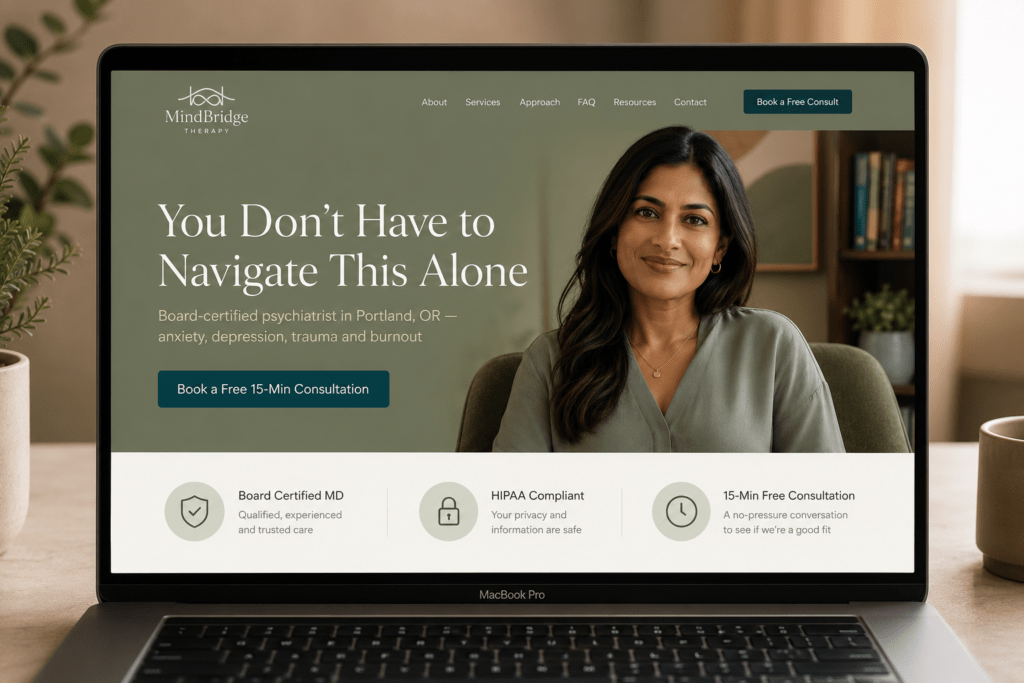
A complete brand and digital ecosystem built around clarity, safety, and trust — the three feelings a prospective patient needs before they’ll pick up a phone and book a session with someone they’ve never met.
Palette: warm sage green, soft off-white, deep charcoal, and muted terracotta. Typography: a warm humanist serif for headings paired with a clean, readable sans-serif for body copy. Every visual and copy decision made with one question: does this make a hesitant person feel safe enough to reach out?
New patient enquiries went from 0 digital leads to 23 per month within 60 days. Google ranking reached position 1 for “psychiatrist Portland OR” within 90 days. The practice reached full capacity (32 weekly sessions) within five months of launch.
Understanding the Private Practice Patient Journey
Unlike a dental appointment or a restaurant booking, the journey to booking a psychiatric consultation is non-linear, emotionally loaded, and often very long. Understanding this changes every marketing decision.
A patient searching for a psychiatrist may research for weeks before making contact. They visit multiple provider profiles, read every word of every bio, look for photographs, read reviews obsessively, and often abandon the process several times before completing a booking. They are not comparison-shopping on price. They are comparison-shopping on whether they feel safe.
The marketing job is therefore not to persuade — it’s to reduce fear. Every touchpoint from Google search to consultation booking page exists to answer one underlying question: will this person understand me and help me?






Lead Generation Strategy for Independent Practitioners
Private psychiatric practice lead generation is different from almost every other healthcare vertical — the patient decision cycle is longer, more emotionally sensitive, and more trust-dependent than any other service category. The strategy reflects that reality.
Primary Channels in Priority Order:
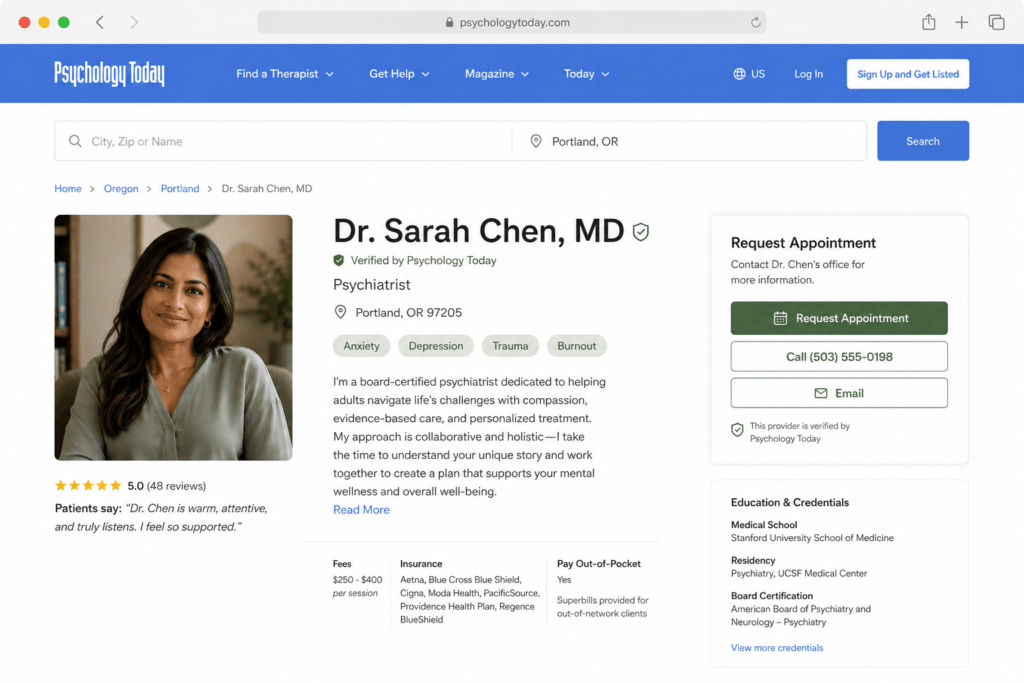
1. Psychology Today Profile — The single highest-converting lead source for independent mental health practitioners in the US. A fully completed, photo-rich, keyword-optimised profile with a clear bio, listed specialties, and visible fee/insurance information generates consistent inbound enquiries from high-intent patients. Subscription cost: $29.95/month. Average ROI for a full practice: 40–60x per month.
2. Google Business Profile — Fully optimised with weekly posts covering mental health awareness topics, session availability updates, and educational content. Reviews handled carefully — patients leave anonymous or first-name-only reviews under HIPAA-informed consent. GBP categories set to Psychiatrist (primary), Mental Health Clinic (secondary).
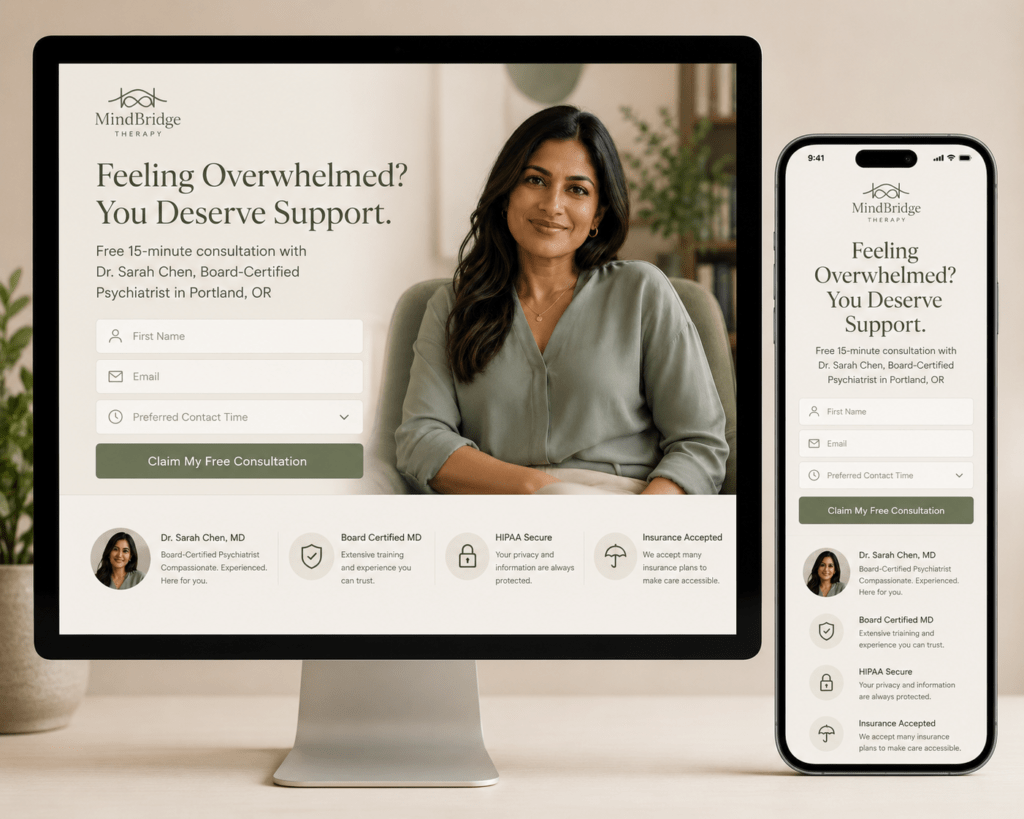
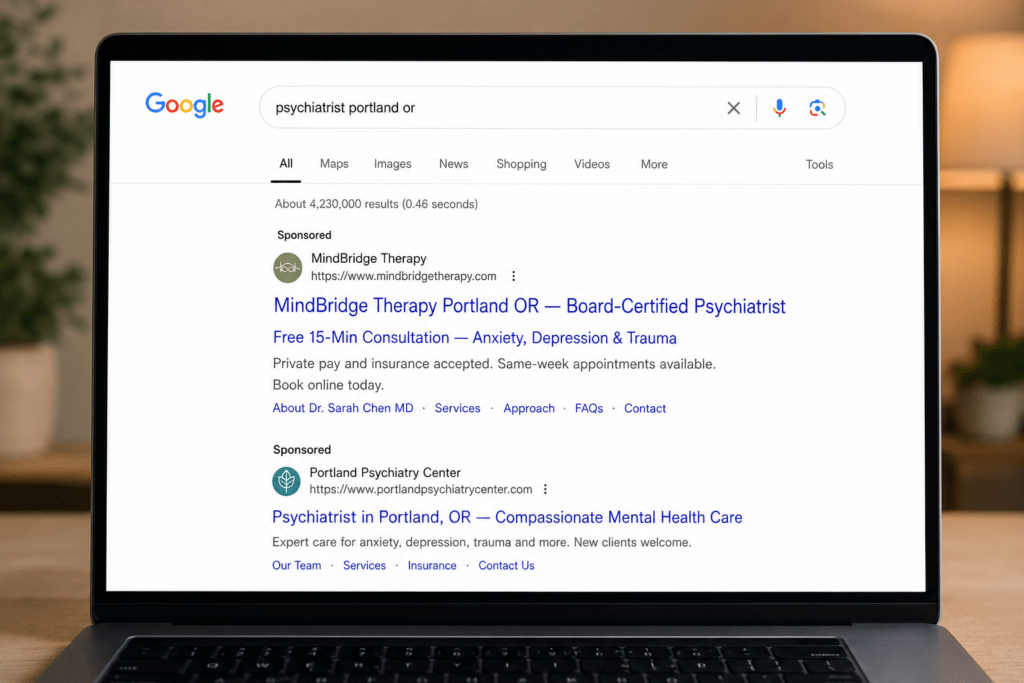
3. Google Search Ads — Targeted campaigns around high-intent local queries (“psychiatrist Portland OR,” “anxiety treatment Portland,” “depression help near me Portland”). All ads linking to a dedicated landing page with a single free consultation CTA. HIPAA-compliant tracking pixels configured to measure form completions without storing PHI.
4. Zencare and Headway — Zencare is the fastest-growing therapist directory for urban markets. Headway specialises in insurance-accepting practitioners and handles billing — reducing administrative burden while generating a consistent new patient stream.
5. Instagram and LinkedIn — Instagram for educational content that reduces stigma and builds familiarity (3 posts per week: quote, educational, behind-the-scenes). LinkedIn for referral network building with GPs, HR professionals, employee assistance programme managers, and other referral sources.
6. Local GP and Corporate Referral Outreach — A targeted letter and one-page practice overview sent to 40 GP practices and 20 HR departments within a 15-mile radius, establishing a formal referral pathway with a named contact.
Compliance and Sensitivity Considerations
Every element of MindBridge’s digital presence was built with HIPAA compliance and patient sensitivity as primary constraints — not afterthoughts.
All patient testimonials are anonymised or use first name only with explicit written consent. Review requests are never sent via standard email marketing platforms — only through HIPAA-compliant practice management systems. Contact forms are hosted on HIPAA-compliant infrastructure with SSL and no third-party cookie tracking storing personally identifiable information. Ad retargeting is configured to exclude visitors who land on pages related to specific conditions (per Meta and Google healthcare advertising policies).
Social media content never depicts identifiable patients, never discusses specific cases, and never makes clinical claims. Every post carries a “This is not a substitute for professional medical advice” footer.
The biggest barrier to independent psychiatric practice growth isn’t clinical skill — it’s visibility. Most exceptional practitioners are invisible to the patients who need them most. A well-built digital presence doesn’t just fill a practice schedule — it connects people in genuine need with the right support at the moment they’re ready to ask for it.
Ready to Build Your Private Practice’s Digital Presence?
If you’re an independently practicing psychiatrist, psychologist, or therapist in the US with a waiting list built on referrals that aren’t reliable — your digital infrastructure is the gap between where you are and a sustainably full practice.
We build complete digital ecosystems for independent mental health practitioners — brand identity, website, Psychology Today and directory optimisation, Google Ads, social content, and ongoing SEO — with full HIPAA compliance and patient sensitivity built into every decision.
What Working With Us Looks Like
✅ Week 1–2: Brand audit, ICP definition, specialty and location keyword research ✅ Week 3–4: Logo, brand identity, and office signage design ✅ Week 5–6: Website design, development, SEO setup, and schema implementation ✅ Week 7–8: Google Ads, landing page, Psychology Today, and directory optimisation ✅ Month 3+: Monthly reporting, review generation, content calendar, and ongoing optimisation
Most independent practices we work with reach measurable new patient growth within 45 days of launch.
📞 Book Your Free 30-Minute Strategy Call
Schedule Your Free Discovery Session →
No obligation. No generic proposal. An honest conversation about your practice, your ideal patient profile, and what a sustainable digital growth strategy looks like for your specific situation.
We work exclusively with healthcare and wellness practitioners and accept a limited number of new clients each quarter.