The complete local SEO guide for small businesses in 2026 — covering Google Business Profile, reviews, citations, local content, schema markup, and AI search visibility
“We opened our second location in March. By May, someone told me they found us by asking ChatGPT for the best accountant in the area. ChatGPT mentioned us by name. I didn’t even know that was possible, let alone that we were doing things that made it happen.”
— Owner, independent accountancy practice, May 2026
That conversation captures something that’s quietly become true across every local service category: the way people find local businesses has fractured into multiple surfaces, and the small businesses winning in 2026 are the ones visible on all of them — not just the ones that were first to claim a Google Business Profile in 2018 and haven’t touched it since.
Local SEO used to be relatively contained. Optimise your Google Business Profile, collect some reviews, get your name in a few directories, and you’d appear in the local pack. That still matters. But the landscape has expanded in ways that reward businesses willing to go further — and expose those who assume the basics are still enough.
This guide covers everything a small business needs to know about local SEO in 2026. Not just the tactics, but the strategy behind them — and where the landscape is heading fast enough that acting now matters.
The State of Local Search in 2026: Why This Matters More Than Ever
Before we get into tactics, let’s establish how significant the local search opportunity actually is — because the numbers consistently underestimate how commercially important this channel is for small businesses.
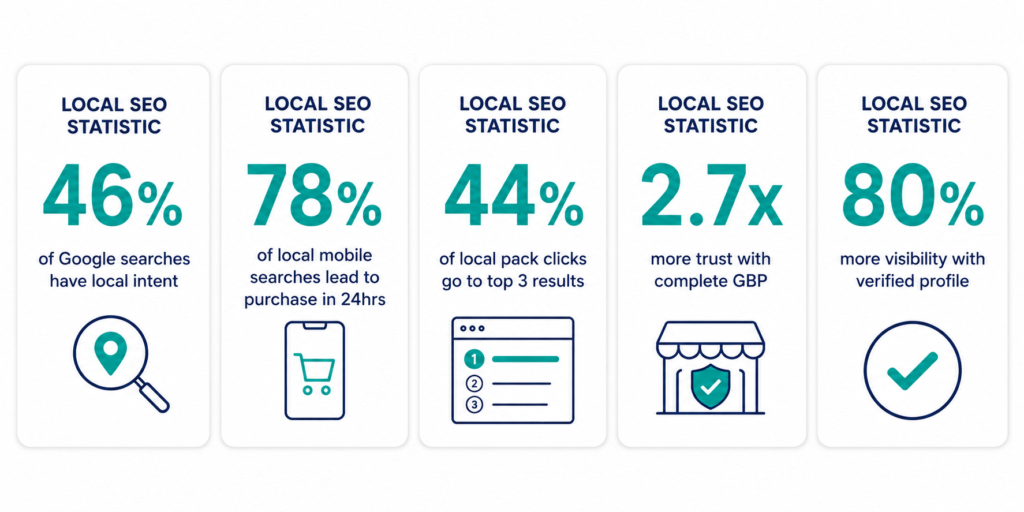
46% of all searches on Google have local intent, 78% of local mobile searches result in an offline purchase within 24 hours, and the top three local pack results capture 44% of all clicks for local-intent queries. Think about what that means for a small business with a service radius. Nearly half the searches relevant to your business have local intent. Three out of four people who search for you on mobile will visit or call within a day.
Customers are 2.7 times more likely to trust a business if they come across a complete business profile on search and Google Maps, and a verified Google Business Profile gets around 200 clicks or interactions per month.
Verified profiles appear 80% more often in search results than unverified ones — verification alone is the single easiest win in local SEO.
And yet, despite all of this: approximately 60% of businesses don’t optimise their websites for local search. In competitive local markets, that neglect is a gift to the businesses that do.
The opportunity is clear. The question is how to seize it systematically — covering every layer from the foundation up.
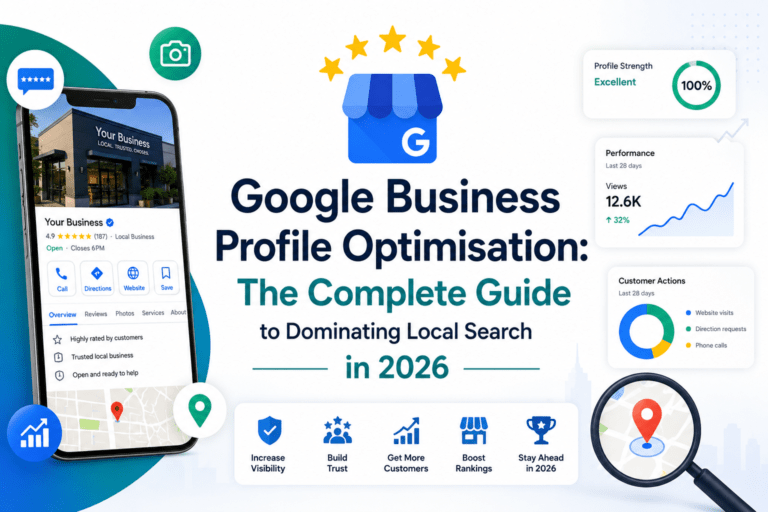
Pillar 1: Google Business Profile — Your Most Important Local Asset
If there’s one thing you do after reading this guide, make it this: treat your Google Business Profile not as a listing to claim and forget, but as a dynamic marketing asset that needs weekly attention.
86% of Google Business Profile views come from discovery searches, not direct searches. Most profile views come from people who did not search your business name — they searched a category or service. That’s the commercial significance of GBP optimisation: you’re not just making it easier for people who already know you to find your contact details. You’re inserting your business into searches by people who don’t know you exist yet, at the exact moment they’re looking for what you offer.
Setting Up and Verifying Your Profile Correctly
The starting point is non-negotiable. Verified profiles appear 80% more often in search results — verification is the single easiest win in local SEO. If your profile isn’t verified, nothing else you do will reach its potential.
Verification is done through Google’s postcard, phone, video, or instant verification process depending on your business type. Once verified, the real optimisation work begins.
Completing Every Field — Not Just the Basics
Your Name, Address, and Phone number must match your website and other listings exactly and must be consistent across all citations. This isn’t a minor formatting detail — it’s a trust signal that Google uses to confirm your business is legitimate and operating as described.
Beyond NAP, complete every available field:
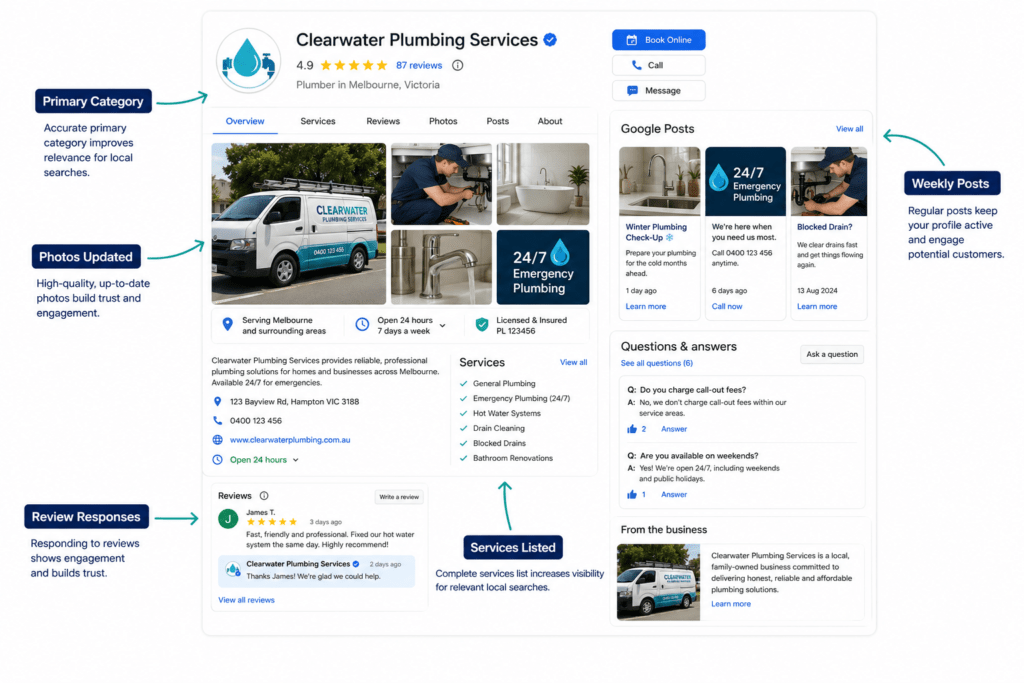
Business category: Your primary category carries the most weight of any single GBP field. Choose the most specific category that accurately describes your primary service — “employment solicitor” beats “law firm”; “boiler installation company” beats “plumbing services.” Add secondary categories for additional services, but never add categories that aren’t genuinely relevant.
Services and products: Detail every service you offer, with specific descriptions and — where appropriate — price ranges. These fields appear in search results and influence which queries your profile matches.
Business description: Write a specific, factual 750-character description that clearly describes what you do, who you serve, and what makes your approach distinctive. Use the language your customers use — not industry jargon.
Attributes: Accessibility features, payment methods, parking availability, whether you’re women-led or veteran-owned — every relevant attribute adds search filter visibility that competitors without them miss.
Photos: GBP profiles with photos get 42% more direction requests. Upload real photography — your premises exterior and interior, your team, your work, your products. Update photos regularly; Google rewards profile activity.
Weekly Profile Management
Advanced GBP optimisation means using every available feature strategically: posting Google Updates at least weekly to demonstrate active management; fully populating the Products and Services sections with keyword-rich, accurate descriptions; uploading high-quality photos regularly; enabling messaging and responding promptly to drive engagement signals; and answering questions in the Q&A section proactively.
The Q&A section is particularly underused. Businesses that populate it with common customer questions — “Do you offer free consultations?” “Do you cover [town]?” “What are your payment terms?” — both serve potential customers and control the information that appears on their profile. Left unpopulated, anyone can post questions that may sit unanswered, or competitors can post unhelpful responses.
Google cross-references your NAP across 50+ directories. If your phone number differs on three sites, Google assumes your business is unreliable or closed — demoting your ranking instantly.
Pillar 2: Reviews — The Ranking Signal You Build One Conversation at a Time
Reviews are simultaneously a ranking factor, a conversion signal, and an AI visibility mechanism. They’re also the one local SEO element that can’t be gamed, automated, or outsourced — which is precisely why they’re so valuable as a competitive differentiator.
Businesses with 50 or more Google reviews earn 266% more leads than those with fewer than 10. Displaying reviews increases conversion rates by up to 270%. 97% of consumers read reviews before choosing a local business.
And yet most small businesses treat review generation as an afterthought — something that happens passively, occasionally, without any systematic effort to accelerate it.
Building a Review Generation System
The word that matters here is “system.” Not a strategy you implement once, not a reminder you send occasionally — a repeatable process that generates fresh reviews consistently, regardless of how busy the team is.
Review velocity and recency both matter — stale review profiles lose momentum in competitive markets. A business with 200 reviews that received its last one eight months ago will often rank below a competitor with 60 reviews arriving steadily each week. Consistency beats total volume.
The mechanics of a review system that works:
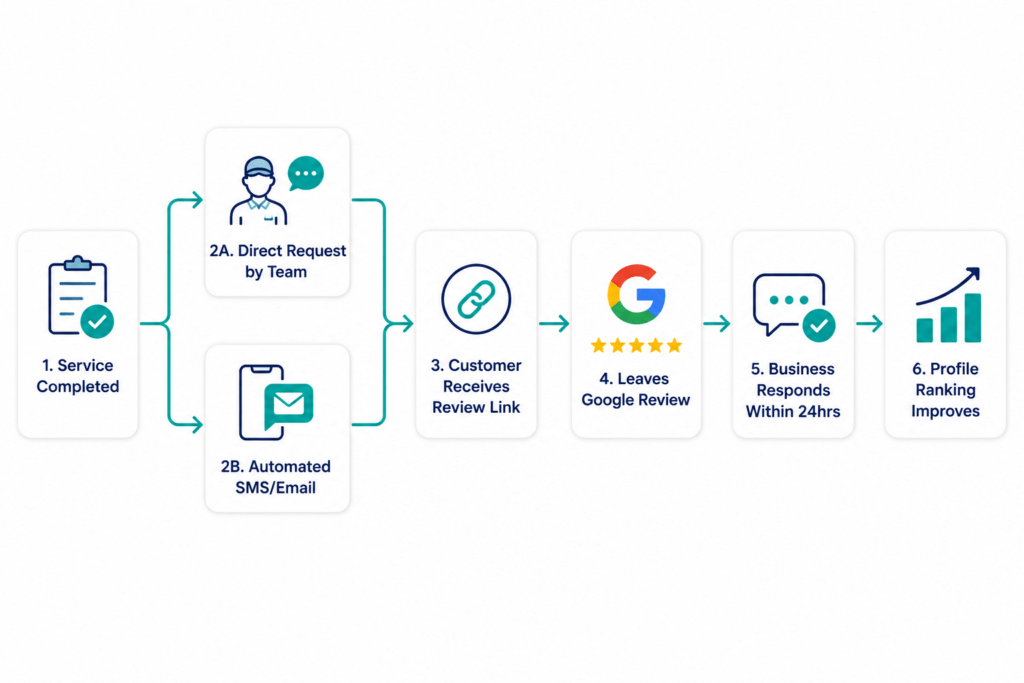
The highest-converting review request is a direct, personalised ask from a person at the moment of positive experience. Train your team to identify the compliment moment — when a customer expresses genuine satisfaction — and follow it with a specific, warm request: “We’d really appreciate a Google review — it makes a huge difference for a small business like ours.”
Back this up with a systematic digital trigger: an SMS or email sent within one hour of a completed job, appointment, or service delivery, with a direct link to your Google review page. Direct review links — bypassing your homepage and going straight to the review compose screen — convert at significantly higher rates than generic “find us on Google” requests.
Make the process frictionless. A QR code in your premises or on receipts that opens the review page in one tap removes every barrier for customers who intend to leave a review but don’t do it because they can’t remember how.
Responding to reviews — every single one:
An active, authentic review profile is significantly more resistant to reputational attack than a thin or artificially inflated one. Beyond the defensive case, review responses are a direct signal to both Google and prospective customers that your business is actively managed by real people who take feedback seriously.
Positive reviews get a warm, specific thank-you — not a copy-pasted template. Using the customer’s name, referencing the specific service, and expressing genuine appreciation demonstrates authenticity that a boilerplate response can’t replicate.
Negative reviews get a professional, non-defensive response that acknowledges the issue, expresses genuine concern, and offers to resolve it offline. How you respond to criticism is one of the most persuasive trust signals a prospective customer will encounter — because it tells them what happens if something goes wrong when they’re the customer.
Beyond Google: diversifying your review presence
Google’s share of consumer reviews dropped from 83% to 71% between 2025 and 2026, with Apple Maps, ChatGPT, and niche platforms gaining ground. This matters for both traditional local SEO and AI visibility — AI tools pull review data from multiple sources when assessing business quality and reputation. A business with strong Google reviews and active Yelp, Trustpilot, and industry-specific directory profiles builds a more robust review footprint than one that’s concentrated entirely on a single platform.
Pillar 3: NAP Consistency and Citation Building
Citations are mentions of your business’s Name, Address, and Phone number across the web — directory listings, review platforms, industry associations, local press mentions, and anywhere else your business details appear online.
NAP consistency across 50+ directories is required for Google to trust your business’s location data — inconsistencies directly suppress map pack rankings. Citation signals account for approximately 7% of local pack ranking factors.
That 7% sounds modest, but it’s fully controllable and often completely neglected — which means the businesses that get it right gain a meaningful advantage over those that don’t.
The NAP Audit: Start Here
Before building new citations, audit the ones you already have. Inconsistencies are more harmful than citation gaps — a business listed as “Smith & Co Plumbers” on their website, “Smith and Co Plumbing” on Yelp, and “Smith & Co” on Apple Maps sends conflicting signals that reduce Google’s confidence in your business data.
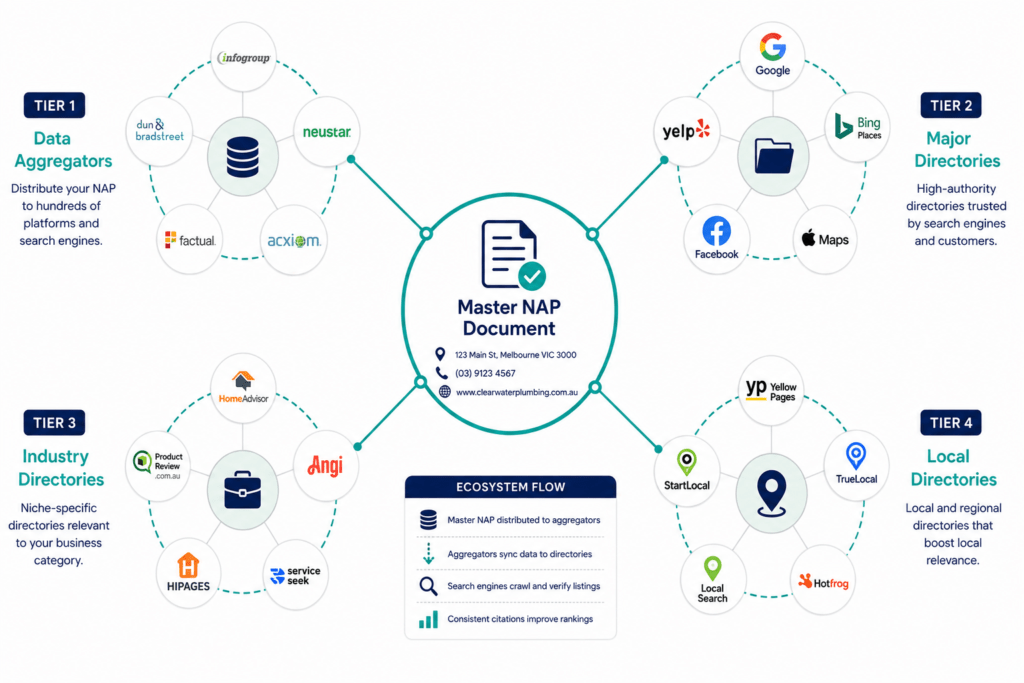
Create a master NAP document to maintain consistency across all future listings. Audit existing citations using tools like Moz Local, BrightLocal, or Whitespark. Update or remove duplicate listings that contain conflicting information.
Free manual audit: Google your exact business name, your phone number, and your address separately. The results will surface the primary places you’re listed and highlight inconsistencies immediately.
Priority Citation Sources
Not all citation sources carry equal weight. Build them in priority order:
Tier 1 — Data aggregators: These distribute your business information to dozens of downstream directories automatically. In the UK, the primary aggregators are Yell, Thomson Local, and similar data providers. In the US: Data Axle, Neustar Localeze, Foursquare. Getting your information accurate on these platforms cascades across the wider citation ecosystem.
Tier 2 — High-authority general directories: Google Business Profile (already covered), Apple Maps, Bing Places, Yelp, Facebook Business. These platforms have their own high-volume search audiences and significant domain authority.
Tier 3 — Industry-specific directories: A solicitor should be listed on the Law Society directory and Solicitors Guru. A plumber should be on Checkatrade, TrustATrader, and Gas Safe Register. An accountant should appear on the ICAEW directory. Industry-specific citations are among the most trusted by both Google and AI tools because they come from sources with editorial credibility in your sector.
Tier 4 — Local directories: Your local Chamber of Commerce, local business associations, town or city directories, and local press business listings. These reinforce geographic relevance in a way that national directories don’t.
Maintaining Citation Health
Citation building isn’t a one-time project. Business details change — new phone numbers, new addresses, seasonal hours — and every change creates a potential inconsistency across your citation profile. Schedule a quarterly NAP audit as a routine maintenance task, and update your master NAP document every time your business details change before updating any individual listings.
Pillar 4: On-Site Local SEO — Your Website as a Local Ranking Signal
Your Google Business Profile is your primary local SEO asset, but your website plays a critical supporting role. The signals it sends to Google about your location, your services, and your area of operation either reinforce or undermine the authority your GBP profile is trying to build.
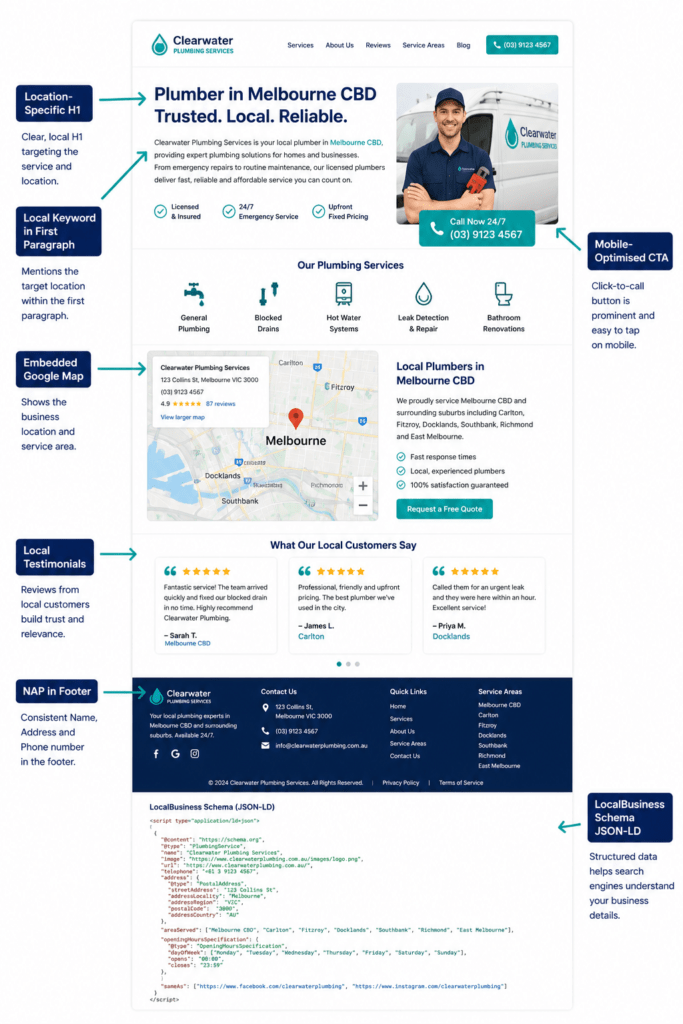
NAP Consistency on Your Website
Your business name, address, and phone number should appear on every page of your website — typically in the footer — and must match your GBP and all directory listings exactly. Every character counts: “Street” vs “St,” “+44” vs “0,” a trailing comma in an address. These are the kinds of inconsistencies that create friction in Google’s location verification process.
Location-Specific Service Pages
If you serve multiple areas, a single “Services” page that mentions all of them in a paragraph is far less effective than dedicated pages for each location. A roofing company covering Manchester, Salford, and Stockport should have three separate service pages — “Roofing Services in Manchester,” “Roofing Services in Salford,” “Roofing Services in Stockport” — each with locally relevant content, a local phone number if possible, local client references or case studies, and an embedded Google Map.
These pages need genuine local content — not the same page with the city name swapped. Reference local landmarks, local projects, local client outcomes, and local context. Google can identify thin “location page” templates, and they perform poorly compared to pages that demonstrate real local relevance.
Local Keyword Targeting in Page Content
The language your local customers use when searching for your services should appear naturally throughout your service pages and home page. “Emergency plumber Birmingham” should appear in the title tag, H1, first paragraph, and naturally throughout the body of a plumber’s Birmingham service page. Not stuffed — naturally, in the context of genuinely useful content.
Long-tail local queries — “how much does an accountant cost in Leeds,” “best family solicitor in Bristol for divorce,” “dog groomer near Cheltenham” — often have lower competition and very high intent. Building content pages or FAQ sections around these specific queries captures traffic that broader terms miss.
Local Schema Markup
As documented in the schema blocks at the top of this article, LocalBusiness schema is the most important structured data type for small businesses targeting local search. AI platforms use LocalBusiness schema to match content with location-based queries like ‘best [service] near me.’ Without it, AI systems may favour competitors with explicit location markup.
Add Service schema for each individual service you offer, with descriptions that mirror the language used on your service pages. This dual layer — LocalBusiness schema establishing your geographic entity and Service schema defining what you offer — gives both Google and AI tools a precise, machine-readable picture of your business that reduces ambiguity and increases citation confidence.
Mobile Performance for Local Search
71% of GBP interactions come from mobile devices. The users finding your business through local search are predominantly on phones, often making decisions in real time. A website that loads slowly or is difficult to navigate on mobile is losing you the leads that your GBP profile worked to generate.
Google’s mobile-first indexing means it ranks the mobile version of your site. Core Web Vitals — LCP under 2.5 seconds, INP under 200ms, CLS below 0.1 — are measured on mobile. Technical SEO performance is local SEO performance, because the people arriving from local search are almost always on phones.
Pillar 5: Local Content Strategy — Earning Authority in Your Area
Most small businesses think of content as something large businesses do — blog posts and resources that require teams and budgets they don’t have. The reality is that local content is one of the highest-leverage and most achievable forms of content marketing available to any business.
You don’t need to compete with national publications or establish yourself as an industry thought leader. You need to be the most useful, most visible local resource in your specific service category, in your specific geographic area. That’s a significantly more achievable goal — and it’s one that national businesses and large competitors almost always neglect.
Types of Local Content That Build Rankings and Authority
Answer local questions: What questions do your local customers ask most? An independent financial adviser in Bristol who publishes a genuinely useful guide to “what does a financial adviser in Bristol actually cost?” or “should I use a local IFA or an online platform?” is answering questions that have high local intent and almost no quality competition.
Document local projects and case studies: Each completed project or client engagement is a content asset. “We installed a new boiler in a Victorian terrace in Didsbury last month — here’s what was involved and what the homeowner should watch for in old properties” is a piece of content that serves prospective clients, demonstrates specific expertise, and targets location-specific keywords simultaneously.
Cover local events and community news (where relevant): Businesses embedded in their local community — that sponsor local events, support local causes, attend local networking groups — have content opportunities that demonstrate genuine local presence. A sponsor mention from a local charity event or a writeup in the local business press is both a citation and a demonstration of community presence that AI tools increasingly recognise as an entity trust signal.
Create neighbourhood guides and service area content: “Complete guide to [your service] in [your city]” pages serve both informational searchers and Google’s local relevance signals. A window cleaning company publishing a “guide to window cleaning in Victorian terraces — what to know before you book” targeting their specific service area is building authority on exactly the terms their highest-value prospects are searching.
Content Consistency Over Volume
One high-quality, locally relevant piece of content per month outperforms ten generic thin pieces. Focus on genuine usefulness for real people in your area — answer their specific questions, address their specific concerns, reference their specific context. Google’s quality systems are increasingly effective at distinguishing substantive local content from location-page templates.
Pillar 6: Local Link Building — Earning Area Authority
Links from locally relevant, authoritative sources are among the most powerful local ranking signals available — and among the hardest to shortcut. You can’t reliably manufacture genuine local links. You earn them.
Link signals account for approximately 15% of local pack ranking factors, making them the second most influential controllable signal after Google Business Profile optimisation.
The most effective local link building approaches:
Local press and media: A story in your local newspaper or regional business publication earns a link from a high-domain-authority, geographically relevant source. Local business press regularly covers new openings, unusual services, community involvement, and expert commentary. Being available as a local expert source for journalists covering your sector is a sustainable local link building strategy with compounding returns.
Chamber of Commerce and business associations: Most local Chambers of Commerce offer member directory listings with followed links. Industry association membership typically includes a listing link. These are some of the easiest local authority links available — and consistently underused.
Community sponsorship: Sponsoring a local sports club, charity event, or community initiative almost always results in a link from the sponsored organisation’s website. These links come from genuinely local domains with community context — exactly the signals Google’s local algorithm values.
Supplier and partner cross-referencing: Businesses you work with regularly — suppliers, referral partners, complementary services — are natural link exchange opportunities. A solicitor and an independent financial adviser who frequently refer clients to each other both benefit from linking to each other’s websites in a relevant, natural context.
Local blogger and influencer mentions: Local lifestyle bloggers, community influencers, and neighbourhood forums are link sources that most businesses never consider. A positive review or mention from a well-followed local account carries both link value and social proof value simultaneously.
Pillar 7: AI Search and Local GEO — The Emerging Layer
Here’s where local SEO in 2026 becomes more complex than it was two years ago — and where businesses that understand the new dynamics are building advantages their competitors haven’t caught on to yet.
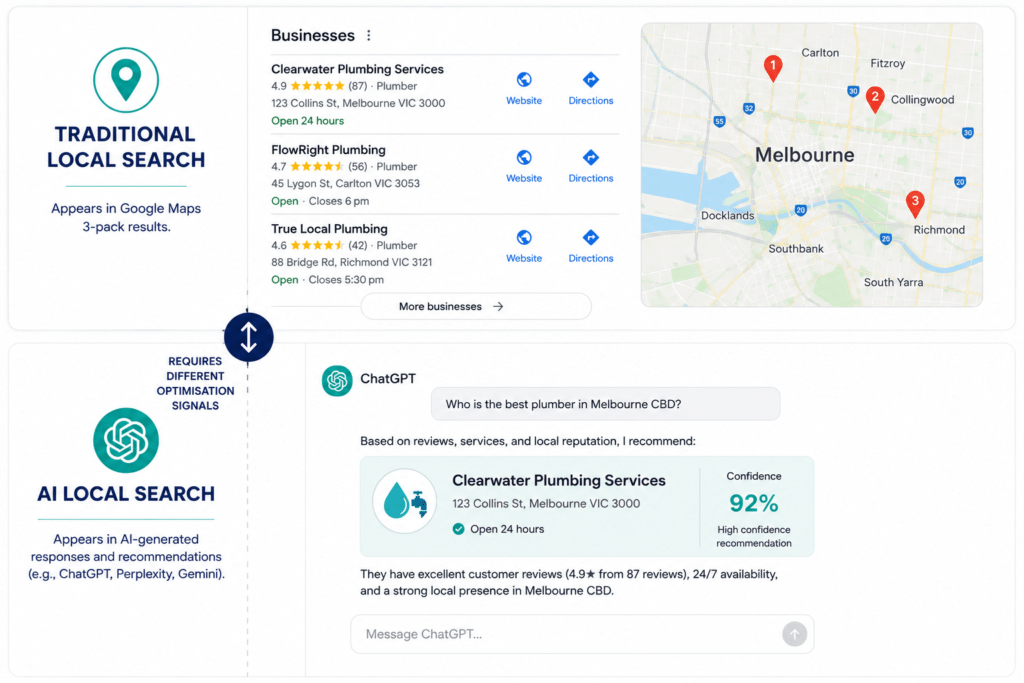
According to SOCi’s 2026 Local Visibility Index, which analysed more than 350,000 locations across 2,751 multi-location brands, only 1.2% of locations were recommended by ChatGPT, 11% by Gemini, and 7.4% by Perplexity. By comparison, those same brands appeared in Google’s local 3-pack 35.9% of the time. AI local visibility is up to 30 times harder to achieve than traditional local search visibility.
That gap is significant. A business can be winning in traditional local SEO — appearing consistently in the local 3-pack — and still be completely invisible to users who ask an AI assistant “who’s the best [service provider] in [area]?” And AI Overviews now appear in 40% of local business queries.
The core problem: AI systems are not ranking pages. They are evaluating confidence. An AI assistant recommends a location because it has high confidence in the accuracy, quality, and reputation of that business.
Building AI Local Visibility
The good news is that the signals that build AI local visibility are largely the same signals that drive traditional local SEO — but executed with more precision and with some specific additions:
Comprehensive, accurate GBP data: Your Google Business Profile is often the primary source of data for AI-driven local search results. AI tools that pull local business data — Gemini in particular, which integrates directly with Google’s business data — use your GBP as a foundational reference. Every field populated, every photo current, every service described specifically.
Multi-platform consistency: The businesses that build comprehensive, accurate, multi-platform digital presences — not just on Google, but across review platforms, directories, community forums, and earned media — are the ones that will perform well regardless of which specific SERP features Google, ChatGPT, or Perplexity prioritise next. AI tools synthesise business data from multiple sources. A business that’s consistent, accurate, and well-reviewed across Google, Yelp, Apple Maps, and industry directories builds the kind of multi-source confidence that makes AI tools comfortable recommending it.
Conversational content for voice and AI queries: By 2026, over 60% of all local searches are conducted via voice or conversational AI interfaces. Voice queries are longer and more natural than typed queries: “best emergency plumber near me for a burst pipe” rather than “emergency plumber.” Content that answers these conversational, specific queries — FAQ sections, service pages that directly address common urgent situations — maps directly onto how voice and AI searches retrieve local recommendations.
Entity authority through earned mentions: Traditional local SEO metrics like rankings, calls, direction requests, and click-through rates still matter, but they are no longer enough. Businesses need to know whether AI engines mention them, cite them, or exclude them from recommendation sets entirely. If ChatGPT recommends three local accountants and your firm never appears, that is a discoverability problem even if your website ranks well in standard search.
Local SEO Ranking Factors: What Actually Moves the Needle
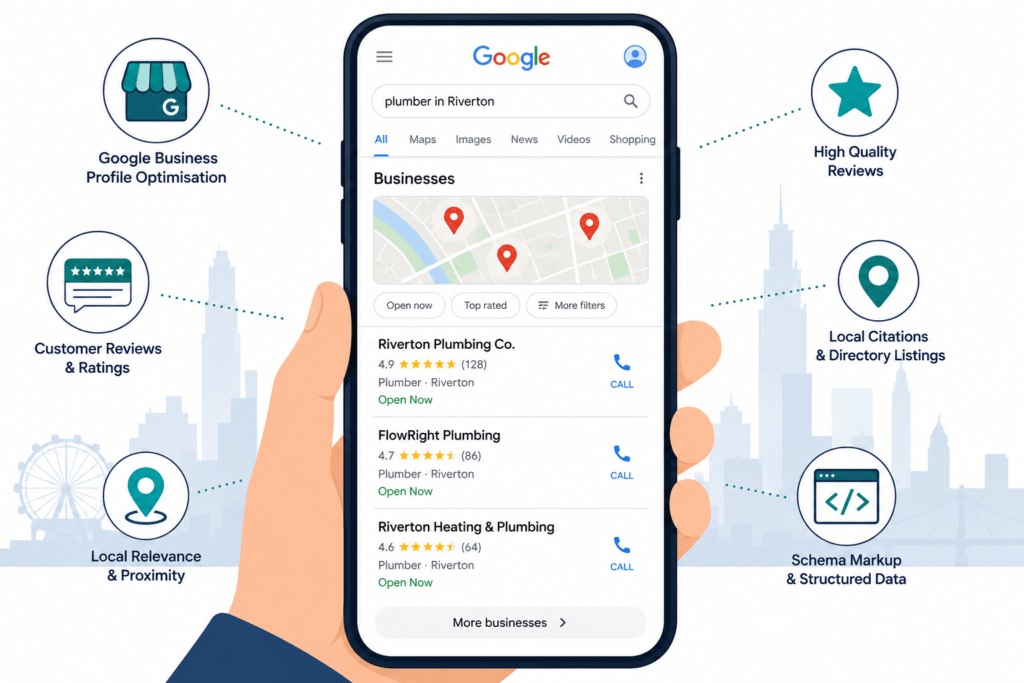
Understanding which factors carry the most weight helps prioritise limited time and budget correctly. The Local Pack ranking factors by weight in 2026 are: Google Business Profile signals — proximity, categories, keyword in title — at 32%; on-page signals including NAP, local keywords, and domain authority at 19%; review signals covering quantity, velocity, diversity, and sentiment at 16%; link signals at 15%; behavioural signals including CTR and mobile clicks-to-call at 8%; citation signals at 7%; and personalisation signals at 3%.
The practical implication of this distribution: your GBP is roughly twice as important as your website for local pack rankings. If you have limited time, prioritise in this order:
- Google Business Profile completeness and verification
- Review velocity and quality
- On-page local signals (NAP, location keywords, local schema)
- Citation consistency
- Local link building
- Local content development
- AI visibility signals
This doesn’t mean lower-priority items don’t matter — they all compound. But if you’re starting from scratch or have limited capacity, this sequence maximises results per hour invested.
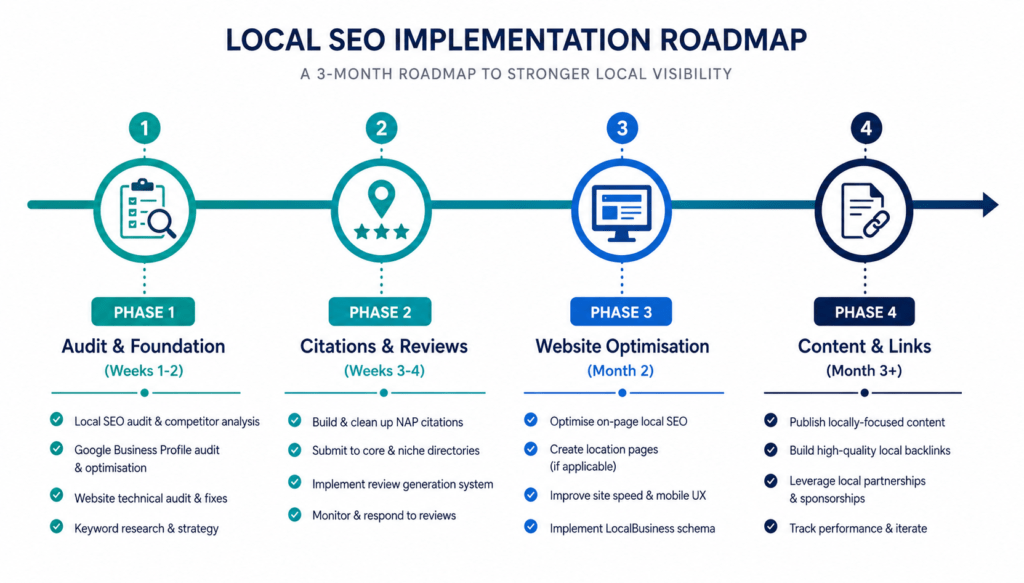
Step-by-Step Implementation Plan
This is the operational sequence we walk small business clients through. Not theoretical — executable in a defined order that builds each layer on the one before it.
Week 1–2: Audit and Foundation
- Claim and verify your Google Business Profile if not yet done
- Complete every GBP field (categories, services, description, hours, attributes)
- Conduct a NAP audit — Google your business name, phone, and address to identify inconsistencies
- Create a master NAP document with your exact, canonical business details
- Install LocalBusiness schema on your website homepage and contact page
Week 3–4: Citation Cleanup and Review System
- Fix all NAP inconsistencies found in the audit
- Submit to Tier 1 data aggregators with your master NAP
- Set up a review generation system — direct link, SMS or email trigger, team training
- Respond to all existing reviews within 48 hours
Month 2: Website Local Optimisation
- Audit website for NAP consistency in footer and contact page
- Review title tags and H1s on service pages for local keyword presence
- Create location-specific service pages for each primary area you serve
- Add Service schema for each service offered
- Implement BreadcrumbList schema for site structure
Month 3: Content and Link Building
- Publish your first locally targeted content piece — a specific question your local clients ask, answered thoroughly
- Join local Chamber of Commerce and claim the directory listing
- Identify three to five local link opportunities (sponsors, partners, associations)
- Begin outreach for local press coverage or community mentions
Month 4 onwards: Ongoing Optimisation
- Post to GBP weekly
- Upload new photos monthly
- Monitor AI visibility for your primary queries (ChatGPT, Perplexity, Google AI Overviews)
- Respond to all reviews within 24 hours
- Publish one piece of local content per month
- Conduct quarterly NAP audit
Common Local SEO Mistakes That Cost Small Businesses Rankings
These patterns appear consistently across the small businesses we audit — often in businesses that have invested real time and money in their marketing.
Inconsistent NAP across the web. If your phone number differs on three sites, Google assumes your business is unreliable or closed — demoting your ranking instantly. This is the most common and most easily fixed local SEO problem. A NAP audit takes two hours. Not fixing it costs rankings indefinitely.
Neglecting the Google Business Profile after setup. Claiming and verifying your profile is step one, not the whole job. In 2026’s AI-driven search landscape, GBP is a dynamic asset requiring weekly attention. Neglect it and visibility withers. Profiles that haven’t been updated in months signal low activity to Google’s local ranking algorithm.
Generating a burst of reviews then stopping. Review velocity matters as much as total count. Asking for reviews in a one-off campaign, generating 40 in a month, and then reverting to passive acquisition produces a review pattern that looks manufactured and loses momentum.
Ignoring negative reviews. A negative review with no response is worse than a negative review with a professional, empathetic reply. Prospects read your responses. A well-handled complaint is actually a trust signal.
Building identical location pages. Duplicate service pages with only the city name changed are identified by Google as thin content. Each location page needs genuinely local content — local case studies, local context, local keyword usage — to perform.
Treating local SEO as a one-time project. Local SEO is an ongoing activity. The businesses that consistently appear in local pack results are the ones running systematic weekly and monthly activities — not the ones that optimised their GBP in 2023 and haven’t touched it since.
Missing the AI search layer. A brand can be winning in traditional local SEO and still be completely invisible to consumers who ask an AI assistant for a recommendation. As AI search usage grows, being invisible at that layer is becoming an increasingly significant commercial blind spot.
Real Business Examples: Local SEO in Practice
A Solicitor’s Practice That Doubled Enquiry Volume in Four Months
A four-partner solicitors’ practice had a verified GBP but a profile that hadn’t been updated in 18 months — no recent photos, no posts, an outdated service list, and 11 Google reviews. Their website had no location-specific pages and inconsistent NAP information between the site, their Law Society listing, and their GBP.
After a full NAP audit and correction, weekly GBP posts, a systematic review generation process (asking clients directly at file closure), location-specific service pages for their three primary towns, and LocalBusiness and Service schema implementation — they went from 11 to 63 reviews in four months, moved from the fifth position in local pack to first for their primary keywords, and saw enquiry volume from local search double.
The investment was primarily time — two to three hours per week of consistent activity across the GBP and local content.
A Plumbing Company That Captured AI Recommendations
A regional plumbing and heating business was performing well in traditional local search but was curious about AI visibility after a competitor was mentioned in a ChatGPT response to “emergency plumber in [their city]” and they weren’t.
After reviewing the competitor’s profile, the difference was clear: the competitor had 112 reviews with specific mentions of emergency callouts and their response time. Their website had a detailed emergency plumbing FAQ page with question-format headings. Their GBP listed “emergency plumber” as a service with a specific description. Their LocalBusiness schema included their service area and operating hours.
The business implemented all of these elements over six weeks. Within two months, a manual test of the same ChatGPT prompt produced a response that named them alongside the competitor.
A New Café That Hit the Local Pack in 60 Days
A new independent café opened in a competitive city centre location. Despite having no domain authority or established review profile, they appeared in the local pack for “café near [city centre landmark]” within 60 days of opening.
The factors: GBP claimed and fully completed on opening day, including all categories, attributes, and menu; professional photos uploaded day one and weekly thereafter; a systematic daily review ask by staff at the till; NAP submitted to all major directories in the first week; and their website built with LocalBusiness and FoodEstablishment schema from launch.
They outranked cafés with years of history that had let their profiles stagnate. Recency, completeness, and review velocity are powerful enough to overcome age disadvantage in local search.
Measuring Local SEO Performance
You can’t manage what you don’t measure. Local SEO performance requires a specific measurement framework — different from standard organic SEO metrics — because the primary value often shows up in phone calls and foot traffic rather than website sessions.
Google Business Profile Insights: Track profile views, search queries that triggered your profile, website clicks, direction requests, and call clicks. These metrics show how your profile visibility is translating into real-world actions — the ones that matter most for a local business.
Google Search Console: Monitor impressions and clicks for location-specific queries. Track your top-performing local queries and watch for ranking changes in the weeks following optimisation activities.
Review tracking: Monitor review count, average score, and review velocity across all platforms weekly. Set alerts for new reviews so you can respond promptly.
Local rank tracking: Tools like BrightLocal, Whitespark, or Semrush’s Position Tracking allow you to monitor your local pack position for specific queries in specific geographic locations. Track your top ten priority local keywords monthly.
AI visibility monitoring: A complete local visibility monitoring setup in 2026 includes both traditional and AI-specific categories. For AI-specific visibility: tools like Mangools AI Search Grader, Semrush AI Visibility, and LocalFalcon track visibility across ChatGPT, Perplexity, Gemini, and Google AI Overviews. Manual testing — running your priority queries through ChatGPT and Perplexity monthly — provides directional data at no cost.
Call tracking: If you’re in a high-call industry (trades, legal, medical, financial advice), call tracking with a dedicated local number on your website and GBP allows you to attribute phone enquiries to specific marketing sources. Without it, you’re likely significantly underreporting your local SEO conversion rate.
Expert Observations: What Separates the Local Leaders
After auditing and managing local SEO for businesses across many categories, a few patterns consistently separate the businesses ranking at the top from those stuck on page two.
They treat the GBP like a social media channel. Weekly posts, monthly photo updates, proactive Q&A management, prompt review responses. The businesses at the top of the local pack aren’t there because of a one-time optimisation — they’re there because they’ve maintained consistent activity that signals to Google this is an active, well-managed business.
They ask for reviews at the right moment, by the right person, in the right way. The most effective review generation isn’t automated — it’s a trained team behaviour. The direct ask from a person who knows the customer, at the moment of highest satisfaction, converts at rates that no automated follow-up can match. Automation supplements this; it doesn’t replace it.
They don’t just build citations — they audit them. The businesses with the cleanest citation profiles run quarterly audits and treat NAP consistency as an ongoing operational discipline, not a one-time setup task.
They write local content nobody else bothers to write. The specific question your specific local clients ask, answered thoroughly and locally. A page that exists nowhere else, serving a real need, in a geographic context that national competitors don’t address. This is the content that earns local rankings, builds local trust, and increasingly gets cited by AI tools recommending local expertise.
Future Trends: Where Local SEO Is Heading
By 2026, over 60% of all local searches are conducted via voice or conversational AI interfaces. The direction of travel is clear: more AI mediation, more conversational queries, more zero-click local answers. The businesses that build for this future now are building advantages that will compound as the technology matures.
Voice search will continue to grow. Optimising for conversational queries — longer, more natural, more question-format — serves both voice search and AI assistant recommendations simultaneously.
AI local recommendations will become more mainstream. As more consumers use ChatGPT and Gemini for local business discovery, AI local visibility will become a standard metric in any local marketing programme. The businesses building multi-platform entity authority now are positioning well for this shift.
Review platforms will continue to diversify. Google’s dominance of the review landscape is declining. Building review presence across Google, Apple Maps, industry-specific platforms, and AI-accessible review sources is increasingly important for both traditional and AI local visibility.
Hyper-local content will become a competitive differentiator. As AI tools make generic content easier to produce, the content that stands out will be the content only a local expert can produce — specific, experience-based, geographically grounded. The barrier to generic content is dropping. The value of genuinely local expertise is rising.
Conclusion: Local SEO Is the Highest-ROI Channel Most Small Businesses Aren’t Fully Using
The commercial case for local SEO is as strong as it’s ever been — and the landscape rewards effort and consistency in ways that most other marketing channels don’t. You don’t need a large budget to rank well locally. You need a complete, well-managed Google Business Profile, a systematic approach to reviews, clean citation data, a well-structured local website, and the consistency to maintain all of it week after week.
75% of local companies say that local SEO efforts generate more leads than paid ads. For a small business with a defined service area, there is no more efficient lead generation channel available.
The businesses that win local search in 2026 are not the ones with the biggest budgets. They’re the ones that treat their GBP as a weekly priority, ask every satisfied customer for a review, keep their business information consistent across the web, and publish the genuinely useful local content that their larger competitors don’t bother with.
The work isn’t complicated. But it is consistent. And consistency, in local SEO, is the competitive advantage that compounds.
Ready to audit your local SEO performance? Start with your Google Business Profile. Run a NAP consistency check. Count your current Google reviews and the date of your most recent one. Those three data points will tell you more about your local SEO gap than any tool can — and they’ll tell you exactly where to start.
Frequently Asked Questions
Q: What is local SEO and why does it matter for small businesses? Local SEO is the process of optimising your online presence to appear in geographically targeted search results — the Google Maps 3-pack, localised organic results, and AI-generated local recommendations. 46% of all Google searches have local intent, and 78% of local mobile searches result in an offline purchase within 24 hours. For small businesses serving a specific area, local SEO is typically the highest-ROI digital marketing investment available.
Q: How do I optimise my Google Business Profile for local SEO? Complete every field — categories, services, description, hours, attributes, and photos. Choose the most specific primary category available. Post Google Updates at least weekly. Respond to every review within 24 hours. Populate the Q&A section proactively. Ensure your NAP exactly matches your website and all directory listings. Verified profiles appear 80% more often in search results — verification alone is the single easiest win in local SEO.
Q: What are local citations and why do they matter? Local citations are mentions of your business Name, Address, and Phone number on external websites. NAP consistency across 50+ directories is required for Google to trust your business’s location data — inconsistencies directly suppress map pack rankings. Build citations in tier order: data aggregators first, then major directories, then industry and local platforms. Audit quarterly and fix inconsistencies promptly.
Q: How many Google reviews does a small business need? Businesses with 50 or more Google reviews earn 266% more leads than those with fewer than 10. But review velocity matters as much as total count — consistent new reviews arriving regularly outperforms a one-time accumulation. Aim for a 4.5+ star average, respond to every review, and build a systematic process for requesting feedback from satisfied customers.
Q: How long does local SEO take to show results? Most small businesses see measurable improvements in local rankings within 30–90 days of implementing the core fundamentals — completing their GBP, fixing citation inconsistencies, and establishing a regular review generation process. Competitive markets take longer. Local SEO compounds significantly over six to twelve months of consistent activity.
Q: What schema markup should a local small business implement? The priority schema types are: LocalBusiness schema with name, address, phone, hours, service area, and aggregate rating; Service schema for each service offered; Review schema if you display reviews on-site; and BreadcrumbList schema for site structure. AI platforms use LocalBusiness schema to match content with location-based queries like ‘best [service] near me’ — without it, AI systems may favour competitors with explicit location markup.
Q: How does AI search affect local SEO for small businesses? Only 1.2% of locations are recommended by ChatGPT and 7.4% by Perplexity, compared to 35.9% appearing in Google’s local 3-pack — AI local visibility is up to 30 times harder to achieve than traditional local search visibility. The signals that improve AI local visibility mirror traditional local SEO — accurate GBP data, consistent citations, genuine reviews — but content structure, LocalBusiness schema, and entity authority across multiple platforms matter even more.
Q: Does local SEO work for service area businesses without a physical address? Yes. Google Business Profile supports service area businesses — you can hide your physical address and list specific cities or regions you serve. The same optimisation principles apply, with particular emphasis on location-specific service pages on your website, service area specification in your GBP, and local content that demonstrates genuine relevance to each area you cover.