This guide is a practical blueprint for closing that gap — building a marketing funnel that does the whole job, not just the top of it.
That story contains the single most important insight in this guide: most marketing funnel problems are not lead generation problems. They’re nurturing problems. The leads exist. The intent exists. What’s missing is the system that builds trust between “I’m aware of you” and “I’m ready to buy.”
68% of businesses have not fully defined or documented their sales funnel strategy. That’s the statistic behind most of the gap between what businesses spend on marketing and what they earn from it.
What a Marketing Funnel Actually Is — And What It Isn’t
The marketing funnel concept traces back to 1898, when Elias St. Elmo Lewis introduced the AIDA model — Attention, Interest, Desire, Action. In 126 years, the underlying psychology hasn’t changed. People don’t buy immediately on first contact. They become aware, they consider, they compare, they decide.
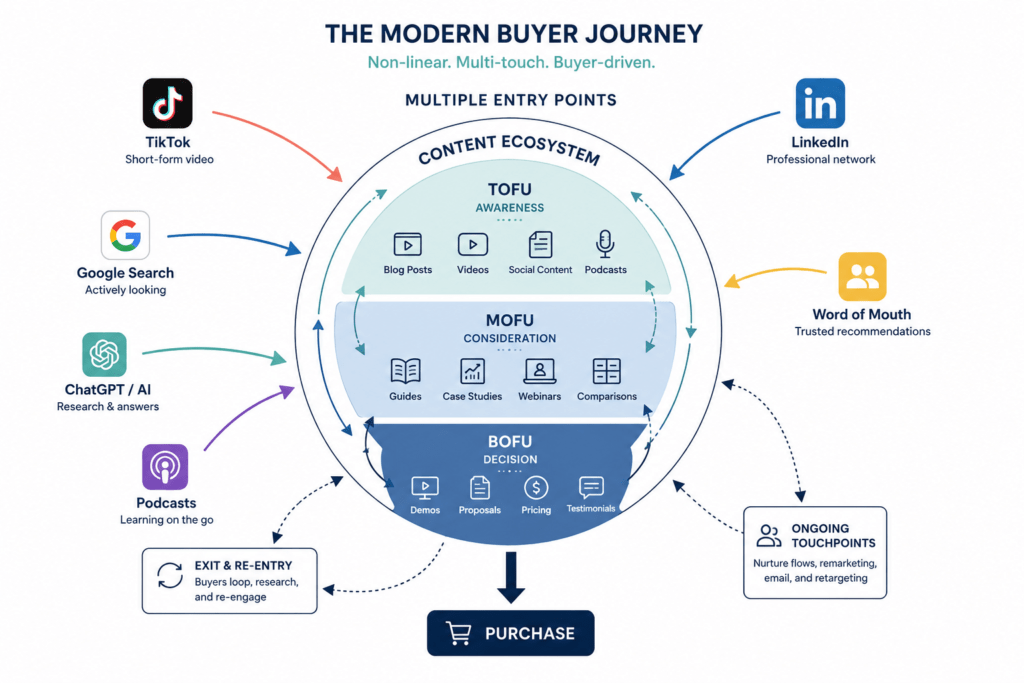
What has changed is the complexity of the journey between awareness and decision. Modern buyers discover via TikTok, compare via ChatGPT, read Reddit reviews, consume a podcast episode, then convert through branded search — in no fixed order.
That non-linearity is why funnel thinking needs a slight reframe in 2026. The traditional model describes a fixed sequence. Modern buyers don’t follow sequences. They navigate a landscape, touching your content, your competitors’ content, third-party reviews, and AI-generated comparisons in whatever order their attention and intent take them.
The practical implication: use funnel stages as descriptions of intent level and content purpose — not as descriptions of a buyer’s journey sequence. A piece of TOFU content serves awareness-stage intent, whether the person reading it is a first-time visitor or a considering prospect who circled back. The framework is a planning and measurement tool. It’s not a pipeline.
That framing matters because it changes what you optimise. You’re not optimising a linear journey. You’re optimising a content and conversion ecosystem where prospects with different intent levels can find the right material, wherever they happen to enter.
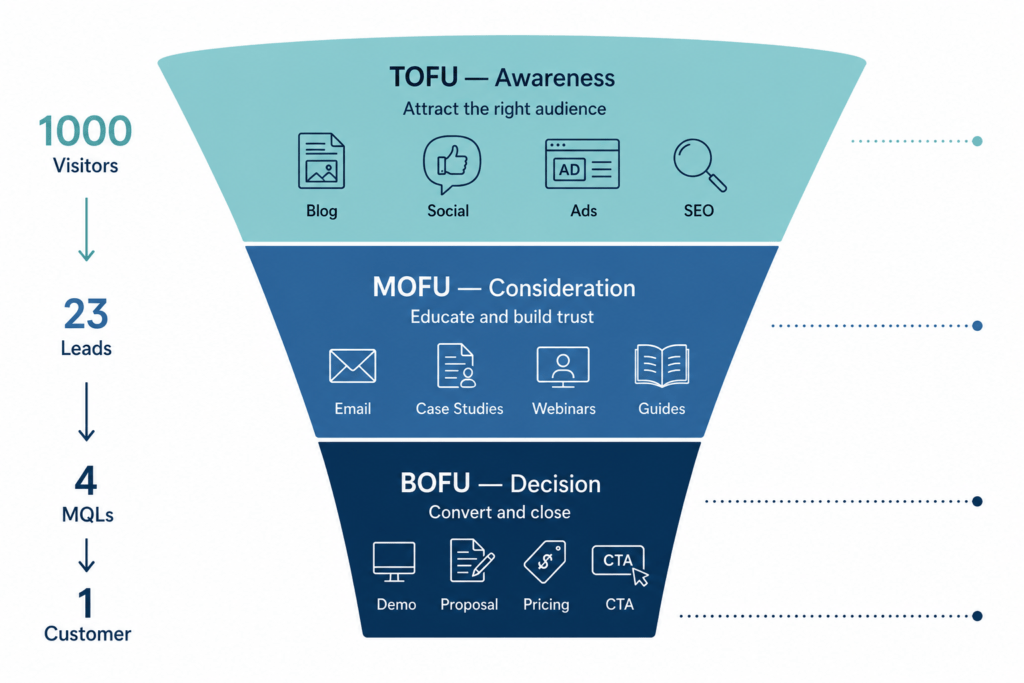
The Three Funnel Stages: What They Are, What They Need, and What They Measure
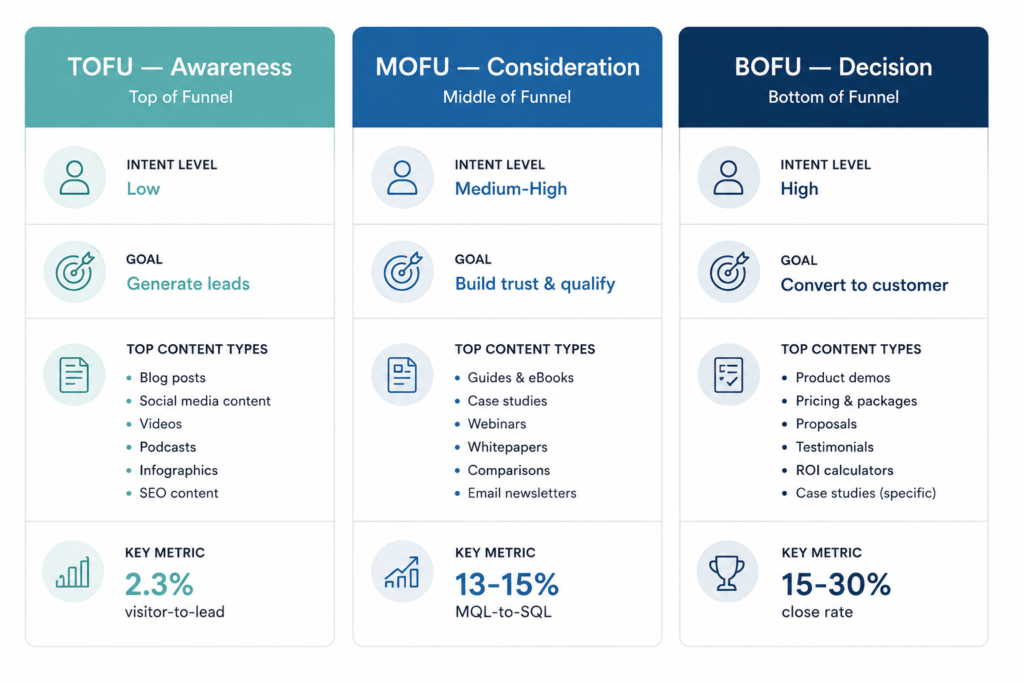
TOFU — Top of Funnel: Awareness
What’s happening: Prospects are becoming aware of your brand, your content, or the problem you solve. They may not know they have the problem you solve, or they may know the problem but not know you exist. They’re early in their research, broad in their thinking, and not ready to be sold to.
The goal: Generate qualified traffic and convert a portion of it into leads (email subscribers, lead magnet claimants, followers).
What this stage needs:
Content that earns attention by being genuinely useful or genuinely interesting to your target audience, without asking for anything in return. Blog posts that rank for the questions your ideal customers are asking. Short-form video that introduces your perspective on a problem. Social content that builds familiarity. Podcast appearances that reach audiences already in your category. Paid advertising that drives traffic to your lead magnet.
The keyword for this stage is relevance. The goal isn’t the biggest audience — it’s the most relevant one. Traffic that doesn’t match your ICP is expensive to nurture and rarely converts to revenue.
TOFU metrics to track:
- Organic traffic volume and trend
- Traffic source breakdown (SEO, paid, social, referral)
- Visitor-to-lead conversion rate (B2B average: 2.3%)
- Lead magnet claim rate
- Cost per lead by channel
TOFU content types that work in 2026:
SEO blog posts targeting awareness-stage search queries. Short-form video (Reels, TikTok, LinkedIn native video) that introduces your perspective. Lead magnets — guides, checklists, templates, assessments — that give real value in exchange for an email address. Podcast appearances. LinkedIn and Instagram organic content. Paid social and PPC driving to dedicated landing pages.
B2B buyers conduct an average of 12 searches before engaging with a specific brand’s site. Being visible across those searches requires consistent TOFU content investment over time — not a single launch campaign.
MOFU — Middle of Funnel: Consideration
What’s happening: Prospects know they have a problem, they’re actively researching solutions, and they’re comparing options. They’ve heard of you — possibly downloaded something from you or followed you on a platform — but they haven’t committed. They’re evaluating fit.
The goal: Build trust, demonstrate specific competence, and move prospects from generally interested to specifically qualified.
TOFU gets traffic investment. BOFU gets conversion optimisation investment. MOFU is chronically underfunded. This is the most consistent funnel failure pattern we see across business of all sizes.
Most businesses invest heavily in generating top-of-funnel leads (advertising, SEO, social) and then invest in converting their best bottom-of-funnel opportunities (sales team, proposals, demos). The middle — where trust is built, objections are addressed, and intent is established — is frequently a gap. Leads enter, receive a generic email drip, and either convert by chance or quietly disengage.
The companies that compound their funnel ROI are the ones that treat the middle as the most commercially important stage to build well.
What MOFU needs:
Dynamic content paths tailored to behaviour improve MQL qualification by 37% versus date-based drip sequences. This is the core principle: MOFU content should respond to what the prospect is doing, not follow a pre-set calendar.
A prospect who downloaded your guide three weeks ago and has visited your pricing page twice is not at the same intent level as a prospect who downloaded the guide and opened one email. Treating them identically wastes both marketing and sales resources.
Behaviour-triggered email sequences based on what a prospect is actually doing. Case studies from relevant industries or company types that mirror the prospect’s situation. Webinars that go deeper on the problem and solution. Comparison guides that help prospects evaluate options (including competitors) with honesty. Detailed guides and frameworks that establish your methodology.
MOFU metrics to track:
- Email open rate, click rate, and engagement trend
- Case study views and guide downloads
- Webinar attendance and replay views
- Pages visited per session and time on site
- MQL volume and MQL quality (% that become SQLs)
The benchmark that matters most: The average MQL-to-SQL conversion rate is 13–15% for most B2B businesses. Top performers achieve 39–40%. The gap between those numbers is almost entirely explained by MOFU investment — specifically, the quality of nurture content and the sophistication of lead scoring.
BOFU — Bottom of Funnel: Decision
What’s happening: Prospects are ready to buy. They’ve built enough trust and understanding to commit, but they need one final confidence-builder. They’re comparing final shortlisted options, justifying the decision internally, or waiting for a commercial trigger (the right price, the right timing, the right framing of the ROI).
The goal: Convert qualified, high-intent prospects into paying customers — with the right offer, the right timing, and the right removal of final objections.
What BOFU needs:
Tailor BOFU content by role, industry, and behaviour so buyers trust you more than the other tabs they have open. BOFU content isn’t generic. It’s precisely targeted to the prospect’s specific situation, role, and hesitation.
A Director of Operations evaluating your workflow automation software has different BOFU needs than a Head of Finance evaluating the same product. The Director needs to see how it integrates with their existing tech stack and what the implementation effort looks like. The Finance leader needs the ROI case and the risk-of-not-buying argument.
BOFU content that works: product demos tailored to the prospect’s industry use case. ROI calculators that let the prospect input their own numbers and see the case for themselves. Pricing pages that are honest and clear. Detailed testimonials and case studies from companies that match the prospect’s profile. Proposal templates. Direct sales outreach from a person, not an automation sequence. Free trial offers for self-service-ready buyers.
BOFU metrics to track:
- SQL-to-opportunity rate
- Opportunity-to-closed-won rate (B2B average: 15–30%)
- Average deal size
- Sales cycle length
- Win/loss ratio and loss reason analysis
Step 1: Define Your Ideal Customer Profile Before You Build Anything
The most expensive funnel mistake is building a funnel before you know precisely who it’s for. Generic funnels for broad audiences produce generic results — low-quality leads, poor nurture engagement, and BOFU conversations that go nowhere because the prospect was never the right fit to begin with.
Your Ideal Customer Profile (ICP) answers these questions:
Firmographic (B2B): What company size, industry, revenue range, and growth stage? What is the prospect’s role and seniority level? What tech stack do they use?
Psychographic: What goals are they pursuing that your solution supports? What problems are they experiencing that your solution solves? What does their current approach cost them — in time, money, or opportunity?
Behavioural: What content do they consume? What questions do they search for? Where do they spend time online? What would make them research solutions like yours today rather than next quarter?
Document the answers. Then use them to evaluate every content, channel, and conversion decision in the funnel. If a piece of TOFU content doesn’t attract your ICP, it’s expensive to produce regardless of its traffic volume. If a MOFU email sequence doesn’t address your ICP’s specific concerns, it has a predictably low engagement rate regardless of how well it’s written.
The ICP definition also drives the channel choices. 89% of B2B buyers conduct 12 searches before engaging with a specific brand. Knowing which searches your ICP is conducting — and which platforms they use for research — tells you where to invest TOFU resources.
Step 2: Audit Your Existing Funnel Before You Build New Assets
Before creating new content, map what you already have against the three funnel stages. Almost every business has more content than it thinks — the problem is usually not volume, but distribution and purpose alignment.
The content audit process:
Export your CMS and identify every published asset — blog posts, guides, landing pages, video content, webinars, case studies. For each piece, ask: what stage of the funnel does this serve? What intent level does it address? Does it have a clear next step for the visitor?
Map against TOFU, MOFU, BOFU. In most audits, the distribution looks like this: heavy TOFU (lots of blog posts), light-to-empty MOFU (some email templates, few case studies), moderate BOFU (proposal templates, pricing page). The MOFU gap is almost universal.
The audit surfaces two things: where the gaps are (so you can fill them strategically) and what’s performing (so you can improve it rather than replacing it).
Step 3: Build Your Lead Magnet — The Gateway From TOFU to MOFU
The lead magnet is the bridge between awareness and nurturing. It’s the value exchange where a prospect becomes a lead — giving you their email address or contact details in exchange for something genuinely useful.
The lead magnet that works in 2026 is specific, fast to consume, and directly useful to your ICP at the awareness stage of their journey. Not a 50-page ebook that takes a week to read — a focused tool, checklist, guide, or assessment that solves one specific problem they have right now.
50% of leads aren’t ready to buy when they first inquire about your business, product, or service. The lead magnet’s job is not to generate ready buyers — it’s to identify people with the right problem so you can nurture them toward readiness.
Lead magnet formats that convert in 2026:
Checklists and templates (highest claim rates — immediately actionable, minimal time investment). Assessments and quizzes (deliver personalised value and qualify the lead simultaneously). Mini-guides on a specific, narrow topic. Webinar access or a recorded training session on a problem your ICP is actively facing. Free tools, calculators, or audit frameworks.
Build a dedicated landing page for each lead magnet — not a generic “resources” page. The landing page should have a specific benefit-led headline, three to four bullet points describing what the prospect gets, a minimal form (email address for most cases), and zero navigation. Every lead magnet deserves its own landing page because each one speaks to a specific segment of your audience.
Step 4: Build the Email Nurture System — The Heart of MOFU
The email nurture sequence is where most marketing funnels either compound value or collapse into irrelevance. Getting someone on your list is the beginning, not the result. What happens next determines whether you’re building a pipeline or a list of strangers who vaguely remember downloading something once.
Email marketing remains a potent tool for driving conversions, with pages receiving traffic from email campaigns achieving an average conversion rate of 13%. AI-enhanced nurture programmes — which adapt email timing, content format, and offer type in real time based on individual engagement signals — convert leads at an average rate of 14.3%, compared to just 2.1% for static, time-based drip sequences.
That gap — 14.3% versus 2.1% — is the commercial case for behaviour-triggered nurture over date-based drips. It’s not a marginal difference. It’s a 7x performance gap driven entirely by whether your nurture responds to what the prospect is doing versus what the calendar says.
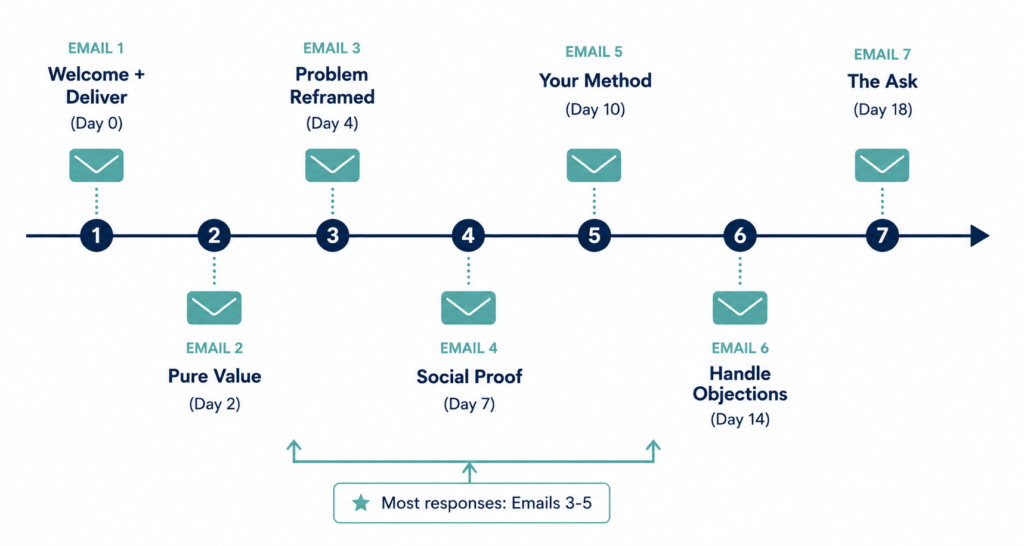
The seven-email nurture sequence framework:
Most responses come from emails 3–5, not email 1. The cadence matters as much as the copy.
Email 1 — Welcome and deliver: Immediate send on signup. Deliver the lead magnet. Set expectations for what comes next. One sentence on what you do and who you help.
Email 2 — Value, not pitch (Day 2): A useful insight, observation, or piece of content directly relevant to the problem that brought them to you. No ask. Pure value.
Email 3 — The problem reframed (Day 4): Articulate the problem your ICP is facing at a deeper level than they may have considered. Show you understand their situation. End with a gentle pointer to a relevant resource (case study, guide, webinar).
Email 4 — Social proof (Day 7): A specific case study or customer story from a business that matches the prospect’s profile. Quantified outcome. Named source. The goal is “that sounds like us.”
Email 5 — Educational depth (Day 10): Your methodology, your framework, or your approach to solving the problem — explained specifically. This is where you differentiate from generic alternatives. What do you do differently, and why does it matter?
Email 6 — Objection handling (Day 14): Address the most common reason people in your ICP’s position don’t take the next step. Is it budget? Timing? Uncertainty about fit? Address it directly and honestly.
Email 7 — The ask (Day 18): A clear, specific invitation to take the next step — book a call, start a trial, attend a webinar, request a proposal. Make the ask concrete and low-friction.
After the seven-email welcome sequence, segment based on engagement. High engagers (opened multiple emails, visited key pages) move into a higher-cadence MOFU sequence. Low engagers drop to a monthly re-engagement cadence.
Automated campaigns demonstrate 2,361% higher sales funnel conversion rates than traditional campaigns. Automated emails drove 37% of all campaign sales while making up only 2% of sends.
Step 5: Implement Lead Scoring — Stop Treating All Leads the Same
44% of sales reps never follow up with a lead at all. Of those who do follow up, many pursue cold leads while qualified prospects sit uncontacted. Lead scoring solves both problems — it identifies who deserves immediate sales attention and ensures resources aren’t wasted on prospects who aren’t ready.
Improving MQL-to-SQL conversion by just 5 percentage points can lift total revenue by up to 18%. That improvement comes primarily from better lead qualification — not more leads.
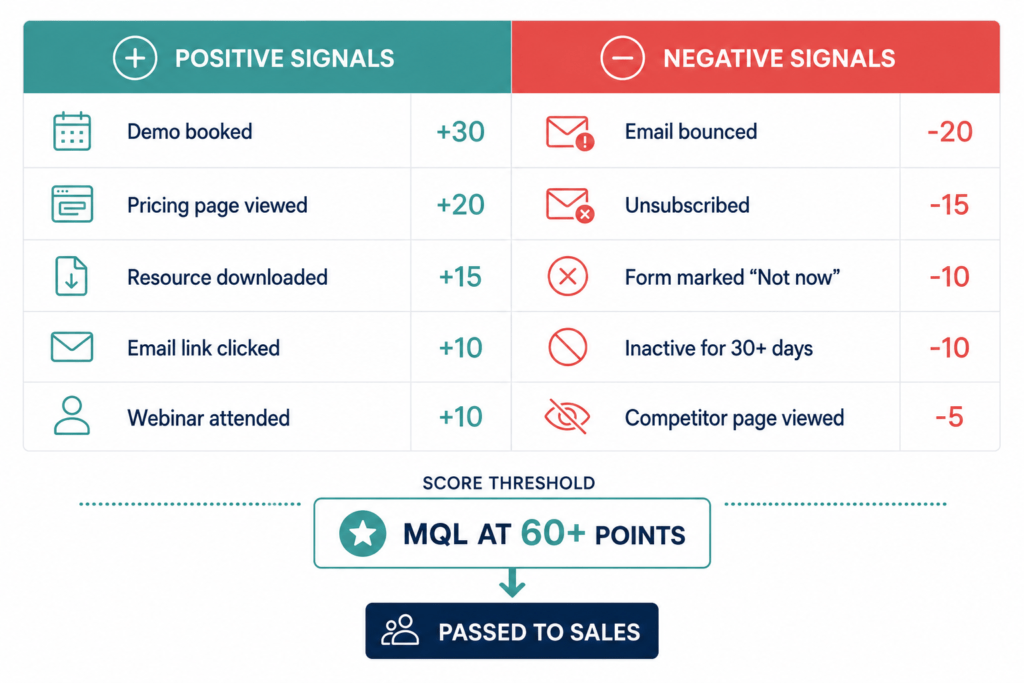
The lead scoring framework:
Assign numerical point values to two categories of signal:
Fit signals (who they are):
- Job title matches your primary buyer persona: +20 points
- Company size in your target range: +15 points
- Industry matches your ICP: +15 points
- Company revenue in your target range: +10 points
- Geographic fit: +10 points
Behaviour signals (what they’re doing):
- Booked a demo or consultation: +30 points
- Visited pricing page: +20 points
- Downloaded a BOFU asset (ROI calculator, comparison guide): +20 points
- Attended a webinar: +15 points
- Opened 3+ emails in sequence: +10 points
- Visited core service/product pages: +10 points
- Downloaded a MOFU asset: +8 points
- Downloaded a TOFU lead magnet: +5 points
Negative signals (reduce confidence):
- Email bounced: -20 points
- Unsubscribed from sequence: -15 points
- Competitor domain email address: -30 points
- Student or academic email domain: -20 points
- No engagement in 60 days: -10 points
Lead scoring without penalty signals inflates your MQL count. Negative signals keep the score meaningful and prevent sales from chasing irrelevant leads.
Set your MQL threshold — the score at which a lead is handed to sales — based on your own data rather than a generic number. Start with a threshold that your sales team agrees signals genuine intent, review the quality of leads passing that threshold monthly, and adjust as you accumulate data.
The critical alignment step: Define your MQL criteria jointly with sales. Poor MQL-to-SQL rates usually trace back to misaligned definitions of “qualified,” not lead quality. Marketing scores by demographics; sales disqualifies by fit. Rebuilding MQL criteria jointly with a shared view of lost-deal data is one of the highest-leverage alignment activities available.
Step 6: The Content Strategy by Funnel Stage — What to Create and When
Content is the engine of every funnel. But content without stage alignment is expensive to produce and unreliable in performance. Here’s the content strategy that works at each stage in 2026.
TOFU Content: Attract and Convert to Lead
The objective is to attract qualified traffic and give visitors a reason to exchange their contact details for something valuable.
Content types with the strongest TOFU performance:
SEO blog posts targeting the questions your ICP searches at the awareness stage. Not “what is [your product]?” — that’s vendor-focused. Instead: “how to solve [their problem],” “why [common approach] isn’t working,” “[industry] benchmark report.”
Short-form video on LinkedIn, Instagram, and TikTok demonstrating your perspective on problems your ICP faces. B2B marketers consider videos (58%) as the most effective content type — and video’s advantage extends across the funnel, but it’s particularly powerful at TOFU for reach.
Podcast guest appearances that reach audiences already interested in your category. These reach prospects who haven’t searched for you — awareness-stage content in the truest sense.
The lead magnet as TOFU conversion mechanism: Every TOFU channel should point toward a lead magnet with a dedicated landing page. The lead magnet converts visitors into contacts — moving them from TOFU to MOFU.
MOFU Content: Build Trust and Qualify Intent
MOFU content must do two things: build specific trust in your approach, and reveal enough about what working with you involves that the prospect can self-qualify.
Content types with the strongest MOFU performance:
Case studies — specifically structured to resemble the prospect’s situation. The challenge they faced, the solution applied, the measurable outcome. Quantified results. Named attribution wherever possible. B2B marketers consider case studies (53%) as one of the most effective content types, and case studies are the top format B2B marketers plan to increase investment in during 2026.
Webinars on specific problems your ICP is trying to solve. Webinars offer something blogs can’t — the perception of real-time expertise demonstration. 38% of companies in software, healthcare, financial services, and consulting plan to increase webinar budget.
Email nurture sequences (as detailed above) — the most scalable MOFU content format.
Comparison guides that help prospects evaluate your solution against alternatives. These work because mid-funnel prospects are actively comparing — a guide that helps them do so honestly, with clear criteria, positions you as confident and credible.
Detailed methodology content — explaining your approach, your framework, your process. The prospect who understands how you work is far better qualified than the one who only knows what you sell.
BOFU Content: Convert Ready Buyers
BOFU is not the place for generic content. Every piece should be precisely calibrated to the specific prospect’s situation, role, and remaining hesitation.
Content types with the strongest BOFU performance:
Product demos tailored to industry or use case. A generic product demo converts significantly worse than one that shows the specific workflow relevant to the prospect’s business.
ROI calculators and diagnostic tools. Interactive tools that let the prospect input their own numbers and see personalised results are the highest-converting BOFU content format. The Belkins ROI Calculator case study (from our Landing Page article) shows 30% of total website conversions coming from a single interactive BOFU tool.
Pricing pages that are honest and specific. Opacity about pricing is one of the most common BOFU conversion killers — prospects who can’t get a sense of investment level before a sales conversation often self-select out before making contact.
Free trials for self-serve products. Direct outreach from a specific person on the sales team for complex B2B sales.
Step 7: Set Up Funnel Measurement — Know Where Your Leads Are Leaking
A funnel without measurement is expensive guessing. The businesses that compound their funnel ROI over time are the ones that know, at every stage, exactly where leads are progressing and where they’re dropping off.
The measurement framework by stage:
TOFU metrics:
- Monthly organic traffic (trend over time, not point-in-time)
- Traffic-to-lead conversion rate by channel
- Cost per lead by channel
- Lead quality score distribution from each channel
SEO-generated leads achieve 51% MQL-to-SQL conversion versus 26% for PPC. SEO produces 2.5x more SQLs per visitor, yet most B2B companies spend more on paid than organic. This channel quality data changes how you should allocate TOFU budget.
MOFU metrics:
- Email open rate, click rate, and engagement by sequence
- Content consumption depth (pages per session, time on site for key MOFU assets)
- MQL volume and velocity
- MQL-to-SQL conversion rate (the most important MOFU metric)
BOFU metrics:
- SQL-to-opportunity rate
- Opportunity-to-closed-won rate
- Average deal size
- Sales cycle length
- Win/loss ratio with loss reason categorisation
The unified dashboard principle: Build a single reporting view that connects stage metrics — so that a decline in closed-won rate can be traced backward to identify whether the root cause is in BOFU conversion, MOFU quality, or TOFU lead profile mismatch. Without this connection, teams optimise in silos and miss the real bottlenecks.
Step 8: The Monthly Funnel Review — How to Use Data to Improve
Data without a review process produces expensive reports that nobody acts on. The funnel review structure that drives continuous improvement:
Monthly: Stage performance review (60 minutes)
For each funnel stage, answer three questions: Did the input metric (traffic, leads, MQLs) grow or decline compared to last month? Did the conversion rate (visitor-to-lead, lead-to-MQL, MQL-to-SQL) improve or decline? What is the primary hypothesis for the change?
Identify the single stage with the largest conversion rate gap versus benchmark or versus the previous month. That’s your optimisation priority for next month.
Quarterly: Full funnel retrospective (half day)
Review the channel mix — which sources are producing the highest MQL-to-SQL conversion rates? Review content performance — which MOFU assets are generating the most engagement and MQL progression? Review lead scoring thresholds — are the right leads reaching sales at the right time? Review the ICP definition — has the market shifted? Are you attracting the right prospects?
The rule that prevents optimisation paralysis: Fix one stage at a time. Every misalignment in your funnel equals lost revenue. But trying to fix everything simultaneously produces no signal about what worked. Choose the stage with the worst performance, fix it, measure the impact, then move to the next stage.
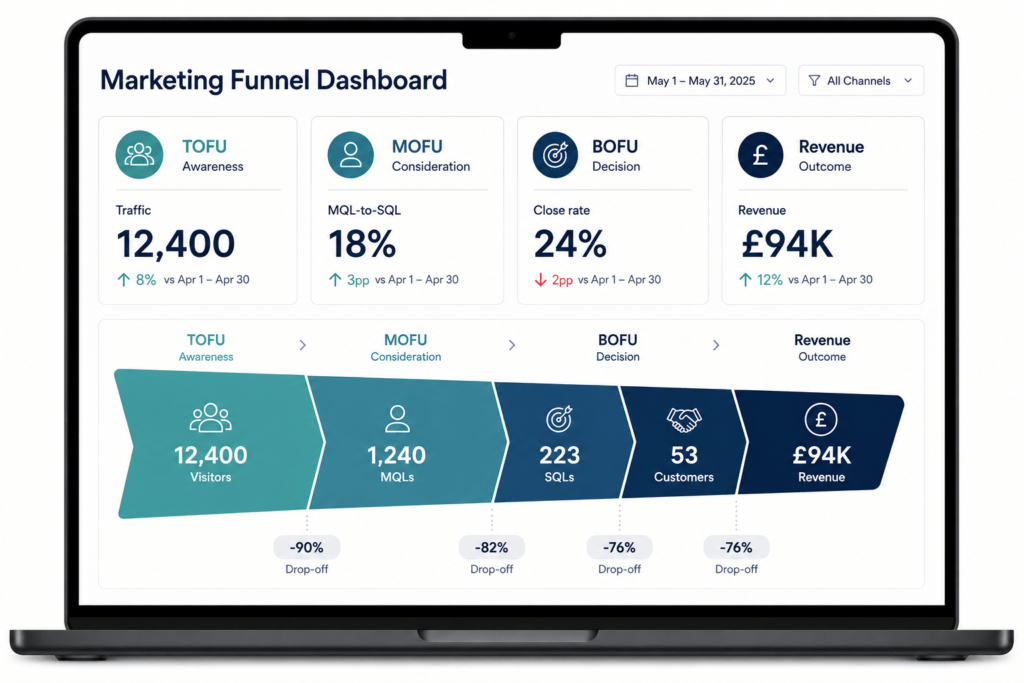
Common Funnel Mistakes That Cost Revenue
These are the failure patterns that appear most consistently — across businesses of all sizes, in all industries, at all stages of funnel maturity.
Building from the top down instead of the bottom up. Most businesses build TOFU first (content, advertising) and then figure out the rest later. The most effective approach reverses this: start at BOFU and work backwards. What does a ready-to-buy prospect need to commit? Build that. What does a considering prospect need to trust you? Build that. What kind of prospect, specifically, do you want to attract? Build TOFU to reach them.
Treating all leads identically. One-size-fits-all sequences are why your nurture programme feels like a graveyard. Not all leads have the same intent, the same fit, or the same timing. A prospect who downloaded a checklist eight months ago and a prospect who attended your webinar last week are at completely different readiness levels. Treating them to the same email cadence produces mediocre results for both.
Ignoring MOFU entirely. TOFU gets traffic investment. BOFU gets conversion optimisation investment. MOFU is chronically underfunded. The consequence is a funnel that generates many leads and converts few — not because the leads are bad, but because the nurturing infrastructure to mature them into qualified prospects doesn’t exist.
Misaligned MQL definitions. Poor MQL-to-SQL rates usually trace back to misaligned definitions of “qualified,” not lead quality. Marketing scores by demographics; sales disqualifies by fit. If marketing is sending sales 400 leads a month and sales is converting 8 of them, the first question is whether marketing and sales have agreed on what constitutes a qualified lead. Usually, they haven’t.
Optimising the funnel but not the post-conversion experience. For SaaS businesses, treating closed-won as the end state misses 40%+ of new ARR. Expansion, upsell, and referral motions live in the loyalty and advocacy stages. The businesses that compound funnel ROI most effectively are the ones that extend the funnel framework beyond initial conversion — building the same attention to content, nurturing, and measurement into their existing customer relationships.
Not having a follow-up system. 44% of sales reps never follow up with a lead at all. Companies that excel at lead nurturing generate 50% more sales-ready leads at 33% lower cost. The funnel without follow-up is a list of missed opportunities.
Real Business Examples: What Funnel Building Produces
A B2B SaaS Company That Fixed Its MOFU and Tripled Conversions
The scenario described in this article’s opening quote is not unusual. A business generating 600 leads a month with an 8-close rate had a TOFU and BOFU infrastructure in place — paid acquisition driving leads, a sales team pursuing opportunities. The MOFU was missing.
After mapping the funnel, they found that 68% of leads tagged as MQL had consumed only one piece of content (the initial lead magnet) and received only two follow-up emails (a welcome and a product promo). The average lead had no case study engagement, no webinar attendance, and no behaviour-triggered contact.
The rebuild: a seven-email welcome sequence tailored to three ICP segments, MOFU case studies from relevant industries, a monthly industry-specific webinar as a nurturing anchor, and lead scoring that moved leads to MQL only after demonstrating multi-touchpoint engagement.
Closed deals moved from 8 to 31 per month over 90 days. Same traffic, same sales team, same offer.
A Professional Services Firm That Built Its First Funnel From Scratch
A management consulting practice had no formal marketing funnel — business came entirely through partner networks and referrals. Growth had plateaued because the referral network had reached its natural ceiling.
Starting from the ICP definition, they built: a targeted LinkedIn content programme (TOFU), a lead magnet assessment (ICP diagnostic tool), a five-email welcome sequence with two case studies and one webinar invite (MOFU), and a consultation booking page as the primary BOFU conversion.
Within six months: 340 email subscribers, 22% MQL-to-consultation rate, 8 new clients from digital marketing alone. No paid advertising. Pure funnel architecture applied to organic reach.
An E-Commerce Brand That Built a Post-Purchase Advocacy Funnel
An independent skincare brand had a reasonable acquisition funnel but poor repeat purchase rates — customers bought once and rarely returned. The brand treated the sale as the end of the funnel.
After building a post-purchase nurture sequence (product education, usage tips, review request, loyalty programme invite) and a referral mechanism (10% off for both the referrer and new customer), repeat purchase rate improved from 12% to 31% in four months. Customer lifetime value increased by 58%.
The acquisition funnel hadn’t changed. The post-conversion funnel had been built for the first time.
Expert Observations: What Separates Funnels That Compound From Funnels That Don’t
After building and optimising funnels across enough businesses to see consistent patterns, a few observations that don’t always appear in standard funnel guides:
The bottleneck is almost always MOFU, not TOFU. Every business wants more leads. Very few want to invest in the infrastructure that converts leads into qualified opportunities. The businesses generating outsized revenue from modest traffic are the ones that have taken MOFU seriously.
Behaviour-triggered sequences change everything. The move from time-based drips (“email on Day 3, email on Day 7”) to behaviour-triggered sequences (“email when they visit pricing, email when they engage with three pieces of content”) is one of the highest-leverage funnel improvements available. It requires a CRM or marketing automation platform, but the 7x performance gap is real and consistent.
Content built backwards from BOFU consistently outperforms content built from TOFU down. When you start with what a ready-to-buy prospect needs and work backwards to what builds the qualification for that decision, every piece of content has a clear commercial purpose. When you start with TOFU ideas and hope some of them lead somewhere, you produce a lot of content without a pipeline.
The funnel review is where the ROI accumulates. Building a funnel is a project. Optimising it is an ongoing practice. The businesses compounding returns from their funnels are the ones running monthly performance reviews, identifying the weakest stage, and systematically improving it. The funnel that was built 18 months ago and hasn’t been reviewed since is running at a fraction of its potential.
Future Trends: Where Marketing Funnels Are Heading in the Next 18 Months
AI-enhanced nurture will become the baseline, not the differentiator. AI-enhanced nurture programmes that adapt email timing, content format, and offer type based on individual engagement signals are already outperforming static drip sequences by 7x. As these capabilities become accessible through mainstream CRM platforms, the businesses running date-based drips will face an increasing performance gap.
AI-assisted content creation accelerates funnel coverage. The speed at which AI-assisted teams can build stage-specific content is dramatically higher than teams working without AI. This matters because funnel gaps — particularly in MOFU — exist primarily because the content is too slow to produce with traditional workflows. AI doesn’t remove the need for strategic thinking and editorial quality, but it removes the bottleneck.
The buyer journey becomes increasingly AI-mediated. Prospects comparing vendors in 2026 are increasingly using AI tools — ChatGPT, Perplexity, Google AI Mode — to do their initial research and shortlisting. Being visible and credible in AI-generated comparisons is a new TOFU and MOFU priority that most funnels haven’t been built to address. Entity authority, structured content, and consistent expert presence across external platforms are becoming funnel inputs, not optional extras.
Post-purchase funnels become commercially non-optional. For SaaS businesses, treating closed-won as the end state misses 40%+ of new ARR. For service businesses, upsell and referral motions are the highest-margin revenue available. The businesses investing in post-purchase funnel infrastructure now are building the most defensible revenue base available.
Conclusion: Build the System That Works While You’re Not Working
A well-built marketing funnel is a business system that generates qualified leads, nurtures them toward readiness, and delivers them to sales (or to a conversion mechanism) at the right moment — consistently, without requiring heroic daily effort.
Companies that excel at lead nurturing generate 50% more sales-ready leads at 33% lower cost. That’s the commercial case for building the funnel properly, not just the top of it.
Start with your ICP definition. Audit what you already have. Fill the MOFU gap before anything else. Build the email sequence. Implement lead scoring. Connect the metrics. Review monthly and fix the weakest stage.
The funnel is never finished — it compounds with every improvement cycle. But the businesses that build it deliberately, measure it consistently, and optimise it systematically are the ones that stop making guesses about why their marketing isn’t working and start making decisions based on data that tells them exactly where to look.
Ready to audit your marketing funnel? Map your current content against TOFU, MOFU, and BOFU. Identify which stages have coverage and which are gaps. Then calculate your MQL-to-SQL conversion rate — if it’s below 15%, your MOFU is the priority. If it’s above 30%, the lever is in BOFU conversion and lead scoring precision. The data will tell you where to start.
Frequently Asked Questions
Q: What is a marketing funnel? A marketing funnel maps the stages a prospect moves through from first becoming aware of your business to becoming a paying customer. It’s divided into TOFU (awareness), MOFU (consideration), and BOFU (decision). 68% of businesses have not fully defined or documented their sales funnel strategy — making funnel clarity one of the most consistently available competitive advantages.
Q: What are the stages of a marketing funnel? The three core stages are: TOFU (Top of Funnel) — awareness, where prospects first discover your brand and content; MOFU (Middle of Funnel) — consideration, where prospects evaluate your solution and build trust; and BOFU (Bottom of Funnel) — decision, where prospects are ready to buy and need the final confidence to commit.
Q: What is a good marketing funnel conversion rate? B2B visitor-to-lead conversion averages 2.3%. The lead-to-customer rate averages 2–5% across B2B industries. The MQL-to-SQL transition averages 13–15% but top performers achieve 39–40%. AI-enhanced nurture programmes convert at 14.3% versus 2.1% for static drip sequences. Funnels achieving 10%+ end-to-end are considered excellent.
Q: What content works best at each funnel stage? TOFU: blog posts, short-form video, lead magnets, social content. MOFU: case studies, webinars, email nurture sequences, comparison guides, detailed methodology content. BOFU: demos, ROI calculators, pricing pages, free trials, direct sales outreach. Case studies and video are the top two formats B2B marketers plan to increase investment in during 2026.
Q: How long does it take to build a marketing funnel? A basic funnel with defined stages, lead magnet, initial email sequence, and measurement can be designed and launched in four to six weeks. A fully optimised funnel with stage-specific content, lead scoring, and behaviour-triggered sequences takes three to six months to build and another three to six to optimise based on real data.
Q: What is lead scoring and why does it matter? Lead scoring ranks leads based on their likelihood to convert using demographic fit signals and behavioural intent signals. It matters because improving MQL-to-SQL conversion by just 5 percentage points can lift total revenue by up to 18%. Effective scoring includes both positive signals (demo request, pricing page visit) and negative signals (competitor email, unsubscribe) — scoring without penalties inflates MQL counts.
Q: Does the traditional linear funnel still work in 2026? The framework remains useful for planning content, allocating budget, and measuring performance by stage. However, modern buyers follow non-linear journeys — discovering, comparing, and consuming content in their own order across multiple platforms. Use funnel stages as descriptions of intent level and content purpose, not as a fixed sequence every buyer follows.
Q: What is the most commonly neglected part of a marketing funnel? MOFU — the middle of the funnel — is chronically underfunded in most businesses. TOFU gets traffic investment and BOFU gets conversion optimisation, while MOFU — where trust is built and intent is established — is frequently left as a gap. The consequence is a funnel that generates many leads and converts few, not because the leads are wrong but because the nurturing infrastructure to mature them doesn’t exist.