

That story is more common than it should be. Instagram is one of the most commercially underused platforms in digital marketing — not because the opportunity isn’t there, but because most businesses have optimised for the wrong outcome. They’ve built audience. They haven’t built pipeline.
This article is about the second thing.
With over 3 billion monthly active users, $42.8 billion in social commerce sales in 2025, and 71% of B2B marketers and 85% of B2C marketers now active on the platform, Instagram is no longer a question of whether to use it. The question is whether you’re using it in a way that moves people from scrolling to enquiring.
The gap between Instagram as a vanity metric machine and Instagram as a genuine lead generation channel comes down to one thing: system. Not follower count. Not content quality. Not budget. System.
Here’s how to build one.
“We had 14,000 followers, posted five times a week, and were getting incredible engagement. But we couldn’t tell you how many leads Instagram had actually generated. We tracked likes. We didn’t track leads.”
— Founder of a UK-based coaching business, strategy review call, 2025
The Problem With How Most Businesses Use Instagram
Before getting into what works, it’s worth being honest about why most Instagram strategies don’t generate leads — even when the content is genuinely good.
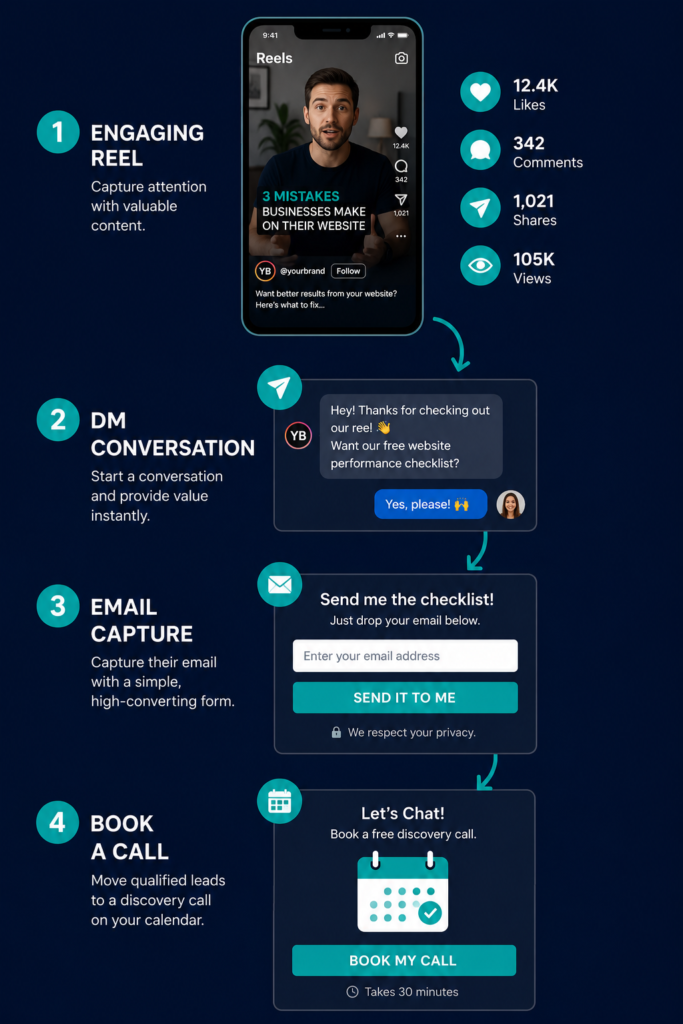
Instagram lead generation usually breaks at the handoff between attention and intent. A brand publishes Reels to drive reach, sees solid engagement, and pushes that traffic straight to a form or landing page. Platform metrics look healthy. The sales pipeline does not.
The reason this pattern repeats is structural. Instagram is primarily a discovery platform. People come to it to be entertained, educated, and inspired — not to fill in a contact form. When businesses treat Instagram like a direct-response channel and send cold audiences straight to a sales ask, conversion rates are abysmal and the whole exercise feels expensive and demoralising.
High-performing Instagram programmes separate discovery, consideration, and capture because each stage needs a different message and a different ask. Problems start when a cold viewer gets the same CTA as a warm follower who has watched Stories for two weeks and replied to a DM prompt.
That staged approach — matching your ask to where someone is in their relationship with your brand — is the foundation everything else is built on.
There’s also a measurement problem. Most businesses measure Instagram performance in social metrics: reach, impressions, follower growth, engagement rate. These matter, but they’re not lead generation metrics. Until you start measuring link clicks to lead pages, DM conversations initiated, form completions, booked calls, and revenue attributed to Instagram, you don’t actually know whether it’s working as a business channel.
Both of those structural issues — pushing the wrong ask at the wrong time, and measuring the wrong things — are fixable. Let’s fix them.
Understanding the Instagram Lead Generation Funnel
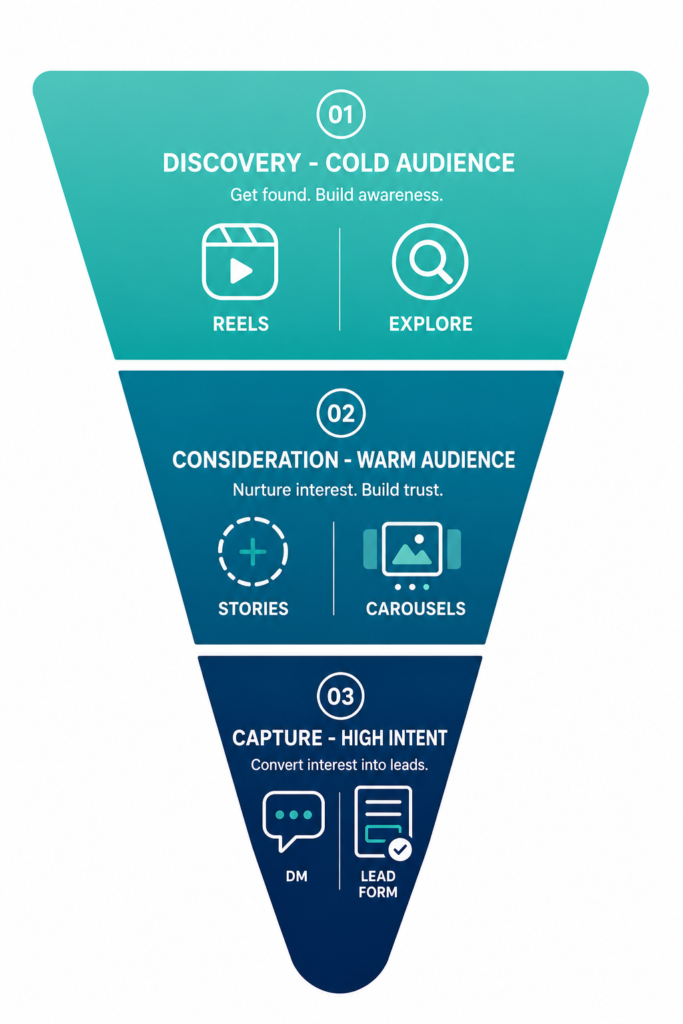
Think of Instagram as a three-stage funnel. Every strategy, every content decision, every CTA should map to one of these stages.
Stage 1 — Discovery (Cold Audience) People encountering your brand for the first time through Reels, Explore, hashtags, or shares. They don’t know you. They don’t trust you. They’re not ready to give you their contact details. The only job at this stage is to give them a reason to follow.
Stage 2 — Consideration (Warm Audience) People who follow you, watch your Stories regularly, engage with your posts, and are building a picture of what you do and whether it’s relevant to them. This is where trust is built. The job here is to deepen that trust, demonstrate expertise, and surface the problem you solve in terms your audience recognises.
Stage 3 — Capture (High-Intent Audience) People who are actively looking for a solution, are familiar with your brand, and are ready to take an action. This is where lead generation happens — where you make a specific, valuable offer and give a clear path to claim it.
The mistake most businesses make is trying to run Stage 3 tactics (lead forms, “book a call” CTAs, sales pages) on Stage 1 audiences. You can’t shortcut the trust-building stages. But if you understand the funnel, you can engineer each stage deliberately and move people through it efficiently.
Strategy 1: Optimise Your Profile as a Conversion Asset
Here’s something most businesses underestimate: your Instagram profile is a landing page. Every time someone discovers your content and clicks through to your profile, they’re making a split-second decision about whether to follow you, explore further, or leave. Most profiles fail this moment entirely.
A strong bio reads like positioning with a CTA attached. A med spa should name the treatment category and desired outcome. A realtor should specify buyers, sellers, or investors. A B2B service firm should say what business problem it solves and for whom.
The structure that converts is simple: one line explaining who you help, one line explaining the outcome you deliver, and one clear CTA with a link. “I help e-commerce founders increase repeat purchase rate → Free customer retention audit below” is a bio that converts. “Entrepreneur | Speaker | Passionate about growth 🚀” is a bio that doesn’t.
Your link in bio needs strategic treatment, not just a Linktree dump.
Many link-in-bio pages hurt conversion because they present too many equal choices. Visitors click, hesitate, and leave. For most businesses generating leads from Instagram, one primary CTA link — to a lead magnet, a booking page, or a high-converting landing page — outperforms a menu of eight options. If you do use a multi-link page, lead with the highest-priority action and treat everything else as secondary.
Highlights are your permanent sales team.
Stories disappear in 24 hours, but Highlights are persistent — and they’re the first thing a curious profile visitor explores after reading your bio. Create Highlights that serve the consideration stage: client results or case studies, your process or methodology, testimonials, FAQs about your service, and a specific Highlight promoting your current lead magnet. Create one called “Free audit” or “Client results.” Each holds short Stories with proof and a clear call to action.
Pin your best-performing lead generation post to the top of your grid.
Instagram allows you to pin up to three posts to the top of your profile. Use at least one of those positions for a post that promotes your lead magnet or demonstrates clear social proof. New profile visitors see it first, comment the keyword, and enter your DM funnel automatically. This works 24/7 as a passive lead generator.
Strategy 2: Create Content That Moves People Through the Funnel
Content is the engine of Instagram lead generation. But not all content does the same job — and building a lead generation system requires intentional content across all three funnel stages, not just content that gets views.
For Discovery (Reels): Hook fast, deliver value, trigger algorithm signals.
Reels remain the primary reach driver on Instagram in 2026. They’re how new audiences find you, and they’re what Instagram algorithmically amplifies to non-followers. The job of a Reel at the discovery stage isn’t to sell — it’s to hook someone’s attention strongly enough that they stop scrolling, watch to the end, and find their way to your profile.
The hook — the first 1-3 seconds of your Reel — determines everything. A weak hook means 90% of viewers leave before they’ve seen anything of substance. Strong hooks name a pain point, make a counterintuitive claim, or open a pattern interrupt: “The reason your Instagram isn’t generating leads has nothing to do with your content quality” is a hook. “Here are five Instagram tips” is not.
Reels with educational value that solve a real problem in under 60 seconds consistently outperform promotional content in both reach and profile visits. Teach something genuinely useful to your target audience — and the people who find it valuable are self-selecting as potential leads.
For Consideration (Carousels): Depth, proof, and positioning.
Carousel posts get 1.4x more reach than single-image posts — but more importantly, they give you multiple slides to build an argument, demonstrate expertise, and earn a save. Saves are one of the highest-value signals you can receive on Instagram: they tell the algorithm your content is worth returning to, and they put your post back in front of the saver every time they open their saved folder.
The best carousel structure for lead generation: hook slide (bold claim or question), value slides (the substance — tips, frameworks, data, insights), proof slide (result, case study, or testimonial), and CTA slide. Share educational content or a mini-guide in slides 1-9, then make slide 10 the CTA: “Want the full [resource]? Comment GUIDE below.” The value in the carousel pre-qualifies interested people before they enter your lead funnel.
For Capture (Stories): Daily presence, soft selling, and DM triggers.
Stories are where your warmest audience lives. Followers who watch your Stories regularly are already in the consideration stage — they’re familiar with you, they’re interested in what you do, and they’re open to hearing about what you offer. This is where soft CTAs work, where you can mention your lead magnet directly, and where DM automation triggers convert best.
Use polls, question stickers, and emoji sliders not just for engagement, but as qualifier tools. “Are you currently getting leads from Instagram? Yes / Not yet” is a poll that identifies where your audience is — and anyone who answers “Not yet” is a warm prospect you can follow up with in the DMs.
Strategy 3: The Comment-to-DM System — The Highest-ROI Tactic on Instagram Right Now
If there’s one strategy that has genuinely changed how Instagram lead generation works in the past two years, it’s this one. And yet the majority of businesses still aren’t using it properly.
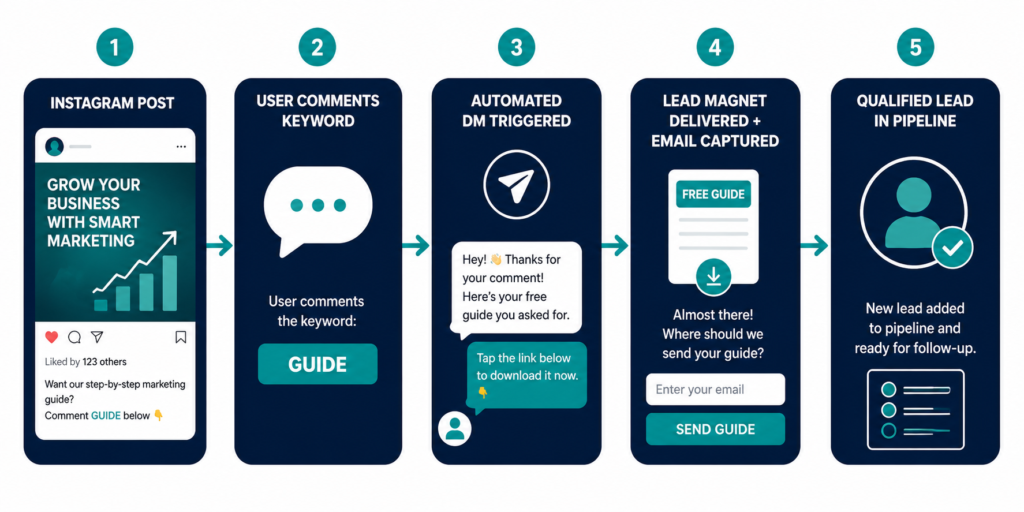
The comment-to-DM system works like this: you post a piece of content — a Reel, a carousel, a Story — and include a CTA asking people to comment a specific keyword to receive something valuable. When they comment that keyword, an automated DM is triggered that delivers the lead magnet, starts a conversation, and (optionally) captures their email address.
The most effective way to capture high-intent leads today is the “Comment-to-DM” strategy. You post a highly engaging Reel or static post and include a clear call-to-action: “Comment the word ‘GROWTH’, and I’ll send you my free guide.” When users comment, it triggers the automation. But it does something else, too: it sends a massive positive signal to the algorithm.
Here’s why this strategy is so powerful: it solves two problems simultaneously.
First, the lead generation problem. Every person who comments the keyword has self-identified as interested in your offer. They’ve taken an active step. They’re warm. Your DM automation delivers the resource instantly, starts a conversation, and gives you a direct line to a qualified prospect — inside the highest open-rate channel on any platform.
Instagram DMs get 90% open rates, compared to email’s 22% average and bio link’s 1-2% click-through rate, making DMs the highest-converting delivery channel.
Second, the reach problem. Fifty people commenting “GUIDE” in the first hour tells Instagram this content is generating real engagement — not passive views, not passive likes, but active conversations. That signal pushes the Reel further. Which brings in more viewers. Which generates more keyword comments. Which captures more leads. The lead generation mechanism and the algorithm growth mechanism are one and the same action.
How to set up comment-to-DM automation:
Tools like ManyChat (which has native Meta approval for this use case), Manychat, and similar platforms allow you to set keyword triggers on your Instagram posts. When the keyword is detected in a comment, the tool automatically sends a personalised DM to that commenter. Critically, this complies with Meta’s automation policies when the user is initiating the interaction — they comment, which constitutes opting in to receiving your message.
The DM sequence itself should do three things: deliver the promised resource immediately, provide one piece of additional value or context, and include a clear, low-friction next step (click a link, reply with a word, or answer a qualifying question). Don’t overload the first DM. One delivery, one value add, one ask.
Creators who pair strong content hooks with comment-triggered DM automation consistently report 2-3x higher comment rates than those using passive CTAs like “link in bio.”
Strategy 4: Lead Magnets That Actually Get Claimed
A lead magnet is the value exchange at the heart of your Instagram lead funnel: you offer something genuinely useful, they give you their contact details or open a conversation. The effectiveness of your entire lead generation system depends heavily on whether the magnet is compelling enough to motivate action.
The days of “Download our 50-page ebook” are over. In 2026, your lead magnets need to be quick, actionable, and easy to access.
The lead magnets that convert best on Instagram in 2026 share three characteristics: they promise a specific, tangible outcome; they’re consumable in under 15 minutes; and they relate directly to the problem your audience is trying to solve. A “Complete Guide to Digital Marketing” is too broad and too effortful. A “5-Minute Instagram Bio Audit Checklist” is specific, fast, and immediately applicable.
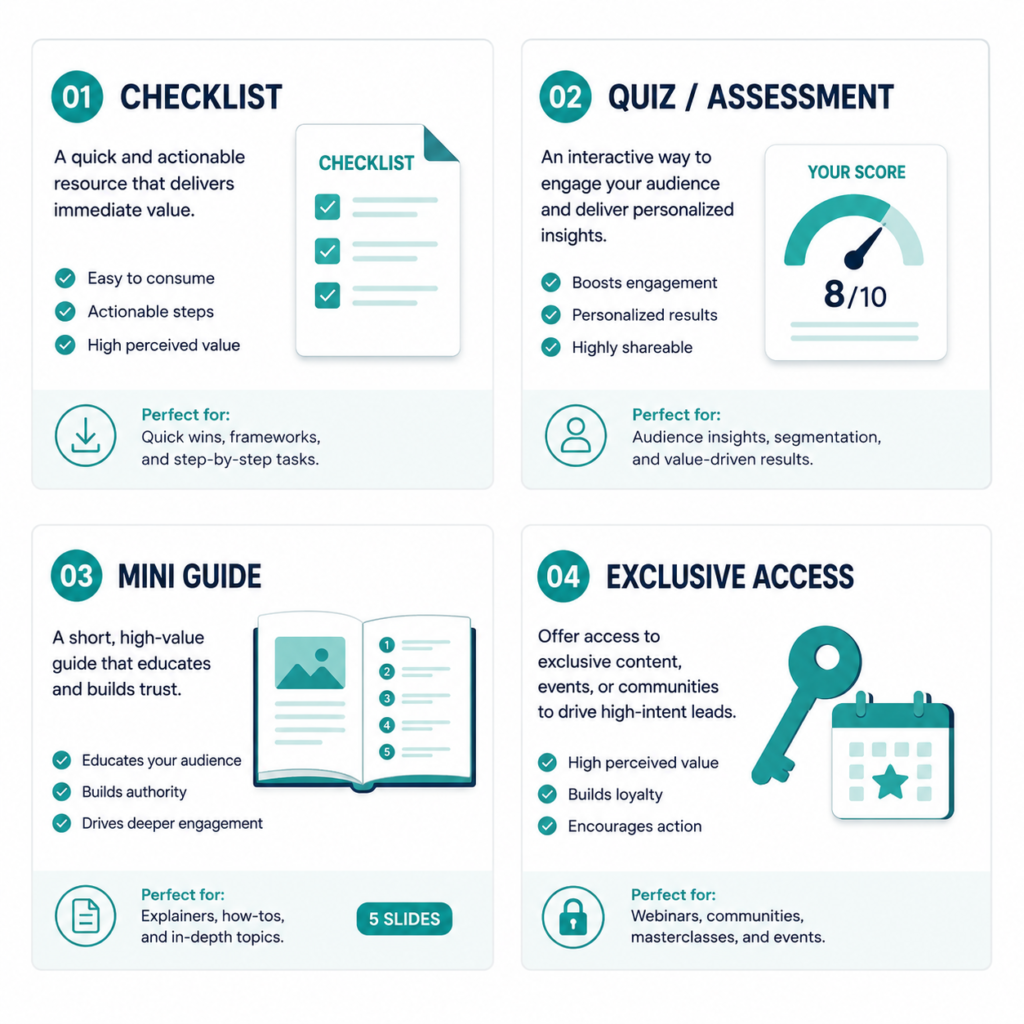
Lead magnet formats that perform well on Instagram:
Checklists and templates are the highest-converting format for most industries — they’re fast to create, easy to consume, and immediately actionable. A checklist that saves someone 30 minutes of work has obvious value. A template that removes a task they’ve been putting off has even more.
Quizzes and assessments work particularly well for service businesses because they qualify the lead at the same time as delivering value. “What’s your Instagram lead generation score?” as a quiz gives the user something personalised and useful — and tells you where they are in their buying journey before you’ve had a single conversation.
Mini-guides (5-10 pages, not 50) on a very specific topic — “How to Write Instagram Hooks That Stop the Scroll” rather than “The Complete Guide to Instagram Marketing” — outperform broad guides because they promise and deliver on a specific outcome.
Exclusive access — to a free live training, a private community, an early-access offer — converts well when your audience already trusts you, because the perceived value is high and the mechanism is immediate.
The delivery mechanism matters as much as the magnet itself.
Delivering lead magnets directly inside the DM conversation — rather than via a separate landing page — consistently produces higher completion rates. Gated, frictionless access through Instagram’s native lead forms or DM automations — no clunky landing pages required — is where the fastest-growing lead gen tactic operates in 2026. The fewer steps between “I want this” and “I have this,” the higher your capture rate.
Strategy 5: Stories That Generate Daily Leads
Instagram Stories are the most underestimated lead generation format on the platform. They’re ephemeral — gone after 24 hours — which creates genuine urgency. They reach your warmest audience first. And they support interactive elements that no other format can match.
Seven Story formats consistently drive leads: “Reply KEYWORD” Stories, poll stickers, question stickers, before/after transformations, countdown/urgency Stories, this-or-that carousels, and testimonial Stories with CTAs.
The “Reply KEYWORD” Story is the Story equivalent of the comment-to-DM strategy: you post a Story saying “Reply YES if you want my free [resource]” and anyone who replies triggers your automation. Reply KEYWORD Stories hit 5-15% reply rates with 30-40% DM click-through. For an account with 5,000 Story views, that’s 250-750 replies per Story — each of them a warm, self-qualified lead.
Poll stickers do double duty: they generate engagement that signals to the algorithm your Story is worth showing to more people, and they identify where your audience is on their problem journey. “Are you currently generating leads from Instagram?” with Yes / No options gives you segmentation data. You can then follow up directly in the DMs with the people who answered “No” — they’ve told you they have the problem you solve.
Question stickers invite your audience to ask you something, which gives you content ideas and opens DM conversations with your warmest followers simultaneously. When someone asks a specific question about your area of expertise in your Story replies, that’s a lead opportunity dressed up as a content interaction.
The consistency principle for Stories:
Posting Stories daily — or at minimum five days a week — keeps you visible to your warmest audience in a way that feed posts don’t. Followers who watch your Stories regularly are in an almost unique relationship with your content: they’re giving you micro-attention every day, building familiarity and trust in a way that occasional feed posts can’t replicate. That daily relationship is what makes Stories the highest-converting content surface for warm-audience lead generation.
Strategy 6: Instagram Lead Ads — When to Use Paid to Accelerate
Organic Instagram lead generation is powerful, but it takes time to build. Paid ads can accelerate every stage of the funnel — if they’re used at the right stage and with the right offer.
The single most common paid Instagram lead generation mistake is running lead forms to cold audiences. Cold traffic doesn’t trust you yet. Showing someone a “Book a free consultation” lead form ad when they’ve never encountered your brand is like proposing on a first date.
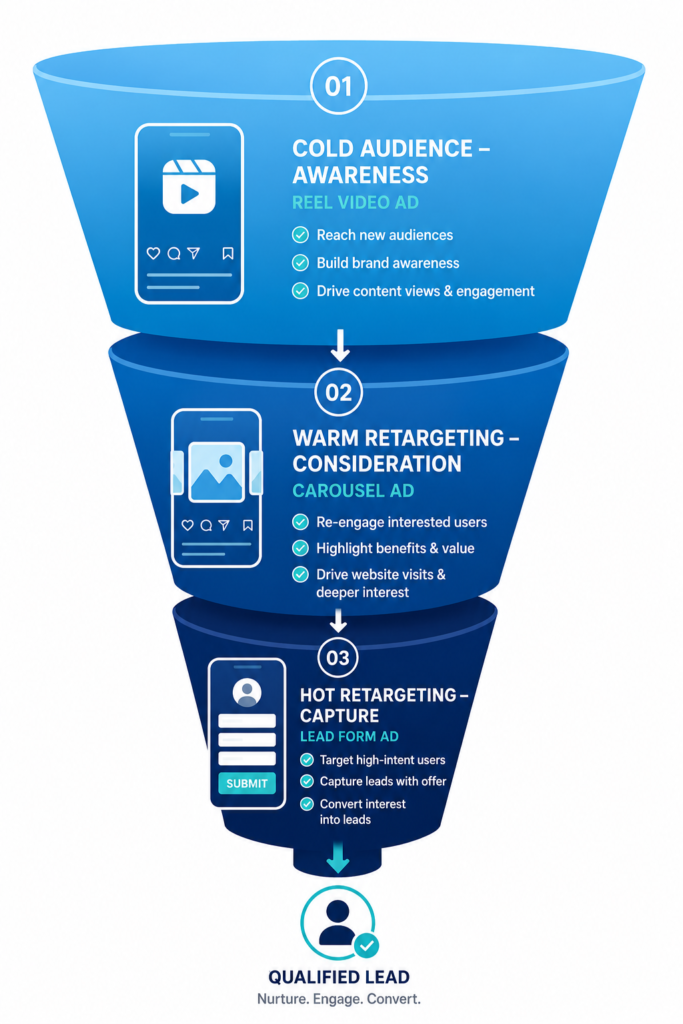
The three-layer approach that works: Layer 1 — run reach or video views campaigns to cold audiences. The goal is not leads — it is building a retargeting pool of people who watched 50%+ of your video or engaged with your profile. Layer 2 — retarget engaged users with educational content that positions your offer. Layer 3 — serve lead form ads or conversion-optimised campaigns to the warmest segment — people who visited your site, engaged with multiple pieces of content, or added to cart.
This layered approach means you’re only spending on lead form delivery — the most expensive conversion event — to people who have already demonstrated genuine interest through multiple touchpoints. Your cost per qualified lead drops significantly, and the quality of leads that come through is dramatically better.
Instagram Instant Forms vs. landing pages:
Instagram’s native Instant Forms capture lead information without requiring users to leave the app — which means higher form completion rates, because friction is minimal. The tradeoff is lead quality: lead form ads generate higher volume but lower quality than landing page conversions — run both and compare cost per qualified lead.
For lower-commitment offers (free resources, webinar sign-ups, quote requests), Instant Forms typically win on volume and cost. For higher-commitment conversions (consultations, demos, high-value purchases), landing pages with more persuasive copy often produce better-qualified leads despite lower raw numbers.
Speed of follow-up is a conversion multiplier you control entirely.
Responding within 1 minute increases conversions by 391% compared to a 30-minute delay. This is one of the most dramatic conversion rate improvements available in any marketing channel — and it requires no creative, no budget, no algorithm. Just response speed. Use automation to send an immediate acknowledgement for every lead form submission, followed by a human follow-up within the hour.
Strategy 7: DM Outreach Done Right
Proactive DM outreach is the most direct path to a conversation with a potential lead — and the most easily ruined by doing it wrong. The line between strategic outreach and spam is thinner than most businesses think, and crossing it doesn’t just fail to generate leads: it actively damages your brand.
The outreach that works starts with content. When you’ve been posting consistently, someone who engages with your content multiple times — likes several posts, watches Stories regularly, saves a carousel — is signalling genuine interest. A personalised DM to that person that references their engagement specifically is not cold outreach. It’s a warm continuation of an existing relationship.
The approach that works: engage from content, personalise the opener, ask one pain-focused question, tag by need or industry, offer a next step (demo or call), and log stages and notes in a CRM for timely follow-ups.
The opener is everything. “Hey, I noticed you’ve been following my content on [topic] — curious whether [specific pain point] is something you’re dealing with right now?” is a DM that opens a conversation. “Hi! I’d love to connect and see if there’s any synergy between our businesses 😊” gets ignored or blocked.
One question per outreach message. One. The purpose of your first DM is not to close a sale or even book a call — it’s to start a genuine conversation. A single, thoughtful, pain-focused question that demonstrates you’ve paid attention to who they are gives the other person something to respond to without feeling interrogated.
Track your DM conversations in a CRM.
As your outreach scales, the conversations happening in your DMs become a sales pipeline. Without a system to track where each conversation is, which leads need a follow-up, and which ones are ready for a next step, things fall through the cracks. Connect Instagram DMs to a CRM (HubSpot, folk, Pipedrive) either natively or through a tool like Zapier, so every meaningful conversation is logged and followed up consistently.
Strategy 8: Build Your Email List Through Instagram
Here’s the strategic principle that separates Instagram lead generation that builds a real business asset from Instagram lead generation that builds only an Instagram presence: always be capturing email addresses.
DMs are the highest-converting delivery channel on Instagram, but email lists are owned assets — you control the data. If your account is restricted, you lose DM access. Your email list is yours regardless of what Meta decides tomorrow.
Every lead generation mechanism on Instagram — your lead magnet, your DM automation, your Instant Forms — should include a step that captures an email address. Not as a barrier, but as part of the value exchange: “I’ll send you the full resource to your email — what’s the best address?”
Email capture from DMs converts at 30-50%. Asking for email directly inside the DM conversation outperforms landing page capture because it stays within the conversation flow.
Think of Instagram as the top of your lead generation funnel and email as the middle. Instagram creates the initial contact and delivers the first value exchange. Email creates the nurture sequence, the trust-building, and the repeated touchpoints that ultimately move someone to a buying decision. The two channels complement each other completely — and building both simultaneously from your Instagram activity is one of the highest-leverage activities in digital marketing.
Common Mistakes That Kill Instagram Lead Generation
These are the patterns that consistently prevent businesses from converting Instagram audiences into leads, regardless of content quality or follower count.
Sending everyone to the same link. Your bio link goes to your homepage. Your homepage is built for everyone. A high-converting lead generation page is built for someone specific, with one job and one CTA. The mismatch kills conversion rates. Send Instagram traffic to a dedicated page that speaks directly to the audience coming from Instagram and offers them something they actually want.
Confusing content performance with lead generation. A post can win distribution and still pull in the wrong audience. Viral reach often creates more filtering work for sales, not better demand. Measure leads generated, not reach achieved. A Reel that gets 50,000 views and generates three DM conversations from relevant prospects is less valuable than a Reel that gets 5,000 views and generates 40 keyword comments from people who match your ideal customer profile.
Giving up too early. Instagram lead generation compounds over time. The first month of implementing a comment-to-DM strategy, consistent Stories, and profile optimisation rarely produces dramatic results — but month four and five, when the content archive is working, the automation is running 24/7, and the algorithm has started pushing your content to more non-followers, looks completely different. Most businesses quit before the compounding starts.
Posting without a content strategy. Posting whatever seems interesting whenever there’s time is not a content strategy. An audience that doesn’t know what you stand for, who you help, or what you offer can’t self-identify as a lead. Every account generating consistent leads from Instagram is publishing with intentional pillars — categories of content that collectively build a clear picture of what the brand does and who it serves.
Ignoring response speed. Responding within 1 minute increases conversions by 391% compared to a 30-minute delay. A lead that waits four hours for a response has cooled significantly. Use automation for immediate acknowledgement and set up notifications so human follow-up happens within the hour during business hours.
Real Business Examples: Instagram Lead Generation in Practice
A B2B Consultancy That Turned 3,000 Followers Into a Full Pipeline
A management consultancy with a modest Instagram following of 3,200 had never generated a verified lead from the platform. Their content was polished but generic — industry news, thought leadership, team photos. No specific audience, no clear offer, no mechanism to capture intent.
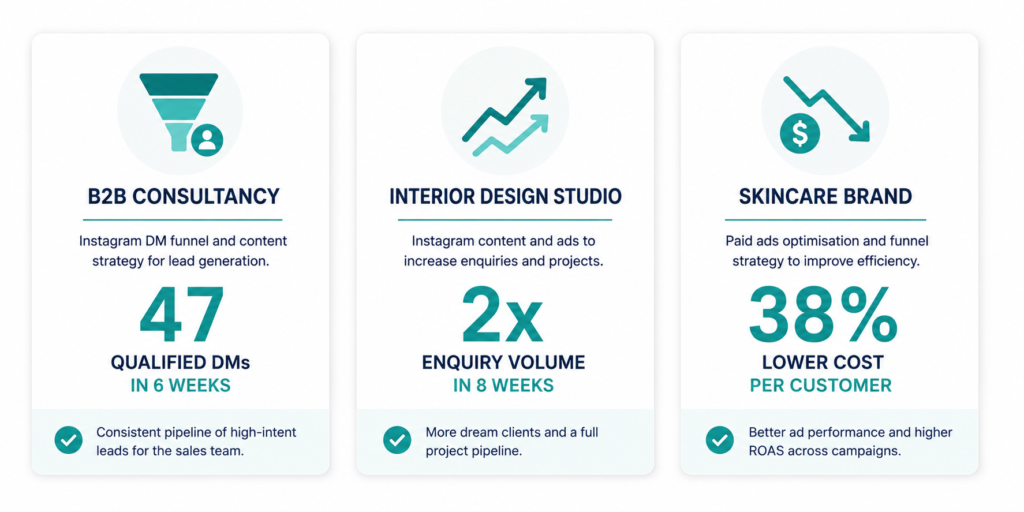
After restructuring their content around a specific niche (HR technology implementation for mid-market businesses), building a lead magnet (a “HR Tech Implementation Readiness Assessment”), and setting up comment-to-DM automation on their educational carousels, they generated 47 qualified DM conversations in the first six weeks. Eleven of those converted to discovery calls. Three became clients.
The follower count didn’t change meaningfully. The system changed.
A Service Business That Doubled Enquiries With Stories Alone
A London-based interior design studio was investing heavily in feed content — professional photography, well-designed carousels — and seeing decent engagement but no lead flow. Stories were an afterthought: a few behind-the-scenes shots per week, nothing strategic.
After implementing a daily Stories routine — including weekly “Reply YES for our project brief template” Story prompts, regular before/after reveals with a “DM us about your project” CTA, and a pinned Highlight of client transformations — enquiry volume from Instagram doubled within eight weeks. The content budget stayed the same. The Stories strategy cost nothing but time.
An E-Commerce Brand That Used the Three-Layer Paid Model
A skincare brand had been running lead form ads to cold audiences and finding the quality of leads disappointing — people who signed up for a discount code and never converted. Cost per lead looked reasonable. Cost per customer was terrible.
After restructuring to the three-layer approach — Reels for awareness, retargeting carousels with ingredient education for consideration, lead form ads only for people who had engaged with at least two pieces of content — their cost per lead increased slightly, but their cost per customer dropped 38%. The pipeline contained fewer names and more buyers.
Expert Observations: What the Data and Experience Show
A few things we’ve seen consistently across client accounts that tend to surprise people:
DM open rates make email look ineffective by comparison. DMs get approximately 88-90% open rates. Email averages around 25%. This isn’t a small advantage — it’s a fundamental difference in how likely your message is to be seen. Any offer or follow-up that can be delivered through a DM conversation should be, before it defaults to email.
Save rate is the most underrated content metric. Posts that get saved are posts that people intend to return to — which means they found something valuable enough to bookmark. Saves signal to the algorithm that your content has lasting value, which feeds distribution. And the people saving your content are some of your warmest prospects. Track saves alongside engagement rate as a content quality signal.
The “value before ask” ratio determines everything. Accounts that consistently give before they ask — educational content, practical tools, genuine expertise freely shared — find that when they do make an offer, their audience responds at dramatically higher rates. Accounts that lead with offers and sell constantly burn their audience’s goodwill quickly and find their lead conversion rates declining regardless of what they promote.
Niche specificity compounds faster than broad reach. An account that speaks specifically to one audience — “Instagram lead generation for B2B service businesses” rather than “Instagram marketing tips” — builds trust within that audience faster, generates more relevant leads, and converts at higher rates. The reduced reach from niching down is almost always worth the increased relevance.
Your Instagram Lead Generation System: A Summary
The system that consistently produces qualified leads from Instagram has seven connected components:
1. An optimised profile that communicates clearly who you help, what outcome you deliver, and what to do next — with a lead-focused bio link and strategic Highlights.
2. A three-stage content strategy — Reels for discovery and reach, carousels for depth and trust, Stories for daily warm-audience engagement and DM triggers.
3. Comment-to-DM automation on your highest-value content, delivering lead magnets and opening qualified conversations at scale.
4. A compelling lead magnet — specific, fast to consume, directly relevant to your audience’s most pressing problem.
5. An email capture mechanism built into every lead magnet delivery, so Instagram conversations build an owned asset alongside the platform presence.
6. A paid amplification layer for when you’re ready to scale — structured as awareness → retargeting → capture, never cold audience → lead form.
7. A measurement framework that tracks DM conversations initiated, lead magnets claimed, email addresses captured, calls booked, and revenue attributed — not just reach and engagement.
None of these components is complex in isolation. The power comes from connecting them intentionally, so that attention flows consistently into conversations, conversations flow into leads, and leads flow into revenue.
Ready to build your Instagram lead generation system? Start with your profile. Audit your bio against the positioning framework above. Check your bio link destination. Review your Highlights. These are the foundation everything else is built on — and they can be fixed this week, before you’ve written a single piece of new content.
Frequently Asked Questions
Q: How many followers do you need to generate leads from Instagram? Fewer than most people think. Accounts with 1,000–3,000 highly relevant, engaged followers consistently outperform larger accounts with generic audiences on every lead generation metric that matters. Follower count is a vanity metric for lead generation purposes. Audience relevance and system quality are what determine results. The comment-to-DM strategy works from your first few hundred followers.
Q: How long does it take to start generating leads from Instagram? With the comment-to-DM strategy and a compelling lead magnet in place, it’s possible to generate qualified conversations within days of launch. Building a consistent, compounding lead generation system typically takes 60–90 days of consistent execution before the results feel reliable. The businesses that quit after 30 days never find out what month three looks like.
Q: Does Instagram lead generation work for B2B businesses? Yes, though the approach is different. Instagram has 20x more engagement than LinkedIn on average, making it a strong complement for B2B brand awareness. B2B lead generation on Instagram works best when it focuses on building trust and authority through educational content, uses Stories for relationship-building with a warm audience, and uses DM conversations as a first step in a longer sales process rather than a direct close.
Q: What’s the best lead magnet for Instagram? It depends on your industry and audience, but checklists and templates consistently produce the highest claim rates across most sectors because they’re fast to consume and immediately applicable. The best lead magnet for your specific business is the one that solves the most pressing, most specific problem your ideal customer is actively aware of — and delivers a tangible result within 15 minutes of use.
Q: How do I track whether Instagram is actually generating leads? Set up UTM parameters on all bio links, so Google Analytics can track sessions and conversions from Instagram specifically. Track DM conversations in a CRM with a clear pipeline stage. Log every lead magnet claim and every email captured from Instagram activity. Build a simple weekly reporting view that shows these numbers alongside your content metrics — so you always know whether your Instagram activity is producing pipeline, not just engagement.
Q: Is it worth running paid Instagram ads for lead generation? Yes, when used correctly. The key is sequencing: use paid reach to build retargeting pools first, then serve lead offers to engaged audiences second. Running lead form ads directly to cold traffic consistently produces high volume, low quality leads that waste your follow-up resources. Start with a modest budget (£10–20 per day) on awareness-stage content, build your retargeting pool, then run lead generation ads to the engaged segment.
Q: What tools do I need for Instagram lead generation? At minimum: ManyChat or a similar Meta-approved tool for comment-to-DM automation, a link-in-bio tool (Later, Linktree, or a custom landing page), and a CRM to track conversations and leads. For paid campaigns, Meta Ads Manager. For tracking, Google Analytics 4 with UTM parameters. Total monthly cost for an independent business or SME can be under £100 — the bottleneck is execution, not tooling.


Hi, this is a comment.
To get started with moderating, editing, and deleting comments, please visit the Comments screen in the dashboard.
Commenter avatars come from Gravatar.