“We spent £85,000 redesigning our website. Six months later, we had 12 enquiries.” — A manufacturing client who came to us after their agency vanished post-launch
That’s not an unusual story. That’s the norm.
I’ve spent the better part of a decade inside digital agencies — reviewing websites, auditing analytics dashboards, sitting across from founders who cannot understand why their beautiful new site isn’t doing anything. And I’ll tell you what I tell all of them: the website isn’t the problem. The thinking behind it is.
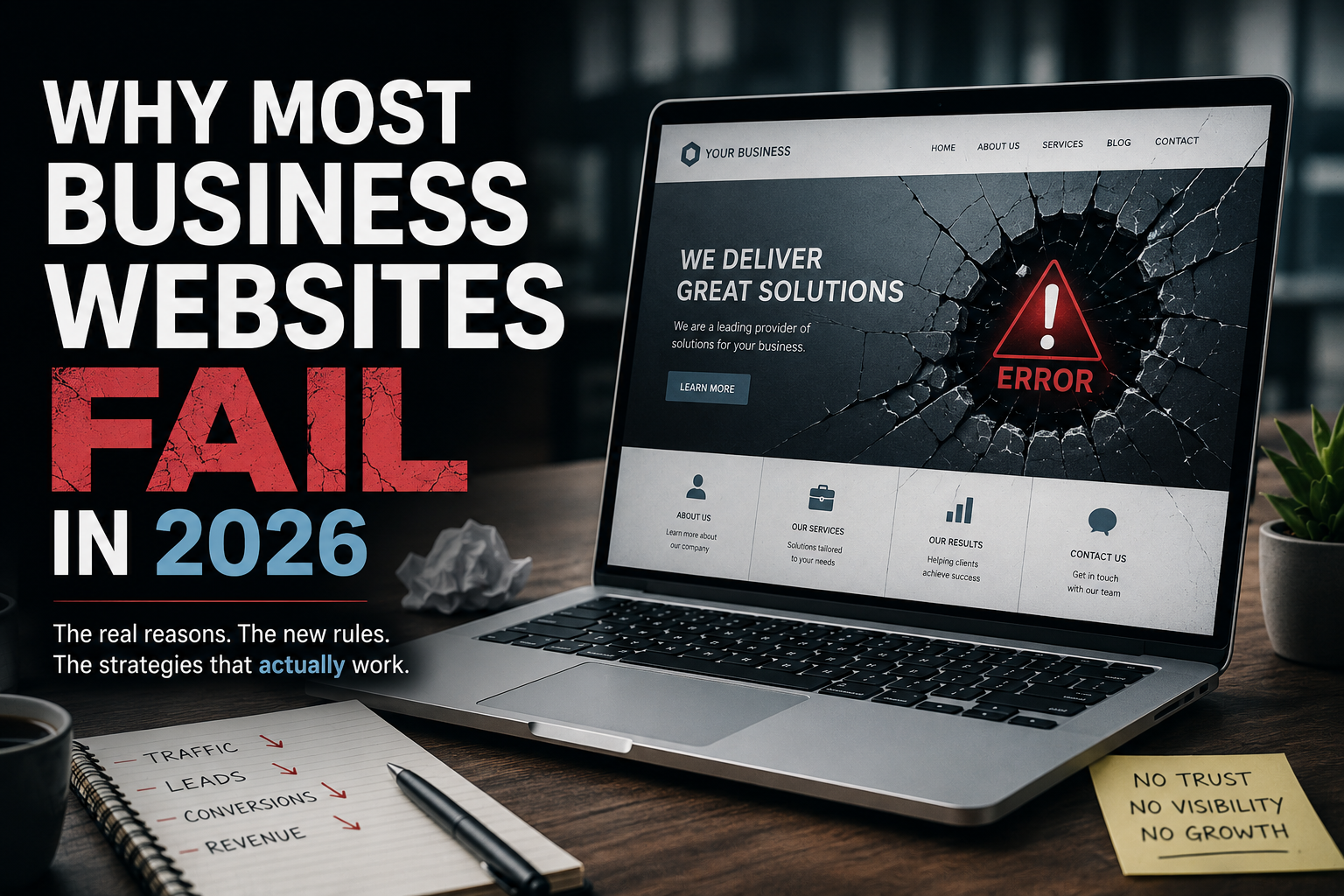
In 2026, a failing business website doesn’t look broken. It loads fast, it’s mobile-responsive, it has all the right pages. It might even rank on Google. But it doesn’t convert. It doesn’t build trust. It doesn’t show up where buyers are actually searching. And in a year when AI-generated search results have fundamentally changed how people find businesses, that’s a death sentence.
This article is not a checklist. It’s a diagnosis. And if you run or market a business, some of it is going to sting.
The Scale of the Problem Nobody Wants to Admit
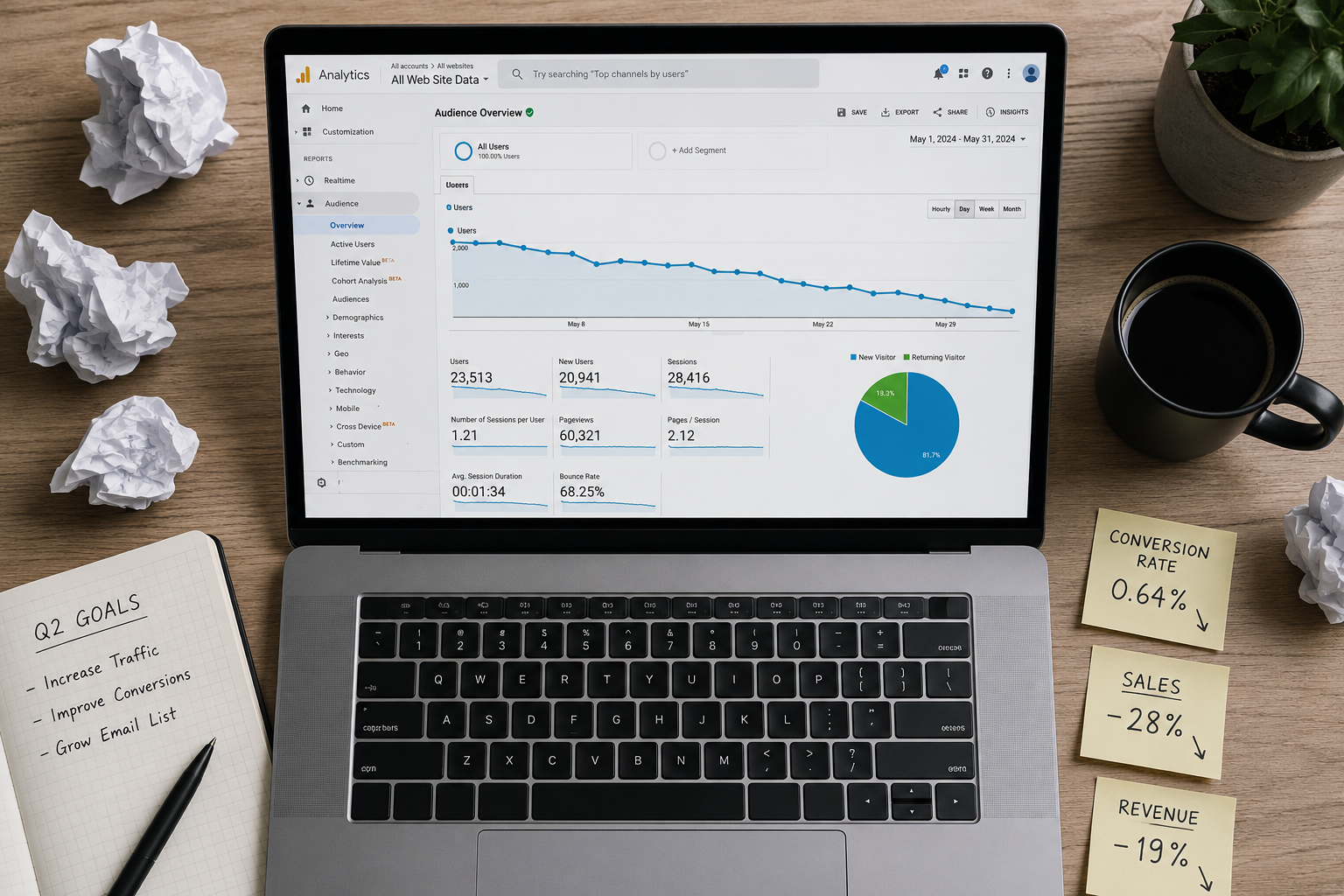
Here’s an uncomfortable number: according to research from Orbit Media, only 22% of businesses are satisfied with their website conversion rates. Another study by Sweor found that 75% of users judge a company’s credibility based on its website design — yet the same businesses spend next to nothing on strategic content or trust architecture after launch.
Meanwhile, a 2025 report from BrightEdge found that AI-generated overviews now appear in over 60% of Google search results, pulling traffic away from websites entirely. The game has changed. Most websites were built for a game that no longer exists.
The agencies that built those sites aren’t entirely to blame. The briefs they receive are usually focused on aesthetics and functionality. “We want it to look premium.” “We need a services page and a contact form.” Nobody is saying: “We want this site to be a trust-generating, conversion-optimised machine that also feeds AI search engines accurate information about our authority.”
That’s the brief it should be. And until businesses start thinking this way, their websites will keep quietly failing.
Industry Problem
Why the Old Playbook No Longer Works
Let’s talk about what agencies sold for years — and why it’s no longer enough.
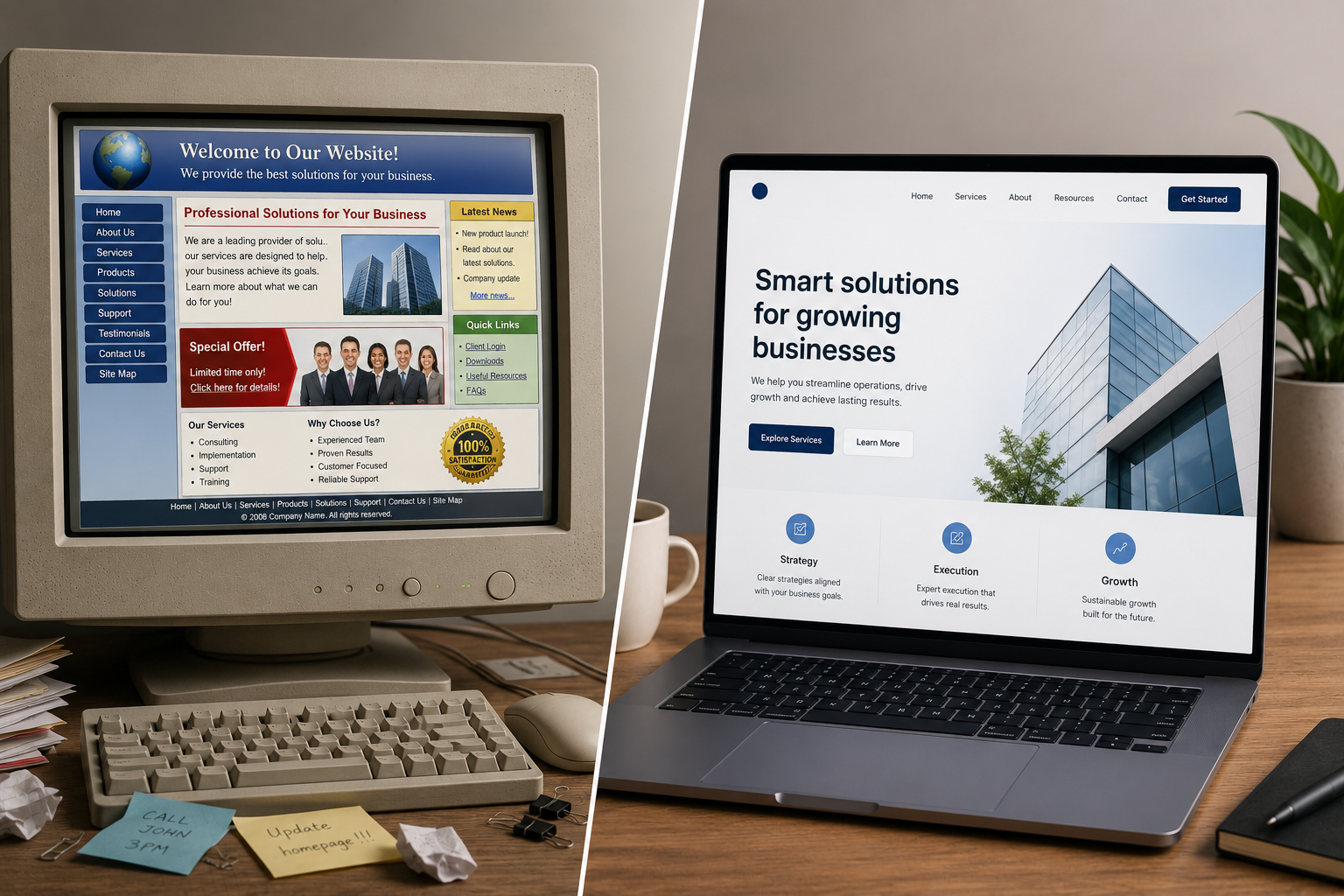
The “brochure site” model was always a compromise. Build a clean website, write some basic copy, stuff in some keywords, submit a sitemap to Google, and wait. This worked in 2014. In 2026, it’s a waste of budget.
SEO as a standalone tactic is fragmenting. Traditional keyword ranking still matters, but it exists alongside AI Overviews, ChatGPT citations, Perplexity answers, and voice search. A business that ranks #3 for “commercial solicitors London” may still get zero clicks if an AI overview answers the query above the fold and doesn’t reference them at all.
The “launch and leave” mentality is arguably the most damaging legacy of the old model. Websites are treated as projects, not platforms. You launch, you move on. Nobody is updating the content, building topical authority, refreshing case studies, or earning the kind of structured trust signals that both human visitors and AI engines need to cite you confidently.
One client — a mid-sized HR consultancy in the Midlands — came to us after spending £60,000 on a brand-new website. It had 42 pages. Seventeen of them were duplicates of each other with slightly different job function names. None of the pages had structured data. Their “About” page mentioned no individual consultants, no credentials, no methodology. Google couldn’t trust the site. Neither could anyone who landed on it.
They had a beautiful, credible-looking website that communicated nothing of substance.
What “Failing” Actually Looks Like in 2026
A website failure isn’t always dramatic. Sometimes it’s simply:
- A bounce rate above 70% on service pages
- No organic traffic growth in 12 months
- Zero citations in AI-generated answers for your industry keywords
- Contact forms with three submissions a month
- Blog content that reads like it was written by someone who has never met a client
The last point matters more than people realise. Generative AI search engines are now evaluating content quality not just by keyword relevance, but by demonstrated expertise, named authorship, cited sources, and semantic depth. Thin content — even well-designed thin content — is being systematically deprioritised.
Google’s Search Quality Evaluator Guidelines, which now heavily influence how both traditional and AI search operates, centre around EEAT: Experience, Expertise, Authoritativeness, and Trustworthiness. Most business websites fail on all four. Not because they’re dishonest, but because they’ve never been built to demonstrate these things.
Modern Website Strategy in 2026: What Actually Works

The businesses whose websites are actually working in 2026 are doing several things simultaneously — and most of them have nothing to do with design.
1. They’re Building for AI Discoverability (GEO)
Generative Engine Optimisation (GEO) is the practice of structuring your content so that AI search engines — ChatGPT, Gemini, Perplexity, Google AI Overviews — can accurately understand, cite, and surface your business as an authoritative answer.
This means:
- Structured data markup (Schema.org) for your organisation, services, FAQs, reviews, and key personnel
- Definitive, citeable content that directly answers specific industry questions rather than vaguely gesturing at topics
- Named authorship with bios that establish real credentials
- External citations and backlinks from credible industry sources
- Consistent entity signals — your business name, location, and expertise appearing uniformly across your website, Google Business Profile, LinkedIn, and sector directories
A law firm we worked with last year saw a 34% increase in organic contact requests within four months — not from ranking higher on traditional search, but from appearing in AI-generated answers to legal queries their target clients were asking on ChatGPT.
2. They’re Treating Their Website as a Trust Engine
The highest-converting B2B websites we’ve reviewed share one thing: they make it extremely easy to believe in the business before you’ve spoken to anyone there.
That means real client logos (with permission), named case studies with specific outcomes, team pages with actual photographs and professional backgrounds, verifiable credentials, professional association memberships, and — increasingly — video content showing real people discussing real problems.
One consultancy client tripled their enquiry rate by doing nothing more than replacing stock photography with real team photos and adding outcome-specific case studies. No technical changes. No redesign. Just authenticity.
3. They’re Writing for Decision-Makers, Not Search Engines
There’s a persistent myth that SEO content and good business content are in tension. They’re not — but badly executed SEO content often produces the kind of robotic, keyword-dense copy that alienates exactly the person you need to impress.
The CFO evaluating your financial software doesn’t want 1,200 words of generic preamble. They want specific answers to specific concerns: integration complexity, implementation timeline, regulatory compliance, TCO. Write for them. When you do, you also tend to write the kind of semantically rich, topically authoritative content that both Google and AI engines favour.
4. They’re Using Conversion Architecture, Not Just Good Design
Design and conversion are not the same thing. A site can be visually excellent and conversion-terrible. Conversion architecture is the deliberate structuring of information, calls to action, social proof, and navigational logic to guide a visitor toward an enquiry.
This includes:
- Above-the-fold clarity: within 5 seconds, a visitor should know exactly what you do, who you do it for, and why you’re credible
- Progressive commitment: low-friction CTAs (download a guide, watch a demo) before high-friction ones (book a call, request a quote)
- Proof at every stage: testimonials adjacent to pricing, case studies adjacent to service descriptions
- Friction reduction: minimal form fields, visible phone numbers, live chat options for high-intent visitors
Step-by-Step: How to Fix a Failing Website Without Starting From Scratch
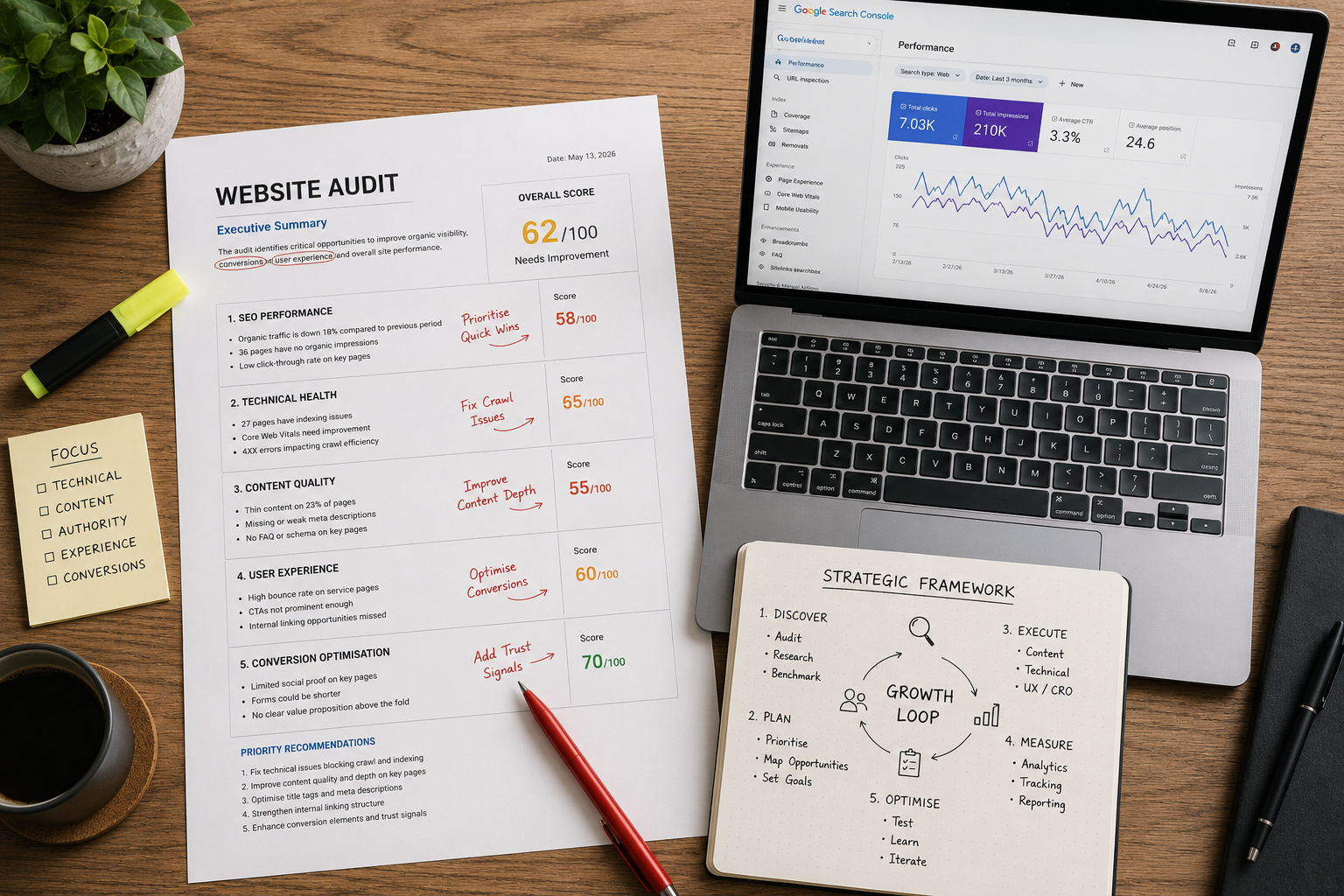
Most businesses don’t need a new website. They need to fix what they have. Here’s a practical sequence:
Step 1: Run a Brutal Audit Look at your Google Search Console data. Which pages get impressions but no clicks? Which get clicks but no conversions? Map your real traffic against your intended funnel. You’ll almost certainly find that 80% of your visits are going to 20% of your pages — and that 20% probably isn’t your most commercially important content.
Step 2: Fix the EEAT Gaps Go through every key service page and ask: does this page demonstrate that a real expert wrote it? Does it show evidence of results? Does it have named authorship? If not, fix this before touching anything else. It’s the highest-leverage change most sites can make.
Step 3: Implement Schema Markup At minimum, implement Organization, LocalBusiness (if relevant), Service, FAQPage, and BreadcrumbList schema. Use Google’s Rich Results Test to validate. This is foundational GEO infrastructure that almost every small-to-mid business website is missing.
Step 4: Rebuild Your Core Pages Around Intent Each service page should answer: What is this service? Who is it for? What problem does it solve? What does working with us look like? What have we achieved? What should I do next? In that order. Most service pages answer only the first question.
Step 5: Build a Content Authority Hub Pick 3-5 topic areas where you genuinely have expertise. Produce substantive, original content in those areas — not generic blog posts, but definitive resources. A “complete guide to X” from someone who actually does X for a living is one of the most durable content assets a business can own.
Step 6: Establish Your Measurement Framework Decide what conversion means for your business. Phone calls, form submissions, demo bookings, guide downloads? Set up proper event tracking in Google Analytics 4. Most businesses are flying blind because they’ve never properly defined or tracked their conversion events.
Common Mistakes That Set Websites Back Years
Letting the web designer write the copy. Designers design. Copywriters write. These are different skills and rarely live in the same person. If your agency is producing both, someone is getting shortchanged.
Publishing content without a distribution strategy. A blog post published and never promoted is not a content strategy. It’s a hobby. Every piece of content needs a minimum viable distribution plan: email list, LinkedIn, industry forums, internal linking.
Optimising for traffic instead of fit. We’ve seen businesses celebrate 40,000 monthly visits from content that never converts because it attracts entirely the wrong audience. Targeted traffic from the right 1,000 people is worth more than untargeted traffic from 100,000 wrong ones.
Ignoring mobile experience at the UX level. Responsive design means your site looks okay on mobile. It doesn’t mean it’s actually usable. If your primary CTA requires pinching and scrolling to find on a phone, you’re losing the majority of your audience.
Treating Google Business Profile as separate from the website. These should be part of the same trust ecosystem. Consistent information, fresh photos, active Q&A responses, and regular posts all feed into how Google perceives and surfaces your business in local and AI-influenced results.
Real Business Examples: What Changed and What It Did
A B2B Software Company, South East England When we audited this company’s site, they had a 4.2% click-through rate on Google but were converting less than 0.3% of visitors into trial sign-ups. Their homepage talked about their product’s features extensively and their customers’ outcomes not at all. We restructured the homepage around three core customer pain points, added a video testimonial from a named client, and rewrote the CTA from “Request a Demo” to “See How [Company] Reduced Admin Time by 40%.” Conversion rate moved to 1.8% within 90 days.
A Regional Accountancy Firm, Manchester They were invisible in AI search results despite ranking page one for several target keywords. The problem: their content was technically optimised but epistemically thin. We implemented FAQPage schema across 12 service pages, produced four in-depth guides authored by named partners, and created a structured data entity profile. Within five months, the firm began appearing in Perplexity and ChatGPT responses to accounting queries in their region.
A Professional Training Provider, Dublin Their site had over 200 pages of course content, none of which was internally linked in any coherent structure. Google was treating them as a shallow site despite years of publishing. A content audit, internal linking restructure, and consolidation of duplicate thin pages into comprehensive course guides resulted in a 67% increase in organic sessions within six months — with no significant new content production.
Expert Insights: What the Data Is Telling Us
“The websites that perform best in 2026 don’t just answer questions — they demonstrate the lived experience of the people answering them. AI engines are remarkably good at detecting depth of expertise versus surface-level coverage.”
This is consistent with what we’re seeing across client accounts. The trust signals that matter to human buyers — real credentials, named experts, specific outcomes — are exactly the signals that AI search engines are learning to prioritise.
There’s also a structural shift happening in how businesses think about content investment. The old model was: build a website once, run ads to it. The new model for sustainable growth is: build a content infrastructure that earns trust, organic visibility, and AI citations over time — and reduces your paid acquisition dependence in the process.
A client in the B2B logistics sector cut their Google Ads spend by 40% last year after their organic and AI referral traffic increased sufficiently to maintain lead volumes. That’s what a properly built website can do. It’s not magic — it’s infrastructure.
Future Trends: Where This Is Heading

Multimodal search is coming fast. Google Lens usage is growing, and AI engines are beginning to process images as part of authority signals. Businesses that properly optimise image alt text, use descriptive filenames, and embed structured data around visual content will have a significant edge.
Zero-click is the new normal for informational queries. If someone is searching “what is X,” AI will answer it. But transactional and evaluative queries — “best X for Y situation,” “compare X and Y” — still drive visits. The strategic play is to own the evaluative space with content that answers the “which one is right for me” question better than anyone else.
Personalisation at scale. The gap between websites that show the same content to every visitor and those that adapt to intent signals, referral source, or firmographic data is widening. This isn’t hypothetical — it’s available now through platforms like HubSpot, Mutiny, and Webflow with personalisation layers. Early adopters are seeing meaningful conversion lifts.
Website credibility as a ranking input will deepen. As Google and other AI engines get better at evaluating the quality of expertise behind content, the businesses that have systematically built named authority — their experts are known, their methodology is documented, their results are public — will compound their advantage. Those who have relied on generic content will find the gap increasingly difficult to close.
The Bottom Line
Most business websites fail not because of bad design or poor SEO mechanics. They fail because they were built to look like a credible business rather than to demonstrate that they actually are one. They were built for a search environment that no longer exists. They were launched and left.
The good news is that this is fixable. The gap between a failing website and a high-performing one is rarely a full redesign. It’s usually a series of deliberate, strategic interventions — fixing trust signals, building content depth, implementing proper structure, and creating genuine reasons for AI engines and human buyers alike to believe you’re the right choice.
If your website isn’t working, the worst thing you can do is commission another aesthetic refresh. The second worst thing is nothing. Start with an honest audit. Follow the money — or in this case, follow the traffic that isn’t converting — and address the real problem.
Your website should be the hardest-working member of your business development team. In 2026, it either is or it isn’t. There’s very little middle ground.
→ Not sure why your website isn’t converting? We offer a no-obligation website performance audit that covers SEO, GEO readiness, EEAT signals, and conversion architecture. Book your audit →
Frequently Asked Questions
Q: What is the most common reason business websites fail to generate leads?
The most common reason is a lack of trust architecture — the site doesn’t make it easy for a visitor to believe in the business before they’ve made contact. This includes missing social proof, unnamed expertise, no specific outcome data, and generic copy that could apply to any competitor. Design and technical issues are secondary to this strategic failure.
Q: What is GEO and why does it matter for my website in 2026?
Generative Engine Optimisation (GEO) is the practice of structuring your content and technical setup so that AI-powered search engines — like Google AI Overviews, ChatGPT, and Perplexity — can accurately understand and cite your business as an authority in your field. With AI Overviews now appearing in over 60% of Google searches, businesses not optimised for GEO are invisible to a significant and growing portion of their target audience.
Q: How long does it take to see results from strategic website improvements?
Conversion-focused changes (rewriting key pages, improving CTAs, adding social proof) can show measurable results within 4–8 weeks. SEO and GEO improvements typically take 3–6 months to compound into significant traffic and citation changes. Content authority builds over 6–18 months. The timeline depends on the baseline state of the site and the competitiveness of your sector.
Q: Do I need a full website redesign or can I fix what I have?
In the majority of cases, a full redesign is not necessary. Strategic content improvements, technical fixes, EEAT enhancement, and proper schema implementation can transform the performance of an existing site. A redesign is warranted when the site architecture itself prevents good performance — for example, when site speed is critically poor, when the CMS cannot support needed functionality, or when the information architecture is fundamentally broken.
Q: What’s the difference between SEO and GEO optimisation?
Traditional SEO focuses on ranking your web pages in search engine results pages (SERPs) for specific keywords. GEO focuses on ensuring your business is cited, referenced, and recommended by AI-powered answer engines. The two overlap significantly — quality content, structured data, and authoritative backlinks serve both — but GEO places greater emphasis on named expertise, semantic depth, entity consistency, and citeable factual content.
Q: How important is website content versus website design?
Both matter, but content is the primary driver of commercial performance. A mediocre design with excellent content will consistently outperform an excellent design with mediocre content. Content is what communicates expertise, builds trust, earns rankings, and converts visitors. Design is what creates credibility at first glance and makes content easy to consume. Invest in both — but if you’re resource-constrained, prioritise content and conversion architecture before visual design.
Q: What is the EEAT principle and how does it apply to business websites?
EEAT stands for Experience, Expertise, Authoritativeness, and Trustworthiness — the framework Google uses to evaluate content quality. Experience refers to demonstrated first-hand knowledge; expertise to relevant credentials and skill; authoritativeness to your reputation within your field; trustworthiness to site security, accurate information, and transparent business practices. Every page of a high-performing business website should actively demonstrate all four.