

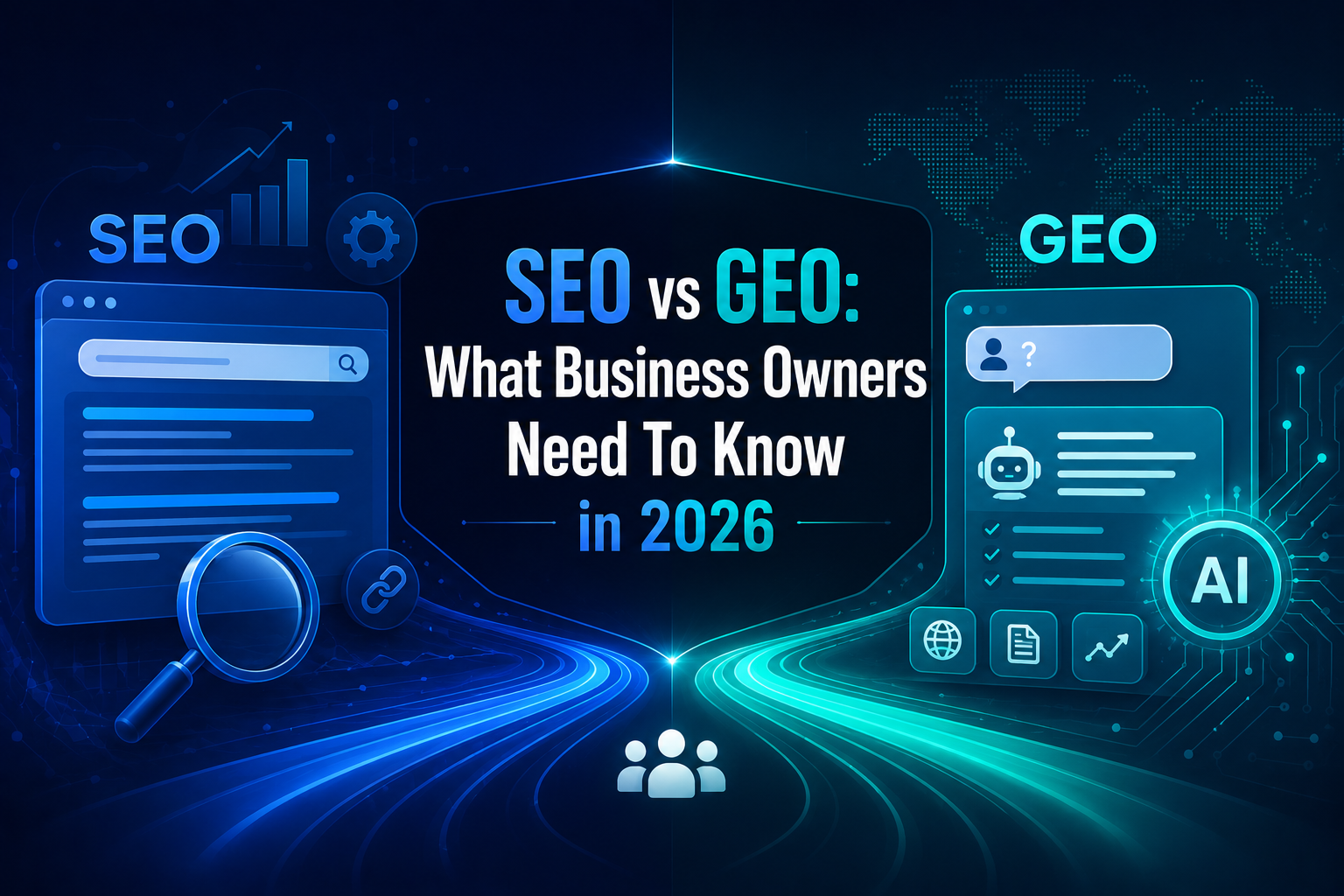
“We ranked number one on Google for three years straight. Then our leads dropped 40% in six months. Nothing changed on our site. The algorithm didn’t penalize us. Our competitors didn’t overtake us. AI did.”
— A SaaS founder we worked with in Q1 2026
That conversation is happening in boardrooms, on founder calls, and in agency strategy sessions across the world right now. And if you’re running a business and haven’t had it yet, you will soon.
This isn’t a think piece about whether AI search is “the future.” It’s here. The question isn’t whether to pay attention to Generative Engine Optimization — it’s whether you understand it well enough to act. And more importantly, whether you understand how it sits alongside traditional SEO, not in place of it.
Let’s get into it.
The Industry Problem Nobody Is Talking About Honestly
Here’s what most marketing agencies won’t admit: a significant chunk of their clients are getting cited in AI Overviews, ChatGPT responses, and Perplexity answers — and generating zero revenue from it. Meanwhile, another group of businesses isn’t showing up in AI answers at all, even when they have category-defining content.
Both groups are confused. Both groups are paying for strategies that were designed for a different era.
The SEO industry, for all its evolution, built its playbook around a specific model: someone types a query, a list of ten blue links appears, and your goal is to be at the top of that list. That model drove billions of dollars of business investment and created entire ecosystems of tools, agencies, and content factories.
Then large language models changed how people find information — fast.
According to a 2025 BrightEdge study, AI-powered search features now influence over 58% of all search interactions in English-speaking markets. Google’s AI Overviews appear in roughly 47% of searches. ChatGPT processes over 10 million search-style queries per day. Perplexity’s user base grew 400% year-over-year between 2024 and 2025.
And yet — most businesses are still optimizing exclusively for traditional rankings. Still chasing keyword positions. Still building backlink profiles without a single thought about how a language model reads, interprets, and cites their content.
That’s the gap. And it’s costing businesses real money.
Why Traditional SEO Alone Is No Longer Enough
Let me be clear about something before we go further: SEO is not dead. Anyone telling you that is either selling you something or hasn’t looked at actual traffic data. Google Search still processes over 8.5 billion queries per day. Organic search still drives the majority of website traffic for most industries.
But traditional SEO was built on a foundation that’s quietly shifting underneath us.
The classic model works like this: you identify keywords, create content optimized around those keywords, build authority through backlinks, and signal relevance through technical structure. Google’s crawlers index your site, assess your authority, and serve your content to users who match your target queries.
That model still works. The problem is it’s increasingly incomplete.
Here’s why.
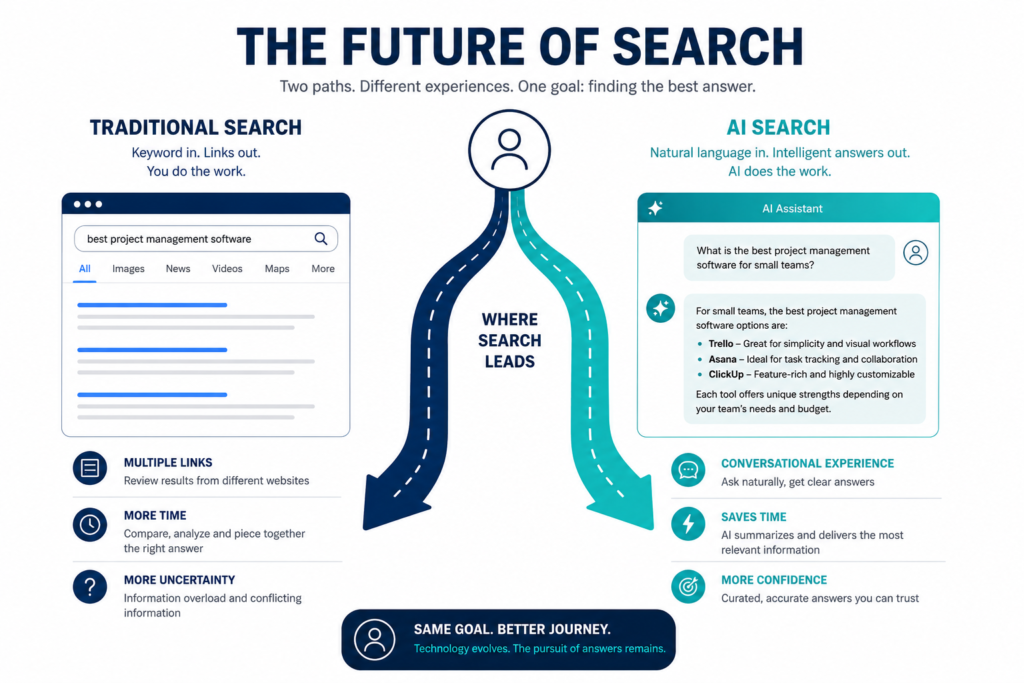
AI models don’t rank pages. They synthesize answers.
When someone asks ChatGPT “What’s the best CRM for a 20-person sales team?” — ChatGPT isn’t checking who ranks first on Google. It’s drawing on its training data, real-time web access (in some configurations), and content it has deemed authoritative enough to reference. The criteria for that determination are fundamentally different from Google’s PageRank logic.
We worked with a B2B software company — let’s call them Reventive (not their real name) — that had dominant first-page rankings for 12 of their 15 core keywords. Impressive by any traditional measure. But when their prospects started using ChatGPT and Perplexity to research CRM solutions, Reventive was invisible. Their content, while keyword-optimized, lacked the structured, definitive, citation-worthy depth that AI models look for when constructing answers.
Their competitors — some with weaker backlink profiles and lower domain authority — were showing up consistently in AI-generated responses because their content was written in a way that LLMs could understand, extract, and confidently cite.
That’s the mismatch. And it’s not fixable with more backlinks or better title tags.
The other failure mode is fragmentation.
Most businesses are now splitting their attention across Google SEO, Google SGE, Bing Copilot, ChatGPT, Perplexity, Claude, and whatever new AI interface launches next quarter. Without a unified strategy, you end up optimizing reactively — chasing each platform’s quirks rather than building authority that transfers across all of them.
Understanding GEO: What It Actually Means
Generative Engine Optimization is the practice of creating content and digital signals that help AI language models understand, trust, and cite your business when generating responses to relevant queries.
It’s not a replacement for SEO. Think of it as the layer above.
Where SEO focuses on helping search engines index and rank your content, GEO focuses on helping AI models understand your content well enough to reproduce its ideas accurately, attribute them to you, and recommend you with confidence.
The Stanford University NLP Group published a landmark study in late 2024 that found certain content characteristics increased citation rates in AI-generated responses by up to 43%. Those characteristics included: citing authoritative statistics, using quotations from recognized experts, adding precise definitions, and structuring content in a way that directly answers specific questions. Interestingly, simply writing longer content or having more backlinks had minimal independent effect.
That’s a meaningful finding. It suggests that GEO optimization is less about volume and more about precision, authority signals, and structural clarity.
Modern Strategies for 2026: Where SEO and GEO Converge
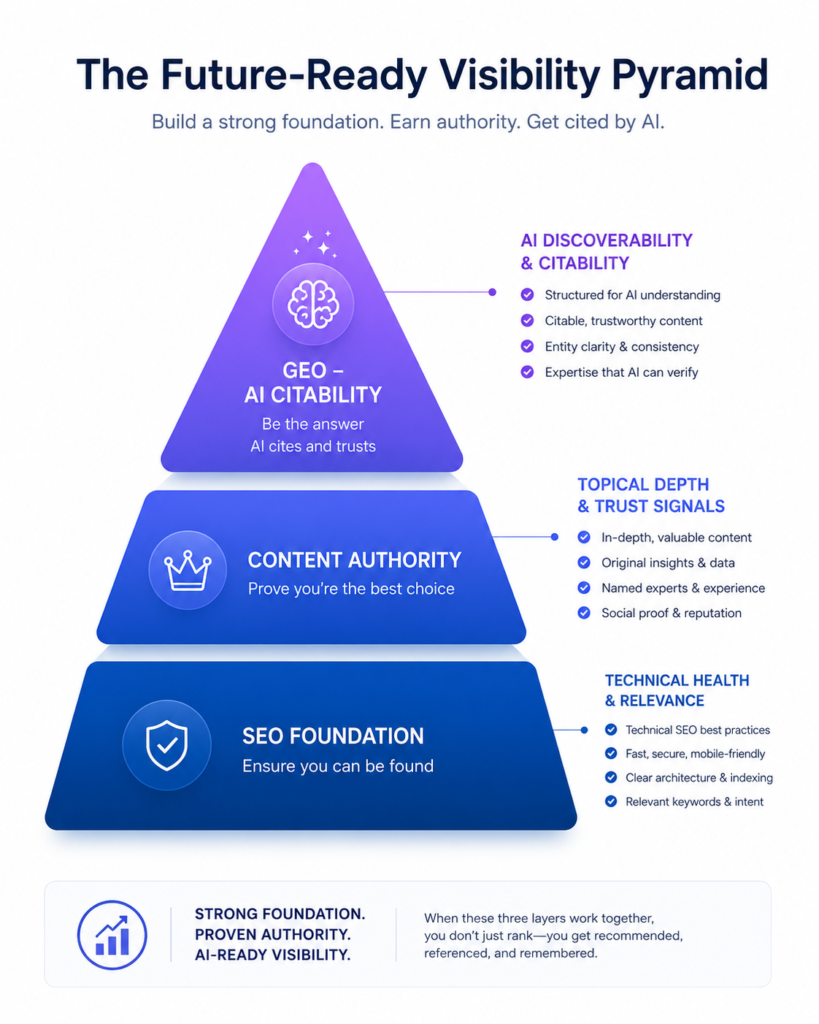
The businesses winning right now — in terms of both traditional rankings and AI citation rates — are the ones who’ve understood that these aren’t competing disciplines. They’re complementary. The best strategy combines both.
Here’s what that actually looks like in practice.
1. Entity-Based Authority Building
Google’s Knowledge Graph and AI training data both rely heavily on entities — the people, businesses, concepts, and relationships that exist in the real world. When your brand is consistently associated with specific topical entities across credible sources, both algorithms and AI models develop a stronger, more confident understanding of what you do and why you’re credible.
Practically, this means earning mentions in industry publications, getting your founders quoted in relevant media, contributing to Wikipedia-adjacent sources, and ensuring your Google Business Profile, LinkedIn, and industry directories all carry consistent, structured information.
2. Structured Answer Content
AI models love content that mirrors the structure of a good answer. Not because they prefer a specific format aesthetically, but because well-structured content is easier for LLMs to parse, extract, and reproduce accurately.
Write content that directly answers questions in the first paragraph, then expands. Use clear H2 and H3 headings. Include definition boxes. Use tables for comparisons. Write FAQ sections that are genuinely useful (not just keyword stuffing disguised as questions).
3. First-Person Expertise and Original Research
Here’s an insight we’ve seen play out with multiple clients: content that contains original data, proprietary frameworks, named methodologies, or direct practitioner quotes is cited significantly more often by AI tools than generic informational content.
When one of our agency clients — a mid-size HR consultancy — published a proprietary workforce retention index based on their own client data, that piece was cited in Perplexity responses over 200 times in the first three months. Their previously published generic content on the same topic? Essentially invisible to AI.
Original research isn’t just good SEO. It’s one of the most powerful GEO signals available.
4. Schema Markup and Structured Data
This hasn’t changed from SEO basics, but it matters more now than it ever has. AI crawlers parsing content for training and real-time retrieval are helped enormously by schema markup. Article schema, FAQ schema, HowTo schema, Product schema, Review schema — these provide machine-readable context that reduces ambiguity and increases the likelihood your content is accurately understood and cited.
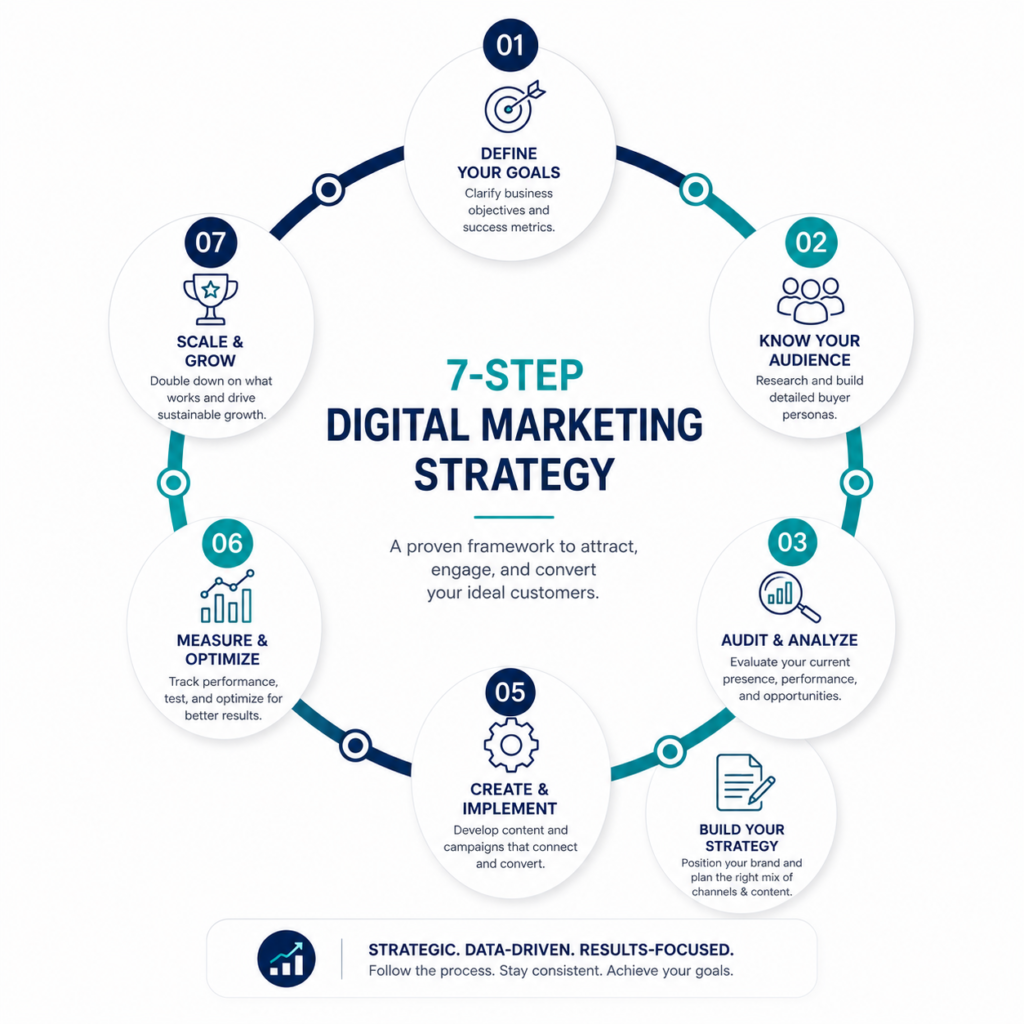
Step-by-Step Implementation: Building a Combined SEO + GEO Strategy
This is what we actually walk clients through. Not a theoretical framework — a practical sequence.
Step 1: Audit Your Current Visibility in AI vs. Traditional Search
Run your primary keywords through ChatGPT, Perplexity, Claude, and Google (with AI Overviews enabled). Document who’s showing up, how they’re being cited, and what content type is being referenced. This gives you a baseline and identifies your most urgent gaps.
Step 2: Map Your Content to Specific Questions
AI models respond to queries, not keywords. Rebuild your content strategy around the actual questions your buyers are asking — not just keyword variants. Use tools like AnswerThePublic, Google’s People Also Ask, and Reddit to identify the real questions in your category.
Step 3: Rewrite Core Pages for Structural Clarity
Take your five most commercially important pages and audit them for AI readability. Does each page clearly answer a primary question in the first 100 words? Does it contain credible data points? Does it define key terms? Does it use structured formatting? Rewrite with these criteria in mind.
Step 4: Build Your Entity Footprint
Get your brand name, founder names, and core service definitions into consistent, authoritative sources. This includes press mentions, industry directories, podcast appearances, LinkedIn articles, and guest contributions. Consistency of information across sources builds entity confidence in AI models.
Step 5: Create Citation-Worthy Assets
Publish at least one piece of original research, proprietary data, or expert framework per quarter. These become anchor pieces that other content — and AI responses — reference back to.
Step 6: Implement Schema at Scale
Add relevant schema markup to all major content types. If you’re on WordPress, plugins like Rank Math or Yoast make this manageable. For custom CMSs, work with your dev team to implement this at the template level.
Step 7: Monitor AI Citation Rates
Use tools like Profound, Semrush’s AI Toolkit, or manual tracking to monitor how often you appear in AI-generated responses. Track this alongside traditional rank tracking for a complete picture.
Common Mistakes That Cost Businesses Time and Money
We’ve seen all of these. Repeatedly.
Mistake 1: Treating GEO as a Separate Content Budget Line
GEO isn’t about writing separate AI-optimized content. It’s about writing better content — content that’s structured, authoritative, and specific enough to serve both human readers and AI models. Businesses that create parallel content tracks for “SEO content” and “AI content” end up with fragmented strategies and wasted resources.
Mistake 2: Optimizing for Visibility Without Conversion Strategy
Being cited in an AI response is meaningless if you’re not driving action. We’ve seen businesses celebrate AI visibility without building any mechanism to convert that attention. AI citations should include brand-attributable claims, links to landing pages, and calls to action that work even when the content is paraphrased.
Mistake 3: Ignoring Technical SEO Foundations
Some businesses have jumped headfirst into GEO content strategies while their sites remain slow, poorly structured, and difficult for crawlers to parse. GEO does not eliminate the need for technical SEO hygiene. Site speed, crawlability, internal linking, and Core Web Vitals still matter. They’re the infrastructure everything else runs on.
Mistake 4: Letting AI Write Everything
The irony of GEO is that AI-generated content performs poorly in AI searches. LLMs trained on internet data can often detect generic, pattern-matched writing — and it doesn’t carry the authority signals (original data, practitioner voice, unique frameworks) that drive AI citation. Use AI as a research and drafting tool, but the strategy and the point of view must be human.
Mistake 5: Not Updating Older Content
Many businesses invest heavily in new content while their existing pages — often the most authoritative ones — deteriorate in relevance. Regular content refreshes, updated statistics, and new internal links are among the highest-ROI activities in any combined SEO/GEO strategy.
Real Business Examples: What This Looks Like in Practice
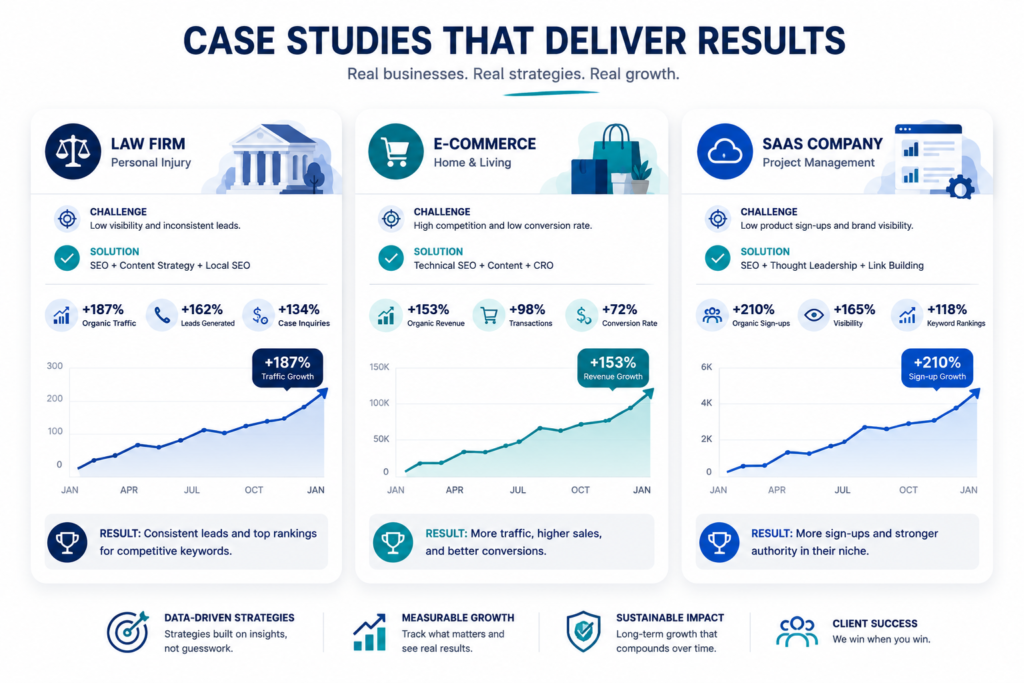
Case 1: Legal Services Firm — From Invisible to AI-Cited
A mid-size employment law firm in London had strong local SEO and ranked well for their core terms. But when their target clients — HR managers at mid-market businesses — started using ChatGPT to ask questions like “What are our obligations when making someone redundant in the UK?” — the firm didn’t appear.
After auditing their content, the problem was clear: their articles were written to rank, not to be quoted. Dense paragraphs, no clear direct answers, no data, no definitions.
Over four months, we restructured 22 key articles, added FAQ schema, added a proprietary Redundancy Compliance Checklist as a lead magnet, and got the firm’s senior partner quoted in two industry publications.
Within three months, the firm was appearing in AI-generated responses for 14 of their target query types. Inbound inquiry rate from digital sources increased 28%.
Case 2: E-commerce Brand — Protecting Existing Traffic
A UK-based outdoor equipment retailer had excellent organic rankings but noticed a plateau in click-through rates despite maintaining positions. AI Overviews were answering informational queries before users reached their content.
Rather than fighting it, they leaned in. They restructured their buying guides to directly answer comparison questions, added structured product schema, and started publishing original gear testing data with their own scoring methodology.
The result: their content started being cited inside AI Overviews — not just ranked below them. Their informational content now drives brand exposure at the AI layer, while their product pages capture the clicks from buyers ready to convert.
Case 3: B2B SaaS — Owning a Category
A workforce analytics platform was competing with enterprise vendors in a crowded space. Traditional SEO was expensive and slow. Backlink acquisition against established players was a multi-year effort.
GEO opened a different door. By publishing a quarterly Workforce Productivity Report with original survey data, building a comprehensive definitions library for category terminology, and structuring all content around specific, answerable questions — they started appearing in AI responses for key category queries within five months.
Notably, their AI visibility was higher than their traditional search visibility for competitive head terms — something almost impossible to achieve through link building alone.
Expert Insights: What the Data Actually Shows
A few things we’ve observed consistently across client accounts that aren’t widely discussed:
AI citation rates correlate with content depth, not content length. We’ve seen 800-word articles cited far more frequently than 3,000-word pieces, simply because the shorter piece answered a specific question more precisely and was backed by a clear data point.
Brand mentions in third-party content amplify AI visibility. When a brand is cited by multiple credible third-party sources in connection with a specific topic, AI models appear to develop stronger entity-topic associations. This is the digital PR function of GEO — and it’s significantly underutilized.
FAQ sections are disproportionately valuable for AI retrieval. Because AI models generate responses to specific questions, content that is itself structured as questions and answers maps directly onto the retrieval patterns of most LLMs. FAQ schema combined with genuinely useful answers is one of the highest-return GEO tactics available right now.
Voice and specificity outperform neutrality. Content that takes a clear, defensible position — written in a practitioner’s voice with concrete recommendations — is more likely to be cited than content that hedges. AI models appear to favor confident, specific claims backed by evidence over diplomatic but vague guidance.
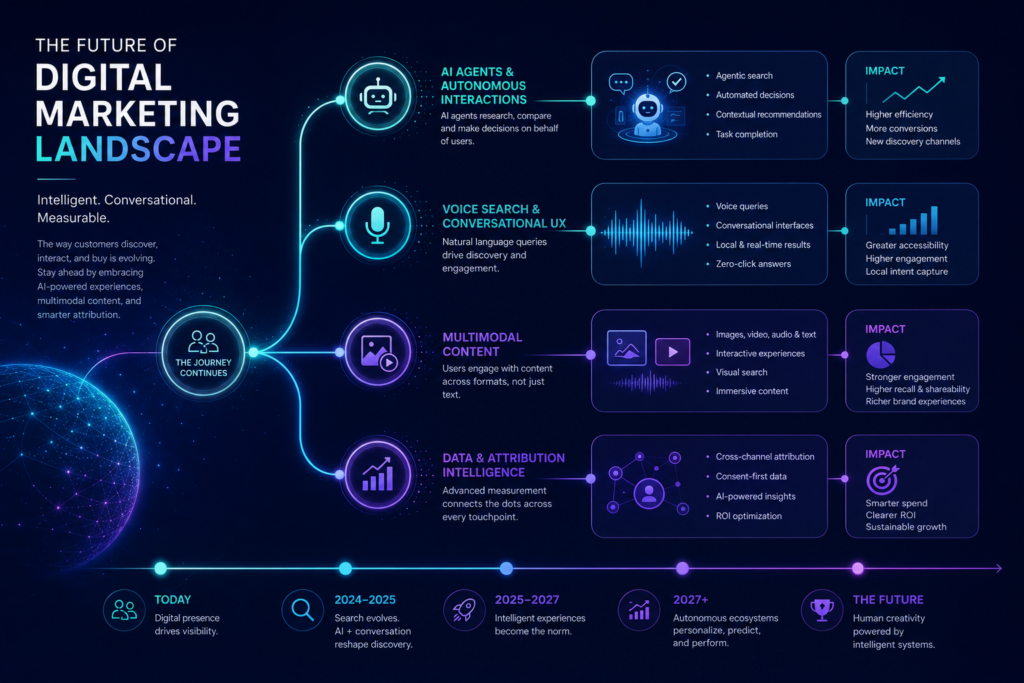
Future Trends: What’s Coming in the Next 18 Months
The landscape is moving fast. Here’s what we’re watching.
Multimodal search is expanding. AI search tools are increasingly processing images, audio, and video alongside text. Businesses that invest in rich media content with strong metadata and structural tagging will have advantages in AI retrieval that text-only competitors won’t be able to replicate quickly.
AI agents will conduct research on behalf of users. As tools like ChatGPT’s Deep Research and Perplexity’s research mode become mainstream, the nature of search behavior changes. Rather than answering a single query, AI agents are synthesizing information across multiple sources to build comprehensive answers. Being a trusted source across multiple touchpoints becomes more valuable than ranking for individual terms.
Citation attribution will become measurable. Early-stage analytics tools are already tracking AI citation rates. By late 2026, this is likely to be a standard metric in any serious digital marketing report — alongside impressions, clicks, and conversions.
Google’s SGE will mature. AI Overviews will become more sophisticated, more prominently placed, and more commercially oriented. The businesses that build content strategies around earning placement within those overviews — not just ranking below them — will maintain visibility while others see declining click-through rates.
Trust signals will become more important, not less. As AI-generated content proliferates, authenticity and verifiable expertise will become increasingly valuable differentiators. EEAT (Experience, Expertise, Authoritativeness, Trustworthiness) is not just a Google framework — it maps almost perfectly onto the signals that AI models use to assess content credibility.
Conclusion: The Only Strategy That Survives
The businesses that will win the next three years of search aren’t the ones who pick a side between SEO and GEO. They’re the ones who understand that we’ve entered an era of layered search — where traditional rankings, AI citations, and direct brand authority all contribute to visibility and trust.
SEO gives you the foundation: domain authority, technical health, indexed content, and keyword relevance. GEO gives you the layer above: AI citability, entity recognition, and the kind of authoritative content that language models reference with confidence.
The playbook isn’t complicated, but it requires intention. Create genuinely useful content. Structure it for both human readers and machine parsers. Build your entity footprint through consistent, credible external mentions. Publish original data. Write with a clear point of view.
And stop waiting for the landscape to settle before you act. It won’t settle. It will keep evolving. The businesses that build adaptive strategies now — grounded in the fundamentals of real expertise and real authority — are the ones that will remain visible regardless of what the algorithm does next.
Ready to audit your SEO and GEO visibility? If you’re unsure where you stand — in both traditional search and AI-generated responses — start with a content and entity audit. Map your current visibility, identify your gaps, and build a combined strategy that covers both layers of the modern search landscape. The gap between businesses that understand this and those that don’t is widening every quarter.
Frequently Asked Questions
Q: Is GEO the same as SEO? No. SEO (Search Engine Optimization) focuses on improving your rankings in traditional search engine results. GEO (Generative Engine Optimization) focuses on making your content easy for AI language models to understand, trust, and cite in their generated responses. Both are necessary in 2026 — they address different layers of the search landscape.
Q: Do I need to completely change my content strategy for GEO? Not completely. Many of the fundamentals overlap — quality content, authoritative expertise, strong structure. The key additions for GEO are: direct answer formatting, original data, clear entity signals, and FAQ-style content structures. Start by auditing your highest-priority existing content rather than rebuilding from scratch.
Q: How do I know if my content is being cited by AI tools? Tools like Profound, Semrush’s AI Overview tracker, and BrightEdge’s AI Search Monitor can track AI citation rates for your brand and content. You can also manually test by running your target queries through ChatGPT, Perplexity, and Google AI Overviews on a regular basis.
Q: Will traditional SEO become irrelevant? Not in any timeframe that should inform current strategy. Google still processes billions of queries daily, and organic search remains the highest-volume traffic source for most businesses. What’s changing is that traditional SEO alone is no longer sufficient. The businesses building combined strategies now will maintain their advantage as search evolves.
Q: How long does it take to see results from GEO optimization? It varies, but in our experience, businesses that implement structural content changes and entity-building activities consistently start seeing measurable AI visibility improvements within 60–120 days. Original research assets tend to generate citations faster than general content rewrites.
Q: Is AI-generated content bad for GEO? AI-generated content that lacks original data, practitioner perspective, and editorial judgment tends to perform poorly in AI citation. AI is a useful drafting and research tool, but the authority signals that GEO relies on — unique data, expert voice, first-person experience — must come from humans.
Q: What’s the most important thing a small business can do right now? Start with your core informational content and restructure it to directly answer the questions your buyers are actually asking. Add FAQ schema. Make sure your entity information (business name, offerings, locations, key people) is consistent across all major online directories and platforms. These steps cost relatively little and have measurable impact on both SEO and GEO visibility.