


“We tried everything. Boosted posts, hired a social media manager, ran a Groupon. Spent about £2,000 over three months and couldn’t tell you with any confidence what actually worked.”
— Independent restaurant owner, Manchester, 2025
Sound familiar? This kind of scattered marketing spend is the norm in hospitality, not the exception. Restaurant owners are some of the hardest-working people in business — and among the most consistently underserved by generic marketing advice that sounds great in theory and delivers nothing measurable in practice.
So let’s skip the theory.
This article covers ten restaurant marketing ideas that have a real track record: strategies backed by current data, informed by agency experience across independent restaurants, multi-location groups, and food-led concepts, and explained in a way that tells you exactly how to execute them — not just what to do.
One honest caveat upfront: not every idea on this list will be right for your restaurant. A fine dining venue in the city centre has different priorities to a family-run pizza place in the suburbs. Read the whole thing, identify the three or four ideas that fit your situation, and go deep on those before trying to do everything at once.
The State of Restaurant Marketing in 2026
Before the ideas, a quick picture of where we are.
The restaurant industry is operating in a genuinely difficult environment. With 91% of operators reporting higher food costs in 2025 and margins squeezed from every direction, marketing spend has to earn its place at the table. There’s no room for vanity metrics or activities that generate Instagram likes but not bookings.
At the same time, the opportunity has never been better for restaurants that understand digital. 67% of all restaurant orders now come through online channels. 64% of diners Google a restaurant before visiting, and 88% of mobile users who conduct a local business search visit or call within 24 hours. That window between search and decision — those 24 hours — is exactly where smart restaurant marketing pays off.
Here’s what actually works.
1. Master Your Google Business Profile Before You Do Anything Else
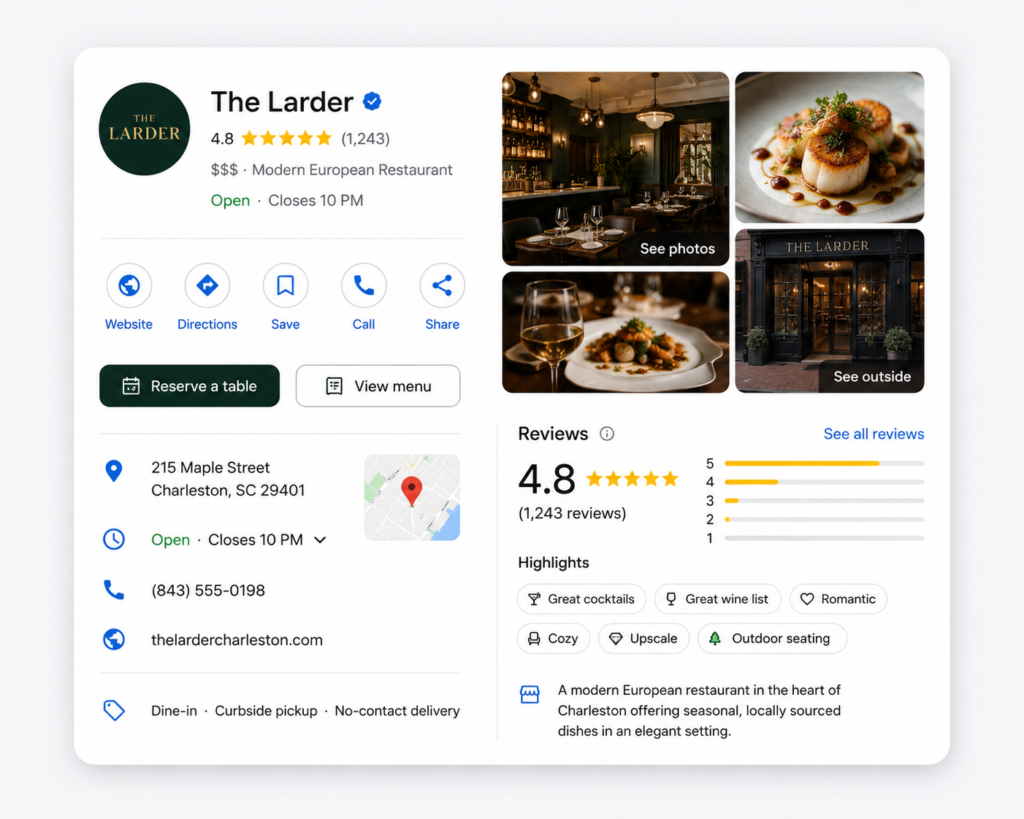
If there’s one marketing task that every restaurant owner should do this week, it’s this one. Not paid ads. Not influencer outreach. Not a new website. Your Google Business Profile (formerly Google My Business) is the single highest-ROI marketing asset available to most restaurants — and the majority of operators are leaving most of its potential untouched.
Here’s why this matters so much: when someone searches “Italian restaurant near me” or “best brunch in [your city],” what they see first isn’t your website. It’s your Google Business Profile. The photos, the reviews, the hours, the menu link, the ability to book a table directly — all of that happens before a user ever clicks through to your site.
Restaurants that properly optimise their Google Business Profile get 2.3x more reviews than those that don’t, and see at least 15% more profile interactions within six months of optimisation. That’s not a small gain — for a restaurant doing £25,000 a month in revenue, a 15% uplift in profile engagement can translate directly to table covers and order volume.
What “properly optimised” actually means:
Fill in everything. Not just the basics — everything. Your cuisine type, parking availability, whether you’re dog-friendly, whether you have a private dining room, whether you take group bookings. Select the most precise category available (“wood-fired pizza restaurant” beats “restaurant”). Upload professional photos of your food, your interior, your team, and your exterior in daylight. Add your full menu with prices. Link your online ordering or reservation system so people can act directly from the profile without needing to visit your website.
Post to your profile regularly. Google Posts are essentially free advertising inside your profile — use them for seasonal menus, events, special offers, and new dishes. They signal activity to Google and give prospective diners something current to engage with.
And respond to every review. Every single one. Positive reviews get a warm, personalised thank-you. Negative reviews get a professional, non-defensive response that shows you take feedback seriously. 86% of consumers say reviews are one of the most important factors in deciding whether to trust a local business. How you respond to criticism is itself a trust signal — and prospective customers read it.
One more thing nobody talks about enough: Google Business Profile is increasingly how AI search tools like ChatGPT and Google’s own AI Overviews form their understanding of local businesses. A fully optimised, consistently updated profile isn’t just good local SEO — it’s increasingly important for appearing in AI-generated “best restaurants near me” recommendations too.
2. Build a Review Generation System (Not a Review Strategy)
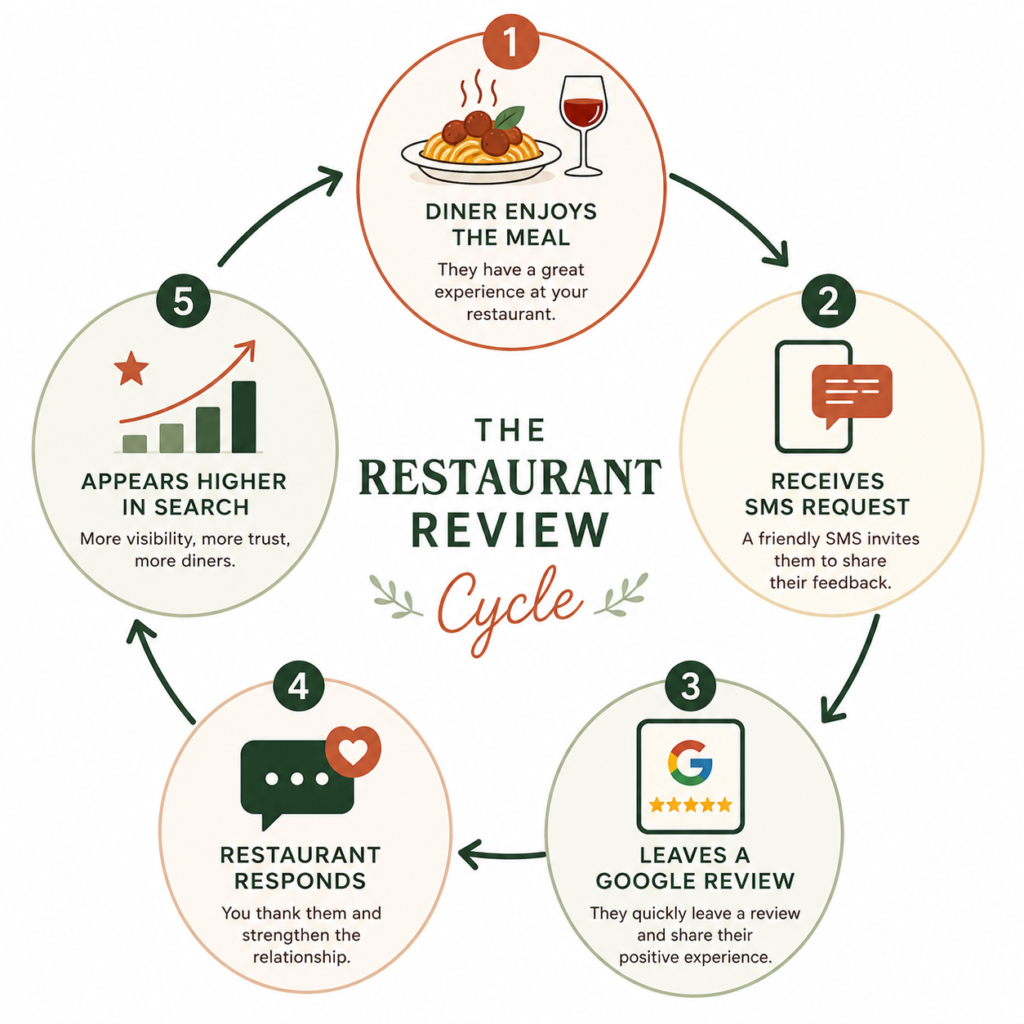
Most restaurants have a “review strategy” that amounts to occasionally asking happy customers to leave a Google review. The restaurants consistently outperforming on local search have something different: a system.
The distinction matters. A strategy is something you think about sometimes. A system runs whether you’re in the building or not.
94% of consumers read online reviews before choosing a restaurant. Review volume and recency are both significant factors in local search ranking — Google rewards profiles that receive consistent, recent, positive reviews. A restaurant with 200 reviews that last received one six months ago will often rank below a newer competitor with 80 reviews arriving steadily each week.
So the goal isn’t just more reviews. It’s more reviews, arriving regularly, with enough detail to be credible.
How to build the system:
The most effective trigger point is immediately after a positive experience — when the emotion is fresh and the customer is still at your restaurant or has just ordered. A well-timed SMS after delivery, a QR code on the receipt, a brief request from a server during the bill moment: these convert at far higher rates than follow-up emails sent days later.
Train your team to read the table. When a customer genuinely compliments the food, that’s the moment to say: “We’d really appreciate it if you left us a review — it makes a huge difference for us.” Said warmly, by a person, not printed on a flyer, this is one of the most effective review generation tactics we’ve seen work consistently.
Use a tool that automates the follow-up. Restaurant-specific platforms like Tock, SevenRooms, or even simple SMS tools can be set up to send a personalised review request within an hour of a visit or delivery completion. Automation makes the system consistent regardless of how busy your team is.
One thing to absolutely avoid: incentivising reviews. Offering discounts or free items in exchange for reviews violates Google’s policies and — if it reads as transactional to potential customers — undermines the trust that makes reviews valuable in the first place.
3. Short-Form Video That Shows the Real Kitchen
This one has changed more than any other restaurant marketing channel in the past two years. The playbook for food content on Instagram used to be simple: hire a food photographer, shoot your hero dishes beautifully, post twice a week. That still has a place. But the content that’s actually driving new customer acquisition in 2026 looks completely different.
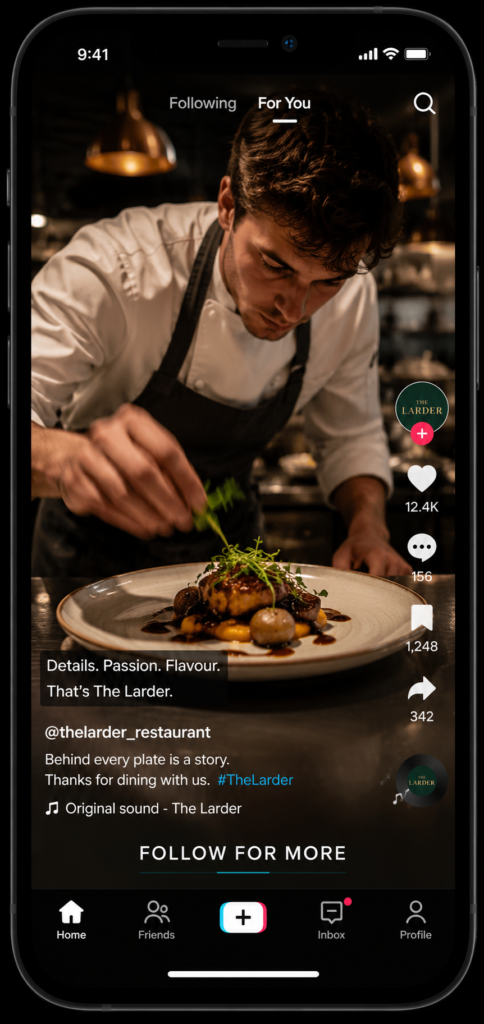
It’s a 30-second Reel of a chef finishing a pasta dish with an indecent amount of butter. It’s a 45-second TikTok of the dining room filling up on a Friday night with a trending audio track. It’s a behind-the-scenes story of prep day that starts at 7am and ends with a sold-out service. Raw, real, unscripted — and consistently performing better than polished brand content.
65% of consumers follow food and lifestyle topics on social media, making it the largest community category in consumer social behaviour. The appetite for food content is enormous. The opportunity for restaurants is that the bar for production quality has dropped dramatically while the bar for authenticity has risen. You don’t need a videographer. You need a phone, decent light, and a willingness to let people see behind the curtain.
What actually gets views and drives bookings:
Cooking process videos consistently outperform plating shots. The sizzle of a pan, dough being stretched, a sauce being reduced — these have an almost visceral appeal that still images can’t replicate. Show the process, not just the result.
“This week’s specials” videos, posted at the start of the week, serve a dual purpose: they generate engagement from existing followers and they create a reason for people who’ve visited before to come back for something new.
Staff personality content builds the kind of loyalty that advertising can’t buy. When customers feel like they know your team, they feel an attachment to your restaurant that makes them regulars rather than one-time visitors. A 60-second “meet the team Monday” series costs nothing but a few minutes of someone’s time.
The practical advice: post three to five times a week consistently, not ten times in one week and nothing for the next three. Consistency is the variable that actually grows accounts. Engagement matters more than follower count. A restaurant with 2,000 followers whose posts regularly generate 200 comments from local food-lovers is more commercially valuable than one with 20,000 passive followers.
4. Email and SMS: The Channels Nobody Talks About Enough
Here’s an observation from years of working with restaurant clients: the marketing channels that generate the most reliable revenue are the ones that feel the least exciting. Email and SMS don’t have the cultural cachet of TikTok. They don’t generate the agency case study headlines that influencer campaigns do. But the ROI data is staggering — and unlike social media, you own the relationship.
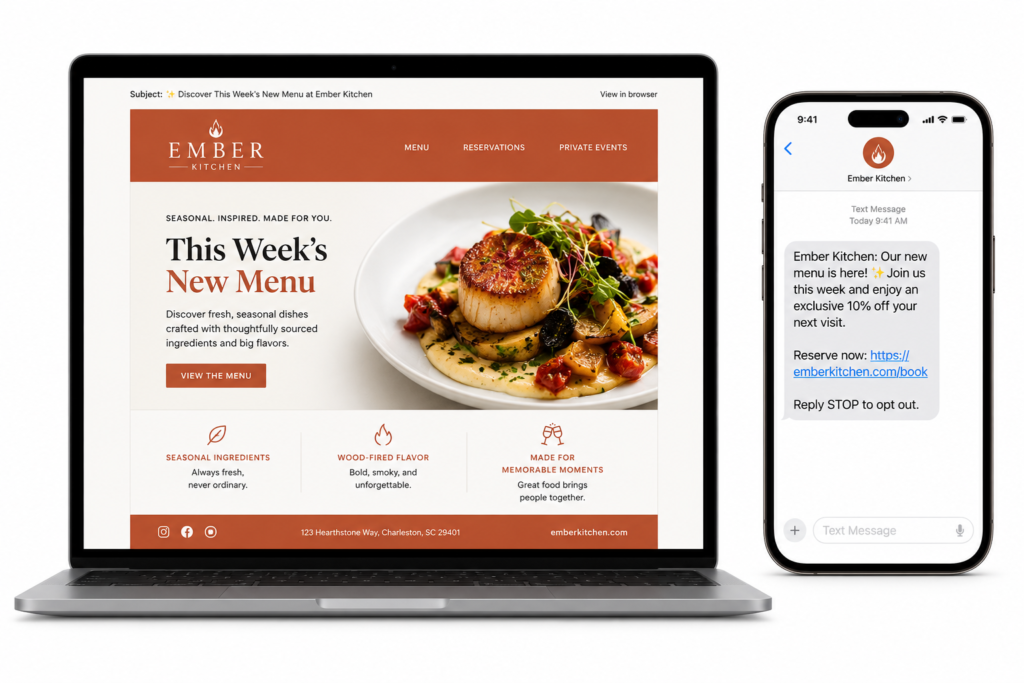
Email marketing delivers an ROI of 4,400% for restaurants in some studies. Almost 60% of customers have registered to a restaurant’s email list specifically to receive exclusive discounts and deals. And email lists don’t disappear when an algorithm changes.
SMS performs even better for time-sensitive promotions. Open rates for SMS hover around 98% — compared to the email average of roughly 21%. A text message saying “Quiet Tuesday tonight — book before 6pm and get a complimentary starter” goes out at 3pm and fills tables by evening. That’s not a marketing strategy; that’s a revenue lever.
Building the list:
Every reservation, every loyalty programme sign-up, every online order is an opportunity to capture a contact with permission to market to them. Most restaurants are collecting these touchpoints already and doing nothing with the data.
Add a simple incentive — a complimentary drink on your next visit, early access to a seasonal menu — and sign-up rates increase significantly. The key word is “simple.” The friction of a complex sign-up process will kill your conversion rate. Name and email address, or name and phone number. That’s enough to start.
What to send:
Weekly or bi-weekly communications work well for most restaurants. A mix of new menu items, upcoming events, a personal note from the chef or owner, and the occasional exclusive offer for subscribers only. The “exclusive for subscribers” element is critical — it’s the reason people stay on the list and open every message.
Birthday emails with a genuine offer (not “come in for a free dessert on your birthday and spend £50”) have some of the highest open and conversion rates of any restaurant email campaign. They’re personalised, timely, and feel like a gift rather than a marketing message.
5. Loyalty Programmes That Feel Like Belonging, Not Points
The word “loyalty programme” makes most restaurant owners think of a punch card or a points app they spent three months trying to get customers to download before giving up. That version of loyalty marketing doesn’t work very well. But the principle behind it — rewarding customers who visit regularly, making them feel seen and valued — is one of the most commercially powerful forces in restaurant business.
Customer acquisition costs keep climbing in 2026. Smart restaurant marketers are obsessing over retention instead. The maths are clear: it costs significantly more to acquire a new customer than to retain an existing one, and a 5% increase in customer retention can increase profits by 25–95% depending on the business model.
What makes loyalty programmes work:
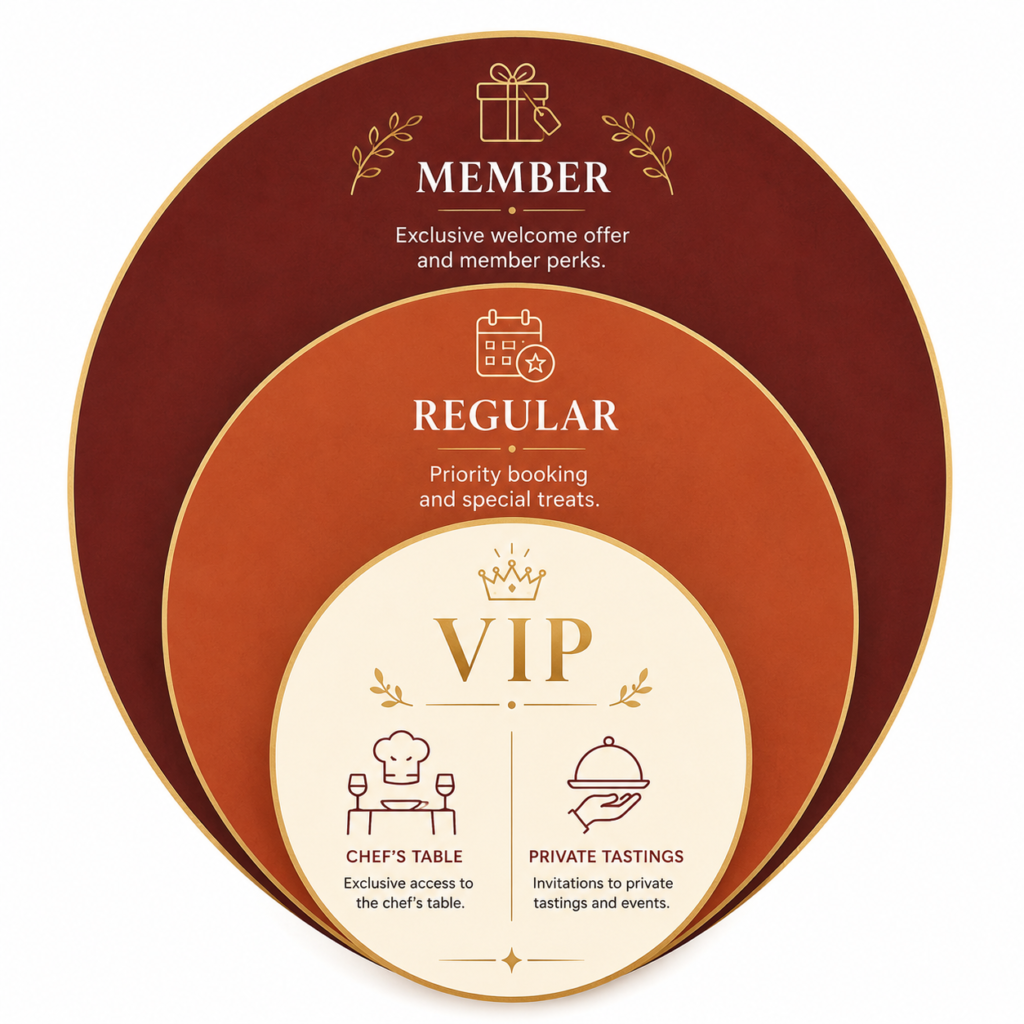
The best restaurant loyalty programmes feel less like a transaction and more like a club. They offer access, not just discounts — things you can’t get anywhere else. Early access to seasonal menus. Priority booking during peak periods. An invitation to a private tasting evening before a menu launch. The chef’s table seat that isn’t listed online.
These things cost the restaurant very little but carry enormous perceived value — and they create the kind of word-of-mouth that no advertising budget can replicate.
Practically speaking:
For most independent restaurants, a simple tiered programme run through an email or SMS tool works better than a complex app. Three tiers — something like Regular, Regular, and VIP — based on visit frequency, with escalating benefits at each level. Keep the mechanics simple enough that your FOH team can explain the whole programme in 20 seconds.
Capture visit data through reservations or digital receipts. Even a basic spreadsheet tracking your top 50 repeat customers and manually sending them a personal message from the owner occasionally is more effective than an ignored app.
6. Micro-Influencer Partnerships (Not Celebrity Food Bloggers)
The influencer marketing conversation in restaurants often gets stuck at the wrong end of the scale. Restaurant owners either dismiss it entirely because they can’t afford a major food influencer, or they spend their entire PR budget on one name with a large following who generates a spike of interest that disappears in a week.
Micro-influencers — creators with between 5,000 and 50,000 followers — consistently outperform their larger counterparts on the metrics that matter for restaurants. Nano influencers (under 10,000 followers) have engagement rates of 6–9%. Micro-influencers average 3–5%. Compare that to macro influencers, whose rates typically fall below 2%.
Why? Because at the micro level, the relationship between creator and audience is genuinely local and genuinely personal. A food blogger with 12,000 followers, most of whom are local to your city and trust their recommendations, is worth more to you than a food influencer with 200,000 followers distributed across the country.
How to approach micro-influencer partnerships that actually work:
Find creators whose audience demographic matches your target customer. Location is more important than follower count. Someone who consistently covers your city’s food scene, who gets DMs from local followers asking “where should I eat this weekend,” is your ideal partner.
Offer an experience, not a transaction. The most effective restaurant influencer collaborations feel like a genuine invitation — a table for the influencer and a friend, a chef’s table experience, access to a private menu preview. The content that comes from a genuine experience reads completely differently to a paid post, and audiences can tell the difference.
Give creative freedom. The moment an influencer starts writing your captions and following your shot list, the authenticity disappears. Brief them on what you want them to communicate and let them do it in their voice. Influencer collaboration posts see 8–15% engagement on average when the content feels genuine.
Track ROI through unique promotional codes or specific booking references so you know which partnerships are actually driving covers, not just impressions.
7. Build a Content-Rich Website That Converts (Not Just Looks Good)
Most restaurant websites are digital brochures. They have a homepage with a beautiful photo, an “About” page with a paragraph about the chef’s passion, a menu page, and a booking widget. They look fine. They convert poorly.
A restaurant website that actually works as a marketing asset does several things a brochure doesn’t: it ranks in search for local queries, it captures email addresses, it tells a story that creates emotional investment before the customer walks through the door, and it gives Google and AI tools enough structured information to confidently recommend you.
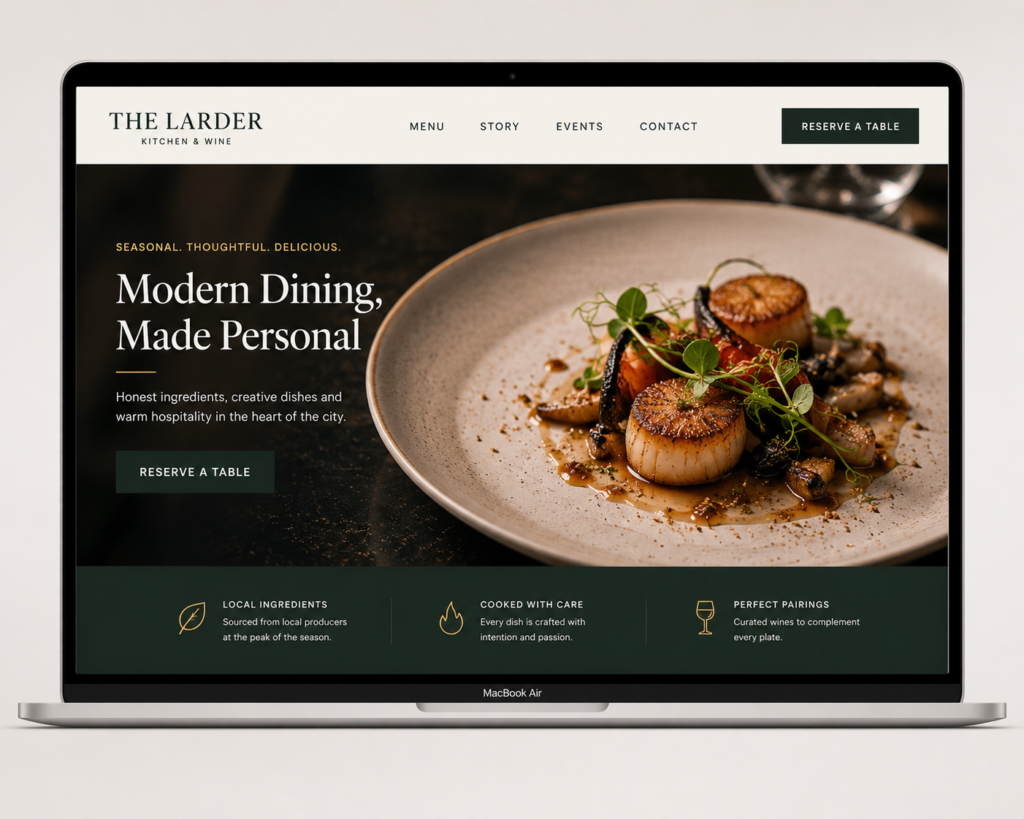
Menus with professional photography increase sales by 20–45%. That principle extends to your website — high-quality, current photography of your food, your space, and your team isn’t a luxury. It’s a commercial investment.
What a high-converting restaurant website needs:
A clear booking mechanism above the fold on every page — not buried at the bottom of the menu page. If someone has to search for how to reserve a table, you’re losing bookings.
A menu that’s actually on the website, not a PDF you have to open separately. PDFs don’t index well on Google and they’re notoriously bad on mobile. Put your menu on a proper webpage with schema markup so it appears in search results and Google Business Profile menu previews.
A genuine brand story that isn’t generic. “We’re passionate about great food and hospitality” is said by every restaurant on Earth. “We source our lamb from a specific farm 12 miles away because the farmer’s rotational grazing produces a flavour we’ve never found anywhere else” is a story. Stories create attachment. Attachment drives loyalty.
A local SEO foundation: your full address, the area you serve, the type of cuisine, and the specific experience you offer — repeated naturally throughout the site and marked up with local business schema. This directly feeds your visibility in local search and AI search tools.
Mobile performance is non-negotiable. Over half of all restaurant searches happen on mobile. A site that loads slowly or presents a menu that’s impossible to read on a phone is losing you covers every single day.
8. Turn Your Regulars Into Your Marketing Team
Word-of-mouth is still the most trusted and commercially effective marketing channel for restaurants. A 20% increase in business can result from positive word of mouth alone. And word-of-mouth in 2026 has a digital component that amplifies its reach far beyond the dinner table.
The best restaurant marketers don’t just hope customers will recommend them — they create conditions that make it natural, easy, and rewarding to do so.
Designing the shareable moment:
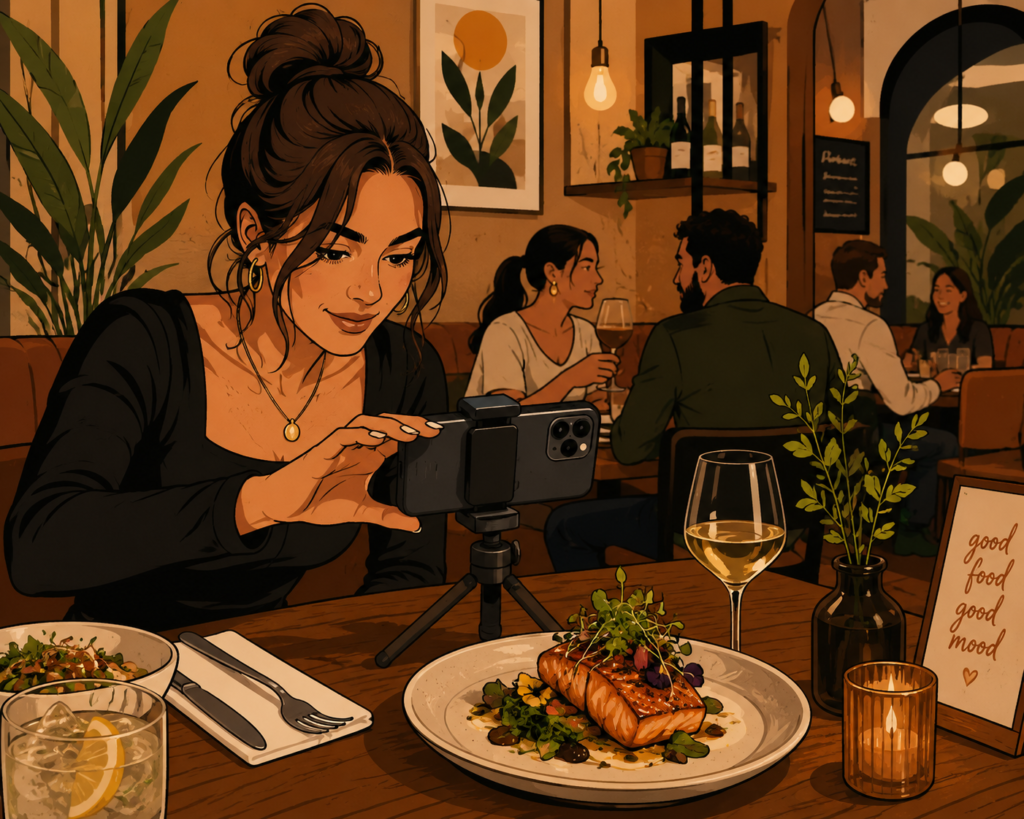
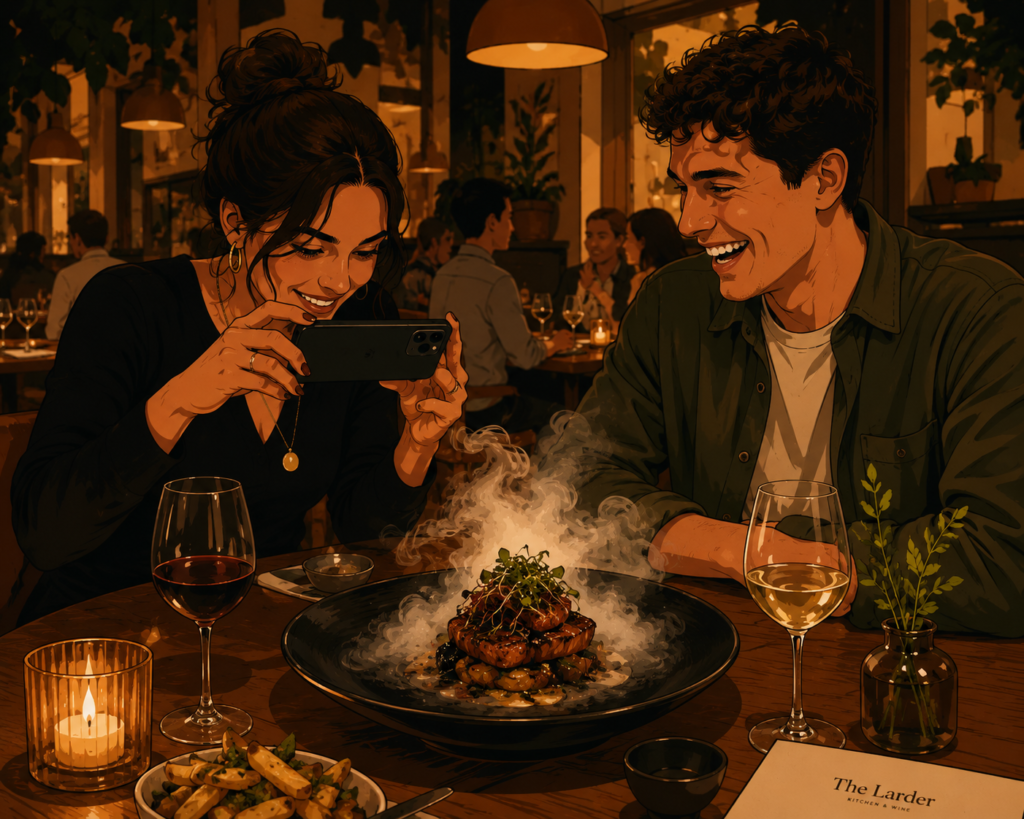
Guests are 2.1x more likely to post content when there’s a photogenic wall, plating setup, or visual element specifically designed for photography. This doesn’t mean plastering your venue with neon signs — it means thinking about where natural light falls, what surfaces make food look extraordinary, and whether you have one dish or one visual element that looks genuinely remarkable photographed from a phone.
The “signature item” principle is powerful: adding a signature dish or visual centrepiece boosts brand recall by 33% and gives your fans something specific to recommend and tag you in. A cocktail that’s theatrical. A dessert that arrives table-side. A bread that’s made from a 100-year-old starter. Whatever it is, make it photographable and give it a name worth mentioning.
Referral mechanics:
A simple “bring a friend” offer — something like a complimentary course when a new customer is introduced by a regular — costs you almost nothing per cover but creates a direct financial incentive for your best customers to recommend you. Referral programmes cost less than a third of what paid ads cost per customer acquisition. For most independent restaurants, that’s a meaningful difference.
Make it easy to refer. A card on the table, a post-visit email, a shareable code through your loyalty system — whatever mechanism fits your operation. The key is removing friction from the act of recommending, not just hoping it happens.
9. Events That Build Community and Create Return Visits
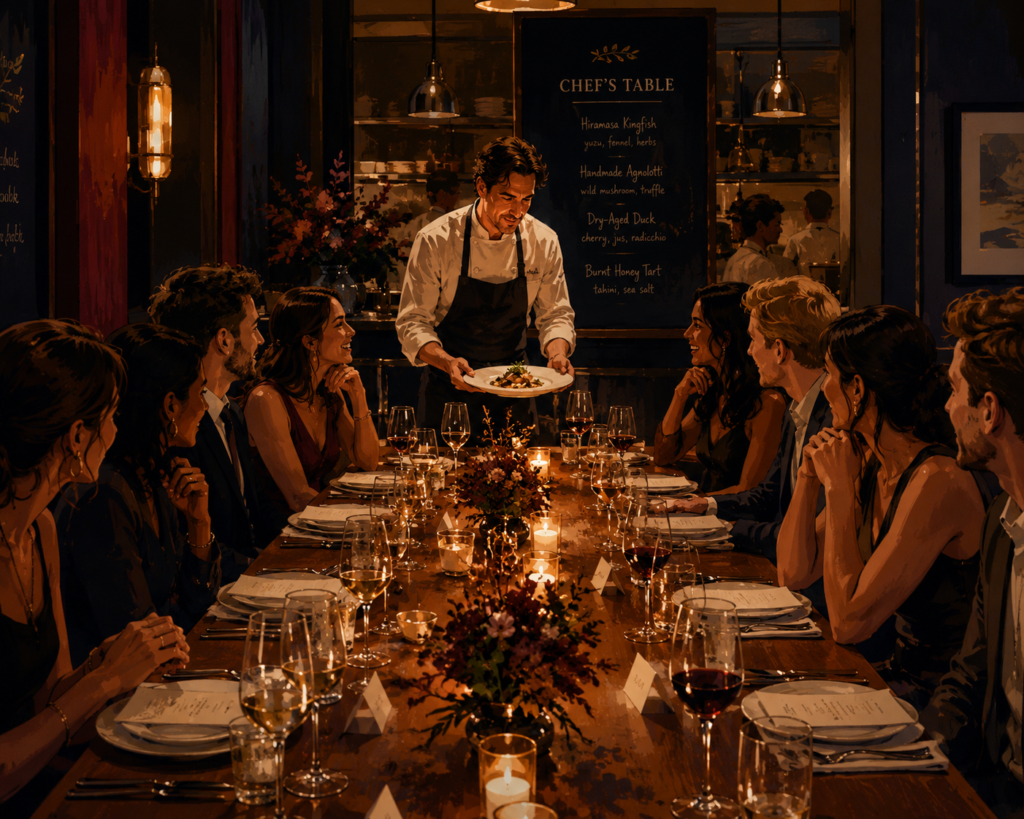
One of the most consistent patterns we’ve observed across restaurant marketing is how disproportionately events drive return visit frequency. A customer who attends one of your events — a wine dinner, a chef’s table evening, a cocktail masterclass — visits your restaurant at roughly twice the frequency of a customer who has only dined normally. They also spend more per visit and are significantly more likely to recommend you.
Events solve a problem that every restaurant faces: giving people a reason to come back even when they’ve already been recently. “I’ve been there, it’s good” becomes “I need to book that pasta masterclass before it sells out.”
Events that work consistently:
Chef’s table evenings — 8–12 covers, a special menu, the chef cooking in front of guests and explaining each dish — command a premium price point and sell out reliably once you’ve established them. They’re low-cost to run (you’re using your existing kitchen and team) and generate some of the highest satisfaction scores of any dining experience.
Seasonal menu launches, framed as an event rather than a menu change, generate coverage, social content, and table bookings during what would otherwise be a quiet changeover period.
Collaboration events — hosting a guest chef, partnering with a local winery for a paired dinner, running a “takeover” night with another concept — create novelty, draw in both restaurants’ audiences, and generate press and social content that a regular service evening never would.
Limited-time menus create 14% more order urgency than standard menus. The “only available this weekend” framing works. Use it deliberately.
10. Track What’s Actually Working — Then Double Down
This is the marketing idea that feels the least exciting and delivers the most long-term value: measurement. Knowing, with actual evidence, which of your marketing activities are generating bookings and revenue — and which ones are generating only the feeling of being busy.
Only 16% of brands currently track their marketing visibility systematically across channels, making decisions based on incomplete data. This number is almost certainly higher in restaurants, where marketing decisions are often made on instinct, what competitors seem to be doing, or the last thing someone read in a trade magazine.
The restaurants that compound their marketing results over time — that get more efficient, more targeted, and more effective each year — are the ones that treat measurement as a core operational function, not an afterthought.
What to track:
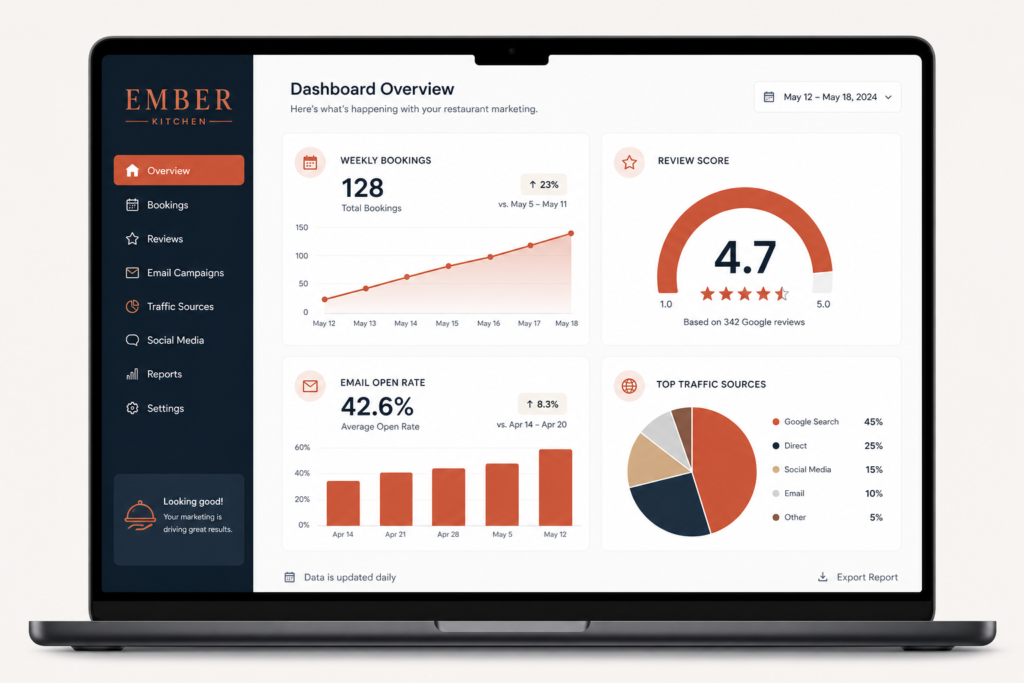
Google Analytics 4 for website traffic, booking conversions, and the pages people actually engage with. Your Google Business Profile analytics for profile views, call clicks, direction requests, and reservation taps — these tell you directly how many people are moving from search to action. Email open rates, click rates, and the specific offers that drove redemptions. Review volume and average score, tracked weekly so you see trends before they become problems.
For events and promotions, use unique booking codes for each channel — one code for the Instagram story, a different code for the email campaign — so you know which channel drove each booking. This kind of attribution takes five minutes to set up and gives you data that most restaurants never have.
The goal isn’t data for its own sake. It’s knowing which of your marketing investments deserves more of your time and budget — and which ones you should stop doing. Resources in hospitality are too tight for activities that can’t justify their place.
Common Mistakes to Avoid Before You Start
Even the best ideas can go wrong with the wrong execution. Here are the patterns we see most often.
Trying to do all ten at once. Pick three that fit your current stage, execute them properly, and build from there. A half-executed loyalty programme and a half-executed influencer strategy will both underdeliver. Depth beats breadth.
Outsourcing your story to someone who doesn’t know your kitchen. An agency or freelancer can handle execution — the scheduling, the technical SEO, the paid campaigns. But the authentic stories, the chef’s voice, the philosophy behind the menu — that has to come from inside. Outsourced authenticity isn’t authentic.
Confusing activity with results. Posting daily, sending weekly emails, and running monthly promotions is not marketing success. Filling more tables, generating more bookings, reducing the gap between busy Fridays and quiet Tuesdays — that’s success. Always connect your marketing activity to a commercial outcome.
Ignoring the basics for the exciting stuff. Influencer campaigns and viral content are exciting. A fully optimised Google Business Profile and a working review system are not. But the basics drive far more consistent, measurable revenue. Get the foundation right before you pursue the headline tactics.
Conclusion: The Restaurant Marketing Principles That Don’t Change
Tactics evolve. The platforms your customers use will keep shifting. The algorithms will keep changing. But the underlying principles of what makes restaurant marketing work — be easy to find, be worth talking about, make loyal customers feel valued, and know what’s working — those don’t change.
The restaurants that consistently win aren’t the ones with the biggest budgets or the most sophisticated tech stacks. They’re the ones who understand their customers, tell a genuine story, treat their regulars like members of something, and show up consistently across the channels that matter for their market.
Start with your Google Business Profile. Build your review system. Start making short-form video that shows the real kitchen. Add email capture to your booking process. Then keep going.
The gap between restaurants that do this and those that don’t is getting wider every year. The investment is smaller than you think. The results — when you execute consistently and measure what matters — are the difference between a restaurant that stays and a restaurant that grows.
Ready to put your restaurant’s marketing on a proper footing? Start with the three ideas from this list that you could realistically implement this month. Get those running consistently before adding more. The compound effect of doing a few things well outperforms the chaos of doing everything poorly.
Frequently Asked Questions
Q: What’s the most effective restaurant marketing channel in 2026? For most independent restaurants, a fully optimised Google Business Profile combined with a systematic approach to review generation delivers the highest ROI of any single channel. It’s essentially free to set up and maintain, it directly influences local search visibility, and it affects the decision-making of 64% of diners who Google a restaurant before visiting.
Q: How much should a restaurant spend on marketing? Industry benchmarks suggest 3–6% of revenue for established restaurants, rising to 8–10% for new openings or periods of aggressive growth. What matters more than the percentage is how it’s allocated: local SEO and GBP optimisation cost almost nothing to run after initial setup; short-form content creation can be done in-house; email and SMS platforms run £50–200 per month for most independents. The highest-cost items are paid media and agency retainers — invest in those only after the lower-cost channels are performing.
Q: Does influencer marketing actually work for restaurants? Yes, but the wrong kind of influencer marketing doesn’t. Paying a major food influencer for one post rarely delivers sustained commercial results. Partnering with micro-influencers (5,000–50,000 followers) who have genuinely local, engaged audiences consistently outperforms larger accounts because the relationship between creator and audience is more personal and the recommendation more trusted.
Q: How often should a restaurant post on social media? Three to five times per week is the range that consistently performs well without creating content fatigue for your team. More important than frequency is consistency — posting irregularly, then going quiet for two weeks, actively hurts account performance. Decide on a realistic frequency you can maintain, build content batches so you’re not scrambling daily, and keep showing up.
Q: What’s the fastest way to get more Google reviews? Train your front-of-house team to identify the natural compliment moment — when a customer says something genuinely positive about the meal or experience — and respond with a warm, direct ask: “We’d really appreciate it if you left us a review.” Pair this with a QR code on your receipt that goes directly to your Google review page (skipping the homepage). This combination consistently produces the highest review conversion rates we’ve seen in practice.
Q: Should a restaurant have a loyalty app or programme? A loyalty programme yes, definitely. A dedicated app is optional — and for most independent restaurants, probably unnecessary given the friction of getting customers to download yet another app. A simple email or SMS-based programme with clear tiers and genuine benefits (not just a points accumulation) outperforms complex app-based systems for independent operators.
Q: How does AI search affect restaurant marketing? Increasingly, when people ask ChatGPT or Google’s AI tools “where should I eat in [city] for a special occasion,” the recommendations come from synthesised information about local businesses — not just traditional search rankings. Your Google Business Profile, your reviews, and your website content all feed into how AI tools understand and represent your restaurant. The same steps that improve your local SEO also improve your AI search visibility: consistent, accurate, detailed information across all digital touchpoints.