

“We haven’t changed our budget. We haven’t changed our team. But our pipeline from search dropped 35% in under a year. We don’t even know where our customers are finding us anymore.”
— Head of Growth, B2B SaaS platform, January 2026
That kind of conversation has become a weekly occurrence in agency calls. Business owners who did everything right by the old playbook — invested in SEO, built domain authority, published consistently — are watching their organic numbers wobble without a clear explanation.
The explanation isn’t mysterious. It’s structural. The way people find information online has quietly, then rapidly, shifted underneath us. And most marketing strategies haven’t caught up.
This article is about understanding that shift clearly — not in abstract terms, but in the practical, revenue-connected way that business owners need. What’s actually happening with AI search, why it changes your marketing, and what you need to do differently starting now.
The Ground Has Shifted. Most Businesses Haven’t Noticed Yet.
Let’s start with the numbers, because the scale of what’s happening is still underappreciated.
Google still processes an estimated 16.4 billion searches per day and remains the world’s dominant search engine — nobody is arguing otherwise. But alongside it, something else has grown at a pace that the marketing industry hasn’t fully reckoned with.
ChatGPT now drives 800 million weekly users and processes 2.5 billion prompts each day. Perplexity experienced 370% year-over-year growth by positioning itself as an AI-first search engine rather than a general chatbot. AI Overviews, which once appeared predominantly for informational queries, now show up for commercial queries too — their commercial appearance rate rose from 8% to 18% in late 2025 alone.
And here’s the number that tends to stop people mid-sentence: Gartner predicts that traffic to the web from search engines will fall 25% by 2026, primarily because AI experiences handle queries without sending users to websites at all.
That’s not a slow trend. That’s a fundamental change to the mechanism that most businesses rely on to be found.
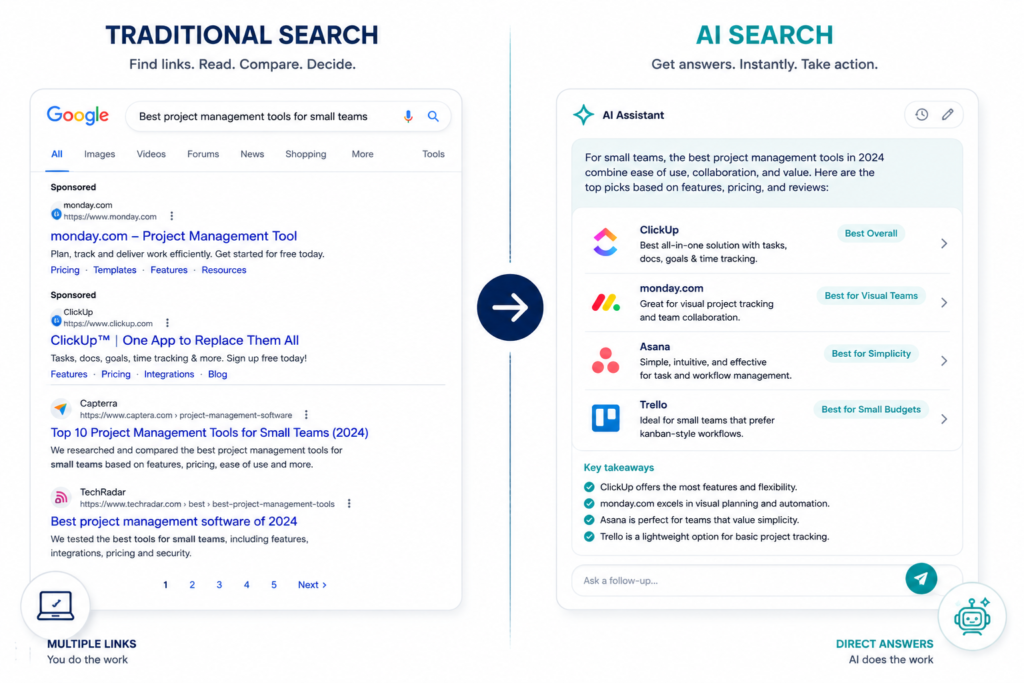
According to the 2026 AI + Search Behavior Study, 37% of consumers now start their search with AI tools rather than Google or Bing. And the reason isn’t novelty. Consumers are choosing AI because search has become too noisy, too effortful, and too slow. They want a direct answer. They want synthesis. They want a recommendation, not a list of ten sites to evaluate.
For marketers, that’s the shift that changes everything — not the technology itself, but the behaviour change that comes with it.
What “AI Search” Actually Means for a Real Business
The term “AI search” gets used loosely, so let’s be precise. There are three distinct surfaces where AI is reshaping how customers find you:
1. AI Answer Engines (ChatGPT, Perplexity, Claude) These are tools people use conversationally — typing questions, getting synthesised answers, sometimes with citations. They don’t return a list of links. They return a response. If your business isn’t referenced in those responses, you don’t exist in that interaction.
2. AI Overviews in Google Search When someone searches Google, they may now see an AI-generated summary above the organic results. Zero-click behaviour varies dramatically by context: 34% of searches end without a click when there’s no AI Overview, 43% when there is one, and a striking 93% in Google’s full AI Mode. That’s the commercial implication of AI Overviews — more visibility for Google, fewer clicks for you.
3. AI-Powered Shopping and Research Agents OpenAI’s Shopping Research feature lets users explore, compare, and discover products through conversational interfaces — and the infrastructure for AI-native commerce is being built right now. This isn’t a feature to watch. It’s a channel that’s already influencing purchase decisions.
Understanding which of these surfaces matters most for your specific business is the starting point of any serious AI search strategy.
What the buyer journey looks like in 2026:
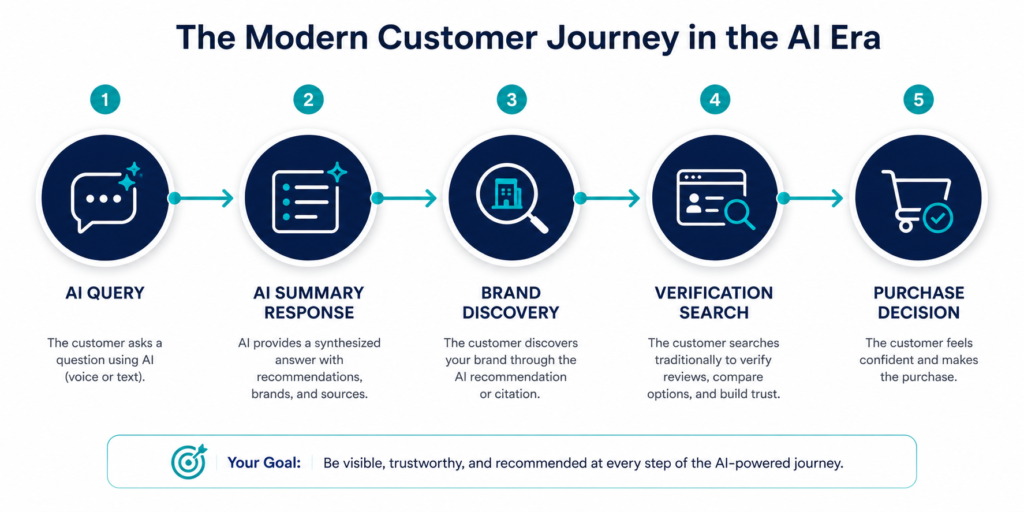
77% of buyers use AI and traditional search together, proving AI does not replace search but complements it. The journey typically works like this: a buyer uses an AI tool to ask an initial question and get oriented, then turns to Google or a brand’s website to verify before purchasing. 86% of buyers still verify AI recommendations at least sometimes, because they worry about hallucinations and want to confirm what they’ve been told.
This is commercially important: the AI interaction happens earlier, shapes the consideration set, and determines which brands even get evaluated. 43% of consumers are discovering completely new brands through conversational AI queries. If your brand isn’t in that discovery layer, you’re not losing visibility — you’re being cut from the consideration set entirely.
Why Traditional Marketing Approaches Are Failing to Adapt
Here’s where the conversation gets uncomfortable. Most businesses are responding to the AI search shift in one of three ineffective ways.
They’re ignoring it. Waiting for the dust to settle before changing anything. This is the most common response and the most costly one. McKinsey projects that $750 billion in US consumer spending will flow through AI-powered search by 2028 — and companies not adapting could see 20–50% declines in search-driven traffic and sales. The dust isn’t settling. The transition is accelerating.
They’re bolting on tactics without changing strategy. Adding FAQ sections to existing pages, updating schema markup, and calling it an AI search strategy. These are useful tactics, but without a strategic foundation — an understanding of how AI models assess and cite content — they deliver marginal results.
They’re treating AI search as purely an SEO problem. Passing it to the SEO team and expecting keyword-level solutions to a fundamentally different challenge. AI search isn’t about keywords. Around 80% of URLs cited in AI search results from ChatGPT, Perplexity, Copilot, and AI Mode do not even rank in Google’s top 100 results for the original query. Let that land. The pages being cited by AI tools aren’t necessarily the pages winning traditional search. Different signals, different outcomes.
The underlying problem is a mental model mismatch.
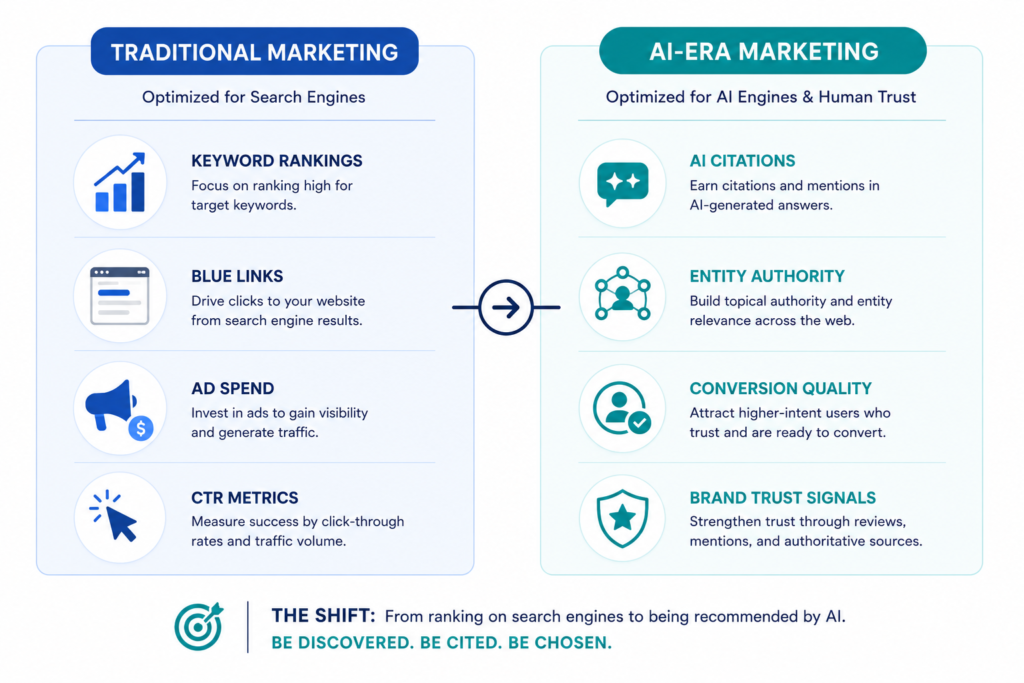
Traditional search marketing was built around a ranking paradigm: optimise to climb a list. AI search operates on a citation paradigm: optimise to be referenced in a synthesised answer. The distinction sounds subtle. The strategic implications are enormous.
Category-term discovery is where AI search has hit hardest: Google serves AI Overviews for non-branded queries 1.9x more often than for branded ones. A query like “what is the best software for video editing” no longer returns just a list of blue links — it returns one or two brands recommended by AI, sometimes with a comparison table, and the buyer often acts on that answer.
If you’re not one of those recommended brands, no amount of keyword optimisation will fix it.
The Shift in How Marketing Actually Functions Now
Let’s get specific about what has changed in the day-to-day mechanics of marketing.
Brand discovery has changed channel.
The old canvas was predictable: ten blue links, a few ads at the top, maybe a featured snippet. Ranking number one for a category term reliably put your brand in front of buyers. That reliability is gone. Position one on Google doesn’t guarantee visibility if the AI Overview above it answers the question without a click. And the AI tools themselves have their own citation logic entirely separate from Google rankings.
What was once a primarily keyword-led activity is becoming a more interpretive, AI-mediated process, where systems synthesise information and present answers directly to users.
Content purpose has changed.
Content used to be written to rank. In 2026, content needs to be written to be cited, quoted, and referenced by AI systems that are making recommendations on your behalf. Those are meaningfully different goals. Ranking-focused content optimises for keyword presence and backlink authority. Citation-focused content optimises for clarity, specificity, verifiable claims, and demonstrated expertise.
Pages with well-organised headings are 2.8x more likely to earn citations in AI search results. 90% of AI citations driving brand visibility originate from earned and owned media, not paid placements.
Conversion dynamics have changed — in your favour.
This is the counterintuitive good news that often gets buried in the anxiety about AI search. The traffic that comes from AI tools converts dramatically better than traditional organic traffic. AI search traffic converts at 14.2% compared to Google organic’s 2.8%. ChatGPT-referred traffic to retail sites converts at 11.4%, more than double Google organic’s 5.3%.
Why? Because people who find you through AI search have already been pre-qualified. The AI has matched your brand to their specific need and presented you as a credible option. They’re not browsing — they’re ready to evaluate. Getting fewer but higher-quality visitors is a better commercial outcome than volume without intent.
Paid media has changed relationship with organic.
Clicks are down, but conversion quality is up. People increasingly turn to ChatGPT, Perplexity, and AI Overviews before ever visiting a website. Those who do click arrive more qualified and ready to act. This changes how you should think about the relationship between paid and organic — and where in the funnel each does its best work.
Modern Marketing Strategies That Work in the AI Era
Here’s what’s actually effective right now, based on working with clients across B2B, e-commerce, professional services, and SaaS.
Strategy 1: Build for Citation, Not Just Ranking
The goal of content shifts from “help this page rank for X keyword” to “make this the most citable answer to X question that exists on the internet.” That means writing with extreme specificity. Making direct claims backed by data. Answering questions in the first paragraph, not the fifth. Using structures — definition sections, comparison tables, clearly labelled FAQ sections — that make it easy for a language model to extract and reproduce your answer accurately.
Successful teams are adding value directly in discovery moments instead of hoping users visit their site later. This means optimising content for “cognitive fit” — value-rich, structured and brand-aligned messaging that AI can recommend with confidence.
Strategy 2: Entity Authority Over Keyword Authority
AI models don’t think in keywords. They think in entities — the recognisable concepts, people, brands, and relationships that exist in the world. Building your entity footprint means making sure your brand, its key people, and its core expertise are consistently and credibly represented across multiple authoritative sources. Press mentions, industry reports, Wikipedia-adjacent references, consistent business data across directories — these build the entity confidence that makes AI tools comfortable citing you.
Brands in the top 25% for web mentions get 10x more AI visibility than others, and the top 50 brands receive around 28.9% of all mentions in AI Overviews. The compounding effect of earned media on AI visibility is one of the most underappreciated dynamics in digital marketing right now.
Strategy 3: Original Research as a Strategic Asset
Generic informational content — “what is X,” “how to do Y” — is being answered directly by AI tools without citing anyone. The content that earns citations consistently is content that AI tools cannot generate themselves: your own data, your proprietary frameworks, your clients’ anonymised results.
A quarterly industry survey. A benchmarking report. A methodology your team developed. These become anchor assets that other content, media, and AI tools reference back to — building both brand authority and AI visibility simultaneously.
Strategy 4: The Verification Chain
86% of buyers verify AI recommendations at least sometimes, turning to traditional search to confirm before purchasing. That verification step is a critical moment. Buyers who’ve been recommended your brand by AI will search your name, look for your website, check your reviews, and look for any press mentions they can find. Your brand needs to hold up under that scrutiny.
This means: a professional, fast, clearly structured website. Consistent reviews on third-party platforms. Recent press or media coverage that confirms your credibility. Case studies or testimonials that are specific and verifiable. The AI gets you into the conversation — the verification chain is what closes it.
Strategy 5: Multi-Platform Presence (Not Multi-Platform Dilution)
Discovery is no longer Google-first. Brands must show up across multiple platforms to stay visible. But this doesn’t mean trying to optimise separately for every AI tool in existence. The underlying signals that make content citable — expertise, structure, specificity, external validation — are largely consistent across platforms. A strategy built on genuine authority tends to transfer.
What needs platform-specific attention: schema markup configurations, content formatting for specific AI interfaces, and monitoring which tools your specific buyers prefer.
Step-by-Step: Rebuilding Your Marketing for AI Search
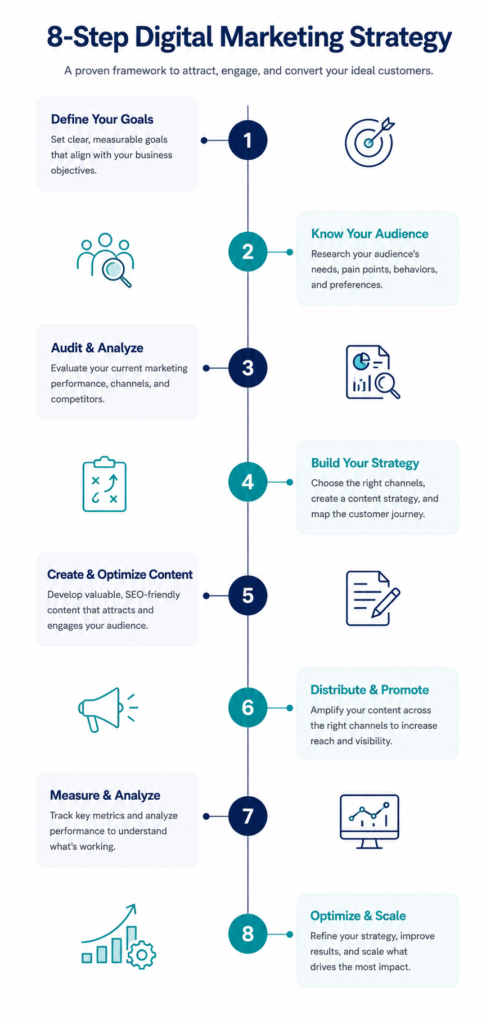
This is the practical sequence we walk clients through. Not theoretical — operational.
Step 1 — Run Your AI Visibility Audit
Open ChatGPT, Perplexity, and Google AI Overviews. Search your 10 most commercially important queries. Document who appears, how they’re described, what content is being referenced. This is your baseline and your competitor intelligence at the same time.
Step 2 — Identify Your Highest-Priority Content Gaps
Where are competitors being cited and you’re not? What questions are being answered without your brand anywhere near the response? These gaps are your immediate priorities.
Step 3 — Restructure Core Pages for Direct Answer Formatting
Take your five most important pages — your service or product pages, your main category pages — and audit them for AI readability. Does each page answer a clear question in the first 100 words? Does it contain specific, verifiable claims? Is it structured with clear headings? Rewrite with those criteria as primary, not secondary.
Step 4 — Publish at Least One Original Research Asset Per Quarter
This is the single highest-leverage content investment in 2026. Survey your customers. Analyse your own project data. Build a benchmark report. These assets attract citations from both journalists and AI tools — and they build the kind of authority that compounds over time.
Step 5 — Build Your External Mention Footprint
Identify the top 20 publications, directories, and platforms in your industry. Create a systematic plan to earn mentions, contributions, and citations from each. Focus on quality and consistency, not volume. Each credible external mention reinforces your entity authority across AI systems.
Step 6 — Implement Technical Signals That Help AI Parse Your Content
Add FAQ schema, Article schema, and relevant structured data across your site. Ensure your site loads quickly (Core Web Vitals still matter). Check that your internal linking clearly signals topical authority. These are hygiene factors — they don’t create AI visibility on their own, but they reduce friction for AI tools trying to understand and cite your content.
Step 7 — Set Up AI Visibility Tracking
Start monitoring your AI citation rates alongside traditional rank tracking. Tools like Profound, Semrush’s AI Toolkit, and BrightEdge’s AI Search Monitor offer varying levels of tracking capability. Even manual weekly checks across your priority queries provide valuable directional data.
Step 8 — Build the Conversion Infrastructure for AI-Referred Traffic
AI-referred visitors arrive pre-qualified and decision-ready. Make sure your landing pages are built to receive them — clear value propositions, specific social proof, fast load times, low-friction conversion paths. Don’t let the quality of that traffic be wasted on a generic homepage.
Mistakes That Are Costing Businesses Real Money Right Now
Mistake 1: Measuring AI Search Success with Traditional Metrics
If you judge your AI search strategy by click-through rates and organic sessions, you’ll chronically undervalue your results — and potentially kill the strategy before it proves itself. AI search delivers brand exposure, pre-purchase influence, and conversion-ready traffic. Measuring only the click misses most of the value.
Mistake 2: Publishing Generic Content and Calling It a GEO Strategy
The volume-based content approach — publish more, optimise for more keywords — doesn’t translate to AI visibility. Only 25.7% of marketers currently plan to develop content specifically for AI citations. The businesses doing this thoughtfully — with precision, original data, and genuine expertise — are building advantages their volume-focused competitors can’t replicate.
Mistake 3: Treating Paid Media as the Fix
90% of AI citations driving brand visibility come from earned and owned media, not paid placements. You can’t buy your way into AI citations the way you can buy ad placement. Authority has to be built. That’s inconvenient for businesses accustomed to solving visibility problems with budget — but it’s also a meaningful competitive advantage for businesses willing to invest in genuine expertise.
Mistake 4: Waiting for a Single Authoritative Playbook
The landscape is moving too fast for there to be one definitive guide that stays current for more than six months. The businesses adapting successfully are the ones building in-house capability to monitor, test, and iterate — not the ones waiting for someone to hand them a finished playbook.
Mistake 5: Siloing AI Search from the Rest of Marketing
AI search strategy isn’t a separate function. It’s a cross-functional discipline that touches content, PR, technical SEO, paid media, brand, and analytics. Businesses that assign it exclusively to one team — typically SEO or content — miss half the levers available to them.
Real Business Examples: What the Shift Looks Like in Practice
A Professional Services Firm Loses the Top of the Funnel
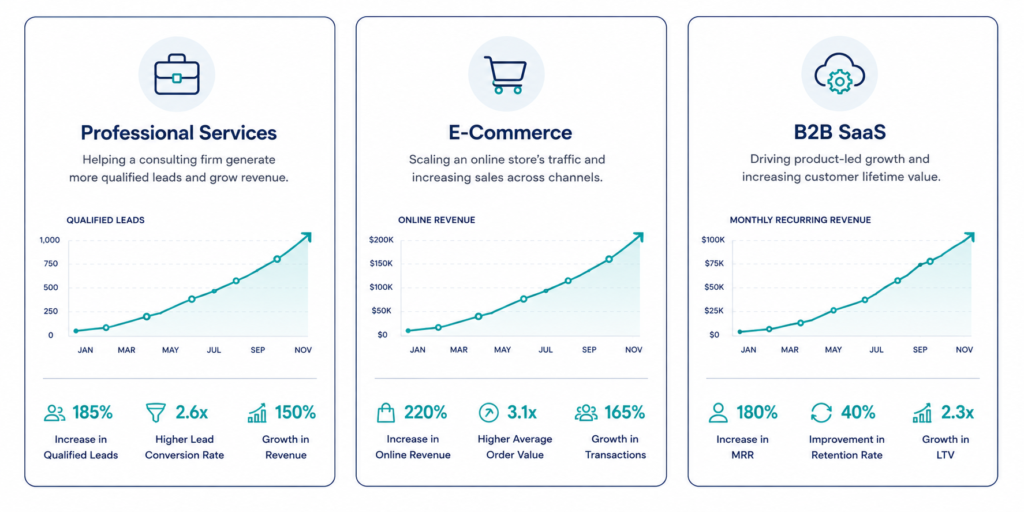
A financial advisory firm with strong Google rankings for their key terms noticed over a 12-month period that their inquiry volume from search had dropped despite maintaining their positions. An AI visibility audit revealed the problem: the primary queries their prospects used when first researching financial planning options were being answered by AI tools, with zero citation of the firm.
Their content — technically competent, well-ranked — was written for keywords, not for answers. It buried the lead, hedged its claims, and provided no original data.
After restructuring six core service pages, adding a quarterly client outcome report, and systematically building mentions in financial press, they recovered inquiry volume within four months — and the inquiries that came in converted at twice the prior rate.
An E-Commerce Brand Gets Ahead of the Shift
A premium cookware brand noticed that product comparison queries — the kind that had historically driven strong organic traffic — were increasingly being answered by AI Overviews and ChatGPT without users clicking through.
Rather than viewing this as a loss, they leaned into it. They published a comprehensive cookware materials guide with original testing data, built relationships with culinary publications for editorial mentions, and added detailed product schema to all category pages.
Within three months, their brand was being mentioned by name in AI-generated product comparisons — without any paid placement. Traffic that did reach their site converted at dramatically higher rates than their prior organic average, consistent with broader data showing AI-referred traffic converting at over 14%.
A B2B SaaS Company Wins a Category It Couldn’t Afford to Own in Traditional Search
A mid-size HR analytics platform was priced out of aggressive link-building against enterprise competitors. Traditional SEO ROI was thin.
They pivoted to an authority-first strategy: publishing a biannual State of Workforce Analytics report with original survey data from 500+ HR professionals, structuring all content around specific answerable questions, and building a definitions library for core category terminology.
Within six months, the platform was regularly cited in AI responses for category-defining queries — queries their enterprise competitors dominated in traditional rankings. Companies using GEO optimisation have reported visibility improvements of 30–40% within 60–90 days, and this firm’s experience tracked closely with that.
Expert Observations from the Agency Front Line
A few things we’ve noted consistently across client work that aren’t widely discussed yet:
AI visibility gaps are competitively asymmetric. In traditional SEO, competitors with large budgets and established domain authority are hard to displace. In AI search, we’ve seen smaller, more agile businesses earn citation rates that rival or beat established category leaders — simply because their content is better structured and more specific. The playing field isn’t level, but it’s more level than it was.
Founder and expert voice is a disproportionate signal. Content written in a practitioner’s voice — with specific opinions, named experiences, and clear recommendations — is cited more frequently than corporate-voice content hedged for committee approval. If your leadership has genuine expertise, getting them on record consistently (through articles, interviews, podcast appearances) is one of the highest-ROI AI visibility investments available.
The entity-brand gap is real and growing. There’s a meaningful difference between businesses that AI tools recognise as established entities versus businesses that exist only as websites. Building entity recognition — through consistent external mentions, structured business data, and credible third-party citations — is foundational to AI visibility in a way it never was for traditional search.
The B2B citation cycle compounds. In B2B particularly, once a brand starts being cited in AI responses, that citation leads to verification searches, which lead to website visits, which lead to content engagement, which leads to further signals that reinforce AI citation. The cycle compounds — and businesses that establish early position benefit from that compounding.
Future Trends: What’s Coming and What to Prepare For
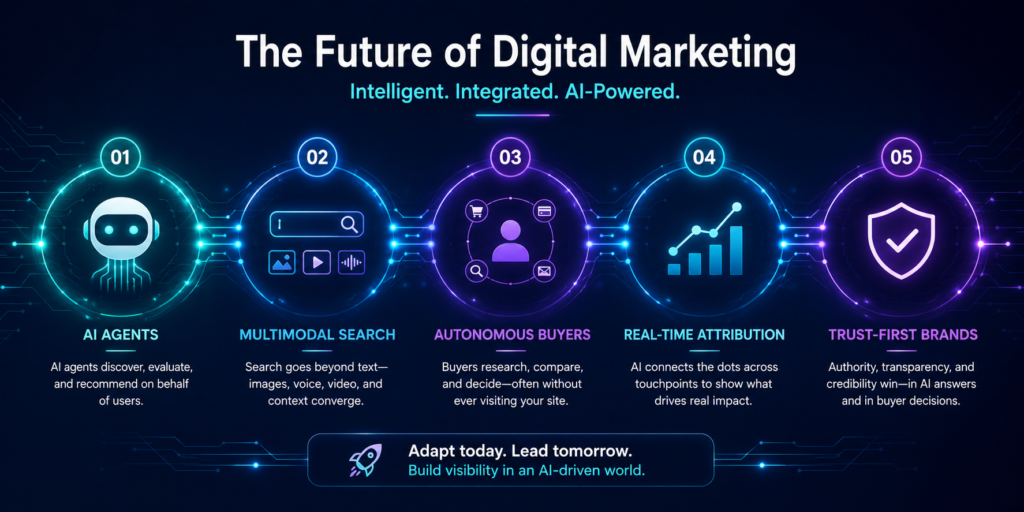
AI agents will conduct purchase research autonomously. 24% of consumers are already comfortable with AI agents shopping for them, rising to 32% among Gen Z. The implication is significant: in the near term, AI systems won’t just influence human buyers — they’ll become buyers themselves, or at least screeners who reduce the consideration set before a human ever gets involved.
The search bar is becoming less prominent. The head of Google Search has suggested that the classic Google search bar will become “less prominent over time” as AI interfaces take centre stage. This is a first-party signal from the company that defined search as we know it. Take it seriously.
Attribution will become more sophisticated — and more important. Only 16% of brands currently track their AI search visibility systematically, while 84% are making marketing decisions based on incomplete data. As AI citation tracking tools mature, measurement capability will become a competitive differentiator. Businesses building that capability now will make better decisions faster than those starting from scratch in 18 months.
Multimodal discovery is expanding. AI systems are increasingly processing images, video, and audio alongside text. Brands investing in rich media — product videos, detailed image metadata, audio content — will have discovery advantages that text-only competitors won’t be able to replicate quickly.
Trust signals will become the dominant differentiator. As AI-generated content proliferates and buyers become more skeptical of unverified information, the brands with demonstrable, verifiable authority will stand out. In B2B contexts especially, where decisions are higher-risk and cycles longer, credibility and depth of expertise become even more critical to visibility. EEAT — Experience, Expertise, Authoritativeness, Trustworthiness — is no longer just a Google framework. It’s the underlying logic of how AI systems assess who to recommend.
Conclusion: The Marketing Shift Is Already Happening
There’s a version of this article that exists purely to alarm you. That’s not the intention here.
The businesses best positioned for the AI search era aren’t the ones panicking — they’re the ones who understand clearly what’s changed, what hasn’t, and where to put their energy. Traditional SEO still matters. Paid media still works. Brand building still compounds. None of that has disappeared.
What’s been added is a new layer — AI-mediated discovery — that operates on different rules and rewards different investments. Being visible at that layer requires genuine authority, not just technical optimisation. It rewards specificity, original expertise, and consistent credibility across channels. It punishes generic content factories and keyword-stuffed service pages.
Generative AI is turning search into conversation and discovery into curation. To stay visible, brands need to structure content for AI parsing and retrieval, and focus on relevance — not just rankings.
The businesses that will win the next five years of marketing aren’t the ones who picked the right AI tool or found the right shortcut. They’re the ones who built real authority — in their content, in their external presence, in their demonstrated expertise — and made that authority visible to both human buyers and the AI systems that increasingly influence their decisions.
That’s a strategy that outlasts any single algorithm update. It’s also the only strategy that earns the kind of trust that converts.
Ready to understand where your business stands in AI search? Start with an AI visibility audit across your five most commercially important queries. See who’s being cited, how they’re described, and what content is driving those citations. The gap between where you are and where you need to be is almost always smaller than it looks — once you know what you’re building toward.
Frequently Asked Questions
Q: Is AI search actually affecting my business yet, or is this still future-focused? It depends on your industry and buyer profile. For B2B buyers, 42% of CRM software buyers now use AI search to evaluate vendors, and AI search ranked as the strongest predictor of purchase intent for that category. For consumer categories, the impact varies — but the trajectory is consistent across all of them. If your buyers are under 40, they’re likely already using AI tools in their purchase research.
Q: Do I need a completely separate strategy for AI search, or does it integrate with what I’m already doing? It integrates. The foundations are the same: quality content, genuine expertise, credible external mentions, technical clarity. What changes is the emphasis — more on specificity and answer structure, more on original data, more on entity-building through earned media. Think of it as upgrading your existing strategy rather than replacing it.
Q: How do I get my business cited in ChatGPT or Perplexity responses? There’s no direct submission process. AI citation comes from building content that AI systems judge as credible and citable: structured, specific, backed by verifiable data, written with genuine expertise, and referenced by third-party sources. The more consistently you demonstrate authority across owned and earned channels, the more frequently AI tools will reference you.
Q: Should I stop investing in traditional SEO? No. Google processes 16.4 billion searches per day and remains the dominant search engine globally. Traditional SEO remains essential. The case here is for adding AI search optimisation on top of — not instead of — your existing search strategy.
Q: How long does it take to see results from AI search optimisation? Based on client experience, businesses that implement structural content changes and entity-building consistently start seeing measurable AI visibility improvements within 60–120 days. Original research assets tend to generate citations faster than general content rewrites. Companies using GEO optimisation strategies have reported visibility improvements of 30–40% within 60–90 days.
Q: What metrics should I be tracking for AI search? Track AI citation frequency (how often your brand appears in AI responses for target queries), AI-referred traffic in Google Analytics 4 (sessions from ChatGPT, Perplexity, and similar sources), conversion rates from AI-referred traffic, and brand mention volume across external sources. These sit alongside — not replacing — your traditional SEO metrics.
Q: Does paid advertising help with AI visibility? Directly, no. 90% of AI citations driving brand visibility originate from earned and owned media, not paid placements. Indirectly, yes — paid media can drive traffic that generates engagement signals, and broad brand awareness supports the entity recognition that underpins AI citation. But you can’t buy your way into AI recommendations the way you can buy a keyword ranking.
Q: What’s the single most important thing I can do this month? Run the audit. Open ChatGPT and Perplexity, search your 10 most commercially important queries, and document what appears. That 30-minute exercise will show you more about your AI visibility gaps than any report can — and it will tell you exactly where to focus.